/ EN

BCIwiki — Brain-computer interface news, research and industry database

Latest

August 2026

China bet $1B on BCI in 6 months. Who got the money?

China's brain-computer interface sector recorded 47 funding rounds in the first half of 2026, 38 of them disclosing terms for a combined RMB 5.38 billion (approx. $750 million). A broader tally used by Chinese financial media puts the total at 64 deals and roughly RMB 7.25 billion (approx. $1 billion). Either figure is more than double the whole of 2025 (49 deals, RMB 2.72 billion) at a comparable deal count. The record lists every deal by month — company, technical approach, round, amount, investors — and identifies three structural patterns: ultrasound and non-invasive approaches moving quickly into a field long defined by implants, Big Tech and municipal state funds entering at the same time, and nearly half of all transactions still sitting at angel or seed stage.
Why it matters The half-year total is already circulating abroad as shorthand for how fast China's BCI sector is scaling; itemising it deal by deal shows what the aggregate hides — 55% of transactions are pre-Series A, a single round accounts for more than a third of disclosed capital, and the one company holding a world-first regulatory approval for an implantable BCI has yet to book any revenue from implants.
Wuhan Union Hospital Registers 1,000-Patient Cohort Testing Non-Invasive BCI for Stroke

A multicenter cohort study aims to enroll 1,000 stroke patients, with the treatment arm receiving closed-loop BCI plus functional electrical stimulation rehabilitation and the control arm receiving conventional training. The primary endpoint is 2-week change in upper and lower limb FMA scores. First enrollment is scheduled for September 1, 2026.
Why it matters Closed-loop BCI plus functional electrical stimulation has been tested mostly in small studies; this one targets 1,000 patients, 500 per arm, an unusually large cohort for BCI stroke rehabilitation in China. The primary endpoint stops at 2 weeks while secondary endpoints run to 12 weeks, suggesting the team wants early motor gains first, then mid-term functional outcomes.

Tongji Hospital Performs Central China's First Fully Invasive BCI Implant

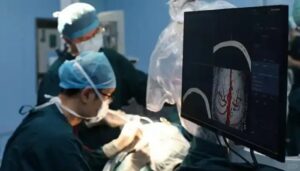
Surgeons at Tongji Hospital in Wuhan, central China, implanted a 256-channel brain-computer interface on 3 August using electrodes 2 to 3 micrometres thick, compared with semi-invasive arrays that are millimetres thick, sit outside the dura and carry eight contacts. Eastern China's Shandong performed its own first provincial case in late July. Hubei now covers all three BCI approaches clinically.
Why it matters Back-to-back firsts in two provinces put invasive BCI beyond China's handful of national centres; the three superlatives attached to this case arrive without a manufacturer's name, and innovative medical device status is fast-track review, not market approval.

CNN bi-LSTM Hybrid Decodes Motor-Imagery EEG

The preprint was posted to arXiv on August 13, 2026, proposing a hybrid deep-learning architecture that combines a convolutional neural network with a bidirectional long short-term memory network to decode motor-imagery EEG. The author notes that motor-imagery brain-computer interfaces are seen as a promising route to flexible communication between the brain and external devices, particularly for people affected by stroke or neurodegenerative disorders, but that reliable decoding remains difficult because EEG recordings carry substantial noise and relate to underlying brain activity in complex, weakly informative ways. In the proposed architecture, the CNN learns high-level spatial and temporal representations directly from raw MI-EEG recordings, while the bi-LSTM models temporal dependencies among the extracted features. The approach was evaluated on both a publicly available dataset and a privately acquired dataset collected with an EEG acquisition system, with robust performance reported on two- and three-class motor-imagery classification and promising subject-independent decoding across the methods compared. The work is a preprint and has not been peer reviewed.
Why it matters Subject-independent decoding, not raw accuracy, is what blocks non-invasive BCIs from leaving the lab, because per-user calibration eats the clinical workflow. The claim worth tracking here is generalization across subjects on both public and self-collected data, and it still has to survive peer review.

Endovascular Electrodes Evoke Cortical Responses

The study was published in Journal of neural engineering on August 13, 2026, presenting the first strength-duration characterization of cortical evoked potentials elicited by endovascular stimulation adjacent to the cerebellum. The authors note that electrical stimulation and neural recording underpin neural prostheses for restoring function and treating neurological disorders, but that clinical adoption is limited by the invasiveness of implantation, while the Endovascular Neural Interface offers an alternative by accessing intracranial targets through the cerebral vasculature. A polymer-based stent-electrode array was deployed into the left transverse sinus of an ovine model, and biphasic current pulses targeting the cerebellum were delivered via the stent electrodes while a subdural electrocorticography grid recorded cortical responses. Endovascular stimulation consistently evoked time-locked cortical potentials with early and late components at approximately 40 ms and 100 ms post-stimulation, and impedance monitoring confirmed electrode functionality and stability throughout. Strength-duration analysis revealed rheobase and chronaxie values, providing a quantitative basis for parameter selection and comparison with established intracranial stimulation modalities.
Why it matters The appeal of endovascular neural interfaces is that they reach the brain without open surgery, but their use has centered on recording rather than stimulation. Quantifying rheobase and chronaxie puts this route on the same footing as established intracranial modalities for parameter comparison, and extends its reach beyond superficial cortex.

Few-Shot Calibration Raises EEG Emotion Decoding Accuracy to 0.77

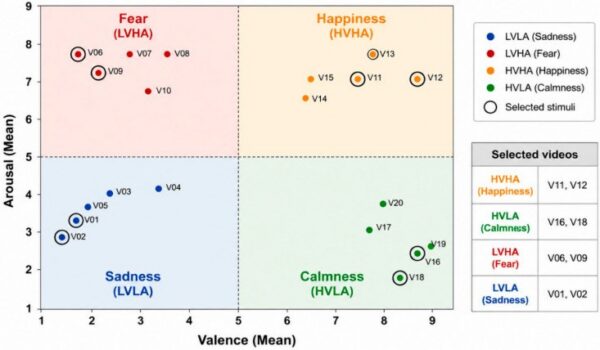
Researchers at Walailak University in Thailand tested EEG-based emotion recognition under auditory stimulation, scoring valence and arousal. Discrete wavelet transform features reached 0.88 accuracy when classifiers were trained and tested on the same subject, but leave-one-subject-out evaluation fell to near chance, exposing how far EEG emotion signatures differ between people. Few-shot adaptation closed part of that gap: with 75% of a new subject's calibration data, functional connectivity features reached 0.77.
Why it matters The negative result carries more weight than the positive one: a cross-subject model at chance level means affective BCIs have no plug-and-play path today, and 0.77 only returns after the system is given 75% of a new user's labelled data. That is a deployment constraint, not a benchmark win.

Deep Learning Benchmark for Ear-EEG BCI

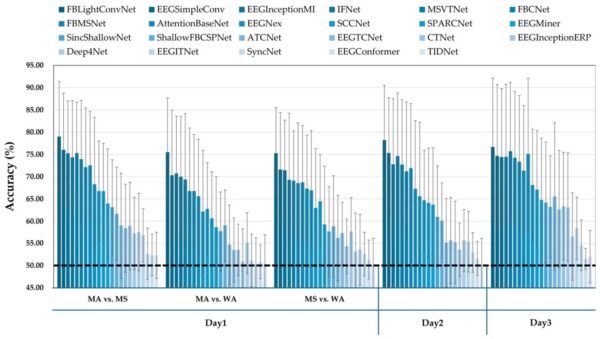
A systematic benchmark of 23 deep learning architectures for ear-EEG BCI mental-task classification identifies FBLightConvNet as the top performer.
Why it matters Ear-EEG is a practical modality for everyday BCI but suffers from low SNR and limited channels. This first large-scale architecture comparison provides critical design insights for developing lightweight, high-performance ear-EEG BCI systems.

BCI Clinic Cohort: 1,641 Motor Patients

A prospective cohort of 1,641 motor dysfunction patients, 66.24% chronic stroke, provides the first clinical profile for personalised BCI system design.
Why it matters Existing BCI studies often recruit idealised subjects, lacking systematic analysis of real-world patient populations. This first-of-its-kind BCI evaluation cohort provides clinical profiles essential for precise patient selection and personalised system design.

Taichung Veterans Hospital Completes BCI-Controlled Exoskeleton Gait Trial After Stroke

A completed RCT compared BCI-controlled versus conventional exoskeleton gait training in stroke patients, training 2 times a week for 4 weeks.
Why it matters This completed RCT directly compares BCI-controlled versus conventional exoskeleton gait training, testing whether brain-signal-driven step initiation yields better rehabilitation outcomes, informing clinical decisions in BCI-assisted gait rehabilitation.

Preprint Proposes EEG-Language Model BLPM

A new preprint introduces BLPM, an EEG-language foundation model that reframes EEG decoding as continuous semantic embedding prediction.
Why it matters continuous latent prediction sidesteps two known weaknesses of current EEG foundation models — masked autoencoding's bias toward low-level reconstruction and autoregressive modeling's mismatch with continuous neural dynamics — offering a potentially more generalizable decoding paradigm if the results hold up under peer review.

© 2026 BCIwiki.com Digest Topics Tips Subscribe Revisions About