

Closed-loop BCIs sense neural activity in real time and automatically deliver adaptive stimulation, forming an autonomous sense-decide-act loop. This topic covers closed-loop neuromodulation for seizure suppression, motor recovery, and mood regulation.
August 2026
2-Block EEG Gait Decoder Reaches 70.5 ms Latency
This preprint reports a 2-block lightweight architecture for real-time EEG gait decoding that the authors say enables closed-loop lower-limb exoskeleton control. In closed-loop deployment, the study reports a 55.3% gait initiation success rate with Rex assistance and 52.7% volitionally, with a mean end-to-end processing time of 70.5 ms (±41.5). The authors add that the manuscript was accepted for publication at the 2026 IEEE International Workshop on Machine Learning for Signal Processing (MLSP 2026).
July 2026
Biohybrid Neural Interface Controls Eel Swimming
Researchers achieved closed-loop speed control of freely swimming eels through lateral-line nerve stimulation, with a proportional-derivative feedback controller dynamically adjusting stimulation frequency. The biohybrid system reduced velocity deviations by 63.7% (forward) and 50.6% (backward) compared to fixed-frequency stimulation.
Miniscope Enables Real-Time Neural Decoding
Beijing Normal University researchers developed a low-cost structured-illumination miniscope weighing less than 3 g. The system uses a Ronchi grating and time-multiplexed excitation for HiLo imaging, providing optical sectioning in freely behaving mice. It suppresses out-of-focus background fluorescence while retaining the speed, field of view, and accessibility of widefield miniscopes, and it supports optically sectioned multiplane imaging to increase neuronal yield. In hippocampal recordings, the researchers observed better region-of-interest signal quality and spatial-information readout. They also demonstrated a proof-of-principle closed-loop brain-machine interface supported by rapid online signal extraction and real-time neural decoding. The work is a bioRxiv preprint and has not been peer reviewed.
Cognitive BCIs Need Closed-Loop Neuromodulation
Brain-computer interfaces already help restore movement and communication, but attention and memory are a different problem: motor and language control rest on relatively localized, stable neural representations, while cognition is spread across brain networks and changes quickly. The review argues that neuromodulation, long used in neurological and psychiatric therapy and now applied causally to cognitive circuits, can complement decoding. Fold signal acquisition, algorithmic analysis and stimulation feedback into an adaptive closed loop, it suggests, and cognitive BCIs might restore mental function and become the basis for neurotherapeutics that monitor and shape cognition in real time. The article reports no new trial data.
Preprint: Dendrite, a Real-Time Python Application for Online BCI Research and Development
A preprint introduces Dendrite, an open-source (GPL-3.0) Python application that bundles multimodal physiological signal acquisition, decoder training and real-time inference into a single modifiable application. It records multiple signal streams concurrently at their native sample rates, fits decoders either from a trained model or live during the pipeline, and tracks every recording, decoder and training run in a database so deployed decoders can be traced to their configuration and training source. The system was validated end-to-end on in-house and public BCI datasets, training and updating decoders in real time; the study has not been peer reviewed.
Successful Single-Session Neural Self-Regulation Through Neurofeedback Varies Between Features
A study of 20 healthy participants who trained self-regulation of four cortical rhythms — frontal midline theta, occipital alpha, unilateral central-temporal sensorimotor rhythm, and central beta — across four neurofeedback sessions found that all could regulate at least two features, but none could regulate frontal midline theta. The authors argue this shows 'non-learners' is not a personal trait that generalizes across features, informing future neurofeedback and BCI training protocol design.
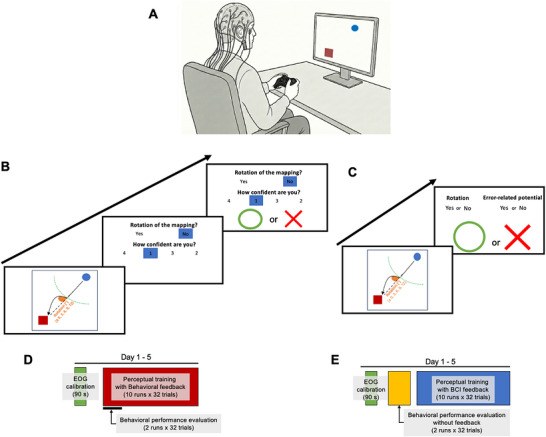
BCI Feedback Sharpens Detection of Subtle Errors
ECoG Network Features Predict Seizure Risk
Nova Southeastern University researchers combine intracranial ECoG network features with a support vector machine and Bayesian updating for real-time continuous seizure risk forecasting.
Passive BCI Decodes VR Intent With Eye Gaze
Researchers combined electroencephalography (EEG)-based passive brain-computer interface (BCI) with eye tracking to decode users' interaction intent in real time during dynamic VR gameplay, reaching 69.64% accuracy in the online closed-loop phase.
June 2026
Northwestern Polytechnical University Registers BCI Stroke Rehabilitation Trial With 4 Arms
A newly registered trial tests a brain-computer interface in post-stroke rehabilitation across 4 parallel arms: full cross-domain (emotion-cognition-motor) adaptive training, integrated cognitive and motor task training, single-dimension motor training, and conventional rehabilitation. Each arm plans 22 participants, 88 in total. It enrolls patients aged 30 to 80 with a first cerebral infarction or hemorrhage 3 months to 1 year earlier, unilateral hemiplegia, and upper-limb Brunnstrom stage II to IV. The primary outcome is a motor function score; secondary outcomes include EEG motor imagery event-related synchronization/desynchronization, prefrontal theta/alpha power ratio, and EEG-fNIRS coupling.
Suzhou Hospital Registers Closed-Loop BCI Trial Using fNIRS and rTMS for Female Overactive Bladder
Women with overactive bladder often rely on drugs and behavioral training, with limited relief. A newly registered trial at The First Affiliated Hospital of Soochow University takes a different route: patients perform a task while functional near-infrared spectroscopy reads prefrontal brain activity, and an algorithm decides when to deliver transcranial magnetic stimulation, closing the loop. The interventional, parallel-design trial plans to enroll 66 women aged 18 to 75, 33 in the experimental arm and 33 in a control arm that receives open-loop sham stimulation, with the overactive bladder symptom score as the primary endpoint. No device model or results are disclosed in the registration, and recruitment has not yet started.
May 2026
Xi'an Jiaotong University Second Hospital Registers BCI Ankle Rehabilitation Trial in 120 Stroke Patients
The multicenter randomized controlled trial pits closed-loop BCI ankle training against conventional active and passive ankle training in subacute stroke patients who are 4 to 12 weeks past onset and have less than 10 degrees of active ankle dorsiflexion. Primary endpoints are active ankle dorsiflexion range of motion and Manual Muscle Testing of the ankle; secondary endpoints include Functional Ambulation Classification, the Berg Balance Scale and the Fugl-Meyer Motor Assessment of the Lower Limb. The trial plans to enroll 120 patients, 60 per arm, with first enrolment set for May 31, 2026.
Brain-controlled hearing system boosts attended talker
Current hearing aids amplify every sound in a noisy room rather than the person a listener wants to hear. Using intracranial EEG in neurosurgical patients, researchers built a closed-loop system that decodes which talker a listener is attending to and amplifies that voice in real time. Across multiple experiments it improved speech intelligibility, reduced listening effort and was consistently preferred by subjects, and it followed both instructed and self-initiated shifts of attention.
Binzhou Medical University Hospital Registers BCI Plus Electrical Stimulation Trial in Parkinson's Disease
The trial plans to enroll 40 patients with Parkinson's disease aged 40 to 80, randomized into 2 groups: one adds brain-computer interface rehabilitation training to functional electrical stimulation, the other receives functional electrical stimulation alone. Both arms train 20 minutes per day for the upper extremities and 20 minutes per day for the lower extremities, completing 12 treatment days within 2 weeks. The primary endpoint is a motor symptom rating scale, with diffusion tensor imaging, magnetic resonance spectroscopy, resting-state fMRI, and sleep, cognitive and mood scales as secondary endpoints, testing whether adding BCI training produces measurable change beyond motor symptoms.
February 2024
China's Neuracle Registers 96-Patient Trial of Closed-Loop Epilepsy Implant
Chinese registry ChiCTR2400081380 describes a 96-patient trial of an implantable closed-loop recording and stimulation system for focal drug-resistant epilepsy in people aged 6 to 70. All participants are to receive the implant and then be randomized one month later to active or sham stimulation, 48 per group. The registry provides no evidence that enrollment had passed 50%.
June 2023
UT Austin Trial Tests Closed-Loop Stimulation for Cognitive Control in Older Adults
The University of Texas at Austin has registered a study on ClinicalTrials.gov, NCT05907343, testing whether non-invasive stimulation can strengthen cognitive control in older adults, enrolling both people with cognitive impairment and people without it. It asks whether theta burst stimulation, a form of transcranial magnetic stimulation, can restore a range of cognitive functions, and whether delivering it in closed loop, timed to ongoing brain activity rather than on a fixed schedule, changes the result.