/ EN

BCIwiki — Brain-computer interface news, research and industry database

Latest

August 2026

Review Outlines Three BCI Paradigms for Post-Stroke Hand Rehabilitation

A review in Topics in Stroke Rehabilitation maps the neurophysiological basis of non-invasive EEG-based brain-computer interfaces for post-stroke hand recovery and sorts the field into three paradigms: motor imagery with physical feedback, motor imagery with virtual or multisensory feedback, and steady-state visual evoked potential (SSVEP)-driven training. These systems decode sensorimotor-cortex rhythms during imagined hand movement in real time to drive exoskeletons, functional electrical stimulation or virtual reality, closing a Hebbian feedback loop meant to strengthen or remodel damaged pathways in patients whom conventional rehabilitation, which depends on active movement, often cannot reach. Studies confirm the approaches can improve upper-limb function, the review says, but clinical adoption still faces low signal-to-noise ratios, wide individual variability and 'BCI blindness.'
Why it matters For anyone building rehabilitation BCIs, the useful part is not the three paradigms but the failure list: low signal-to-noise, wide inter-subject variability and 'BCI blindness' are what decide whether any of them leaves the lab, and the review treats them as open problems rather than footnotes.
Interpretable BCI Framework Pairs Emotion Recognition With Thought-to-Speech Decoding

A new study proposes an interpretable brain-computer interface framework that combines affective state recognition with EEG decoding to enable emotion-aware thought-to-speech. Tested on public imagined-speech EEG datasets in subject-independent settings and scored on accuracy, precision, recall, F1-score, inference speed and interpretability, the framework improved decoding reliability over conventional opaque models and produced clinically meaningful explanations, the authors report. They present it as a practical basis for assistive communication tools for people with paralysis, amyotrophic lateral sclerosis, locked-in syndrome and other conditions that disrupt natural speech.
Why it matters Speech BCIs decode what a user wants to say but not the affect behind it, and interpretability is a separate barrier to clinical acceptance; targeting both in one framework is the interesting move here, even though the evidence so far rests on public benchmark datasets rather than patients.

Children Designing Their Own P300 BCI Interface Choose Animation, Color and Sound

Thirty-eight typically developing children aged 8 to 12 used a design application to build their own picture-based interface for a P300 brain-computer interface augmentative and alternative communication (P300-BCI-AAC) system, in a study of what children themselves want from such interfaces. They consistently chose preferred colors, animation — zooming most of all — and sound cues: animation aided visual accessibility and target location, background color changes carried preferred colors into the display, and video GIFs and picture overlays added personal relevance. The authors call motion, color, personalization and visual clarity preliminary priorities for pediatric BCI-AAC design, and point to follow-up work with children who use AAC daily and with people who have motor difficulties.
Why it matters The cohort is both the point and the caveat: preferences elicited directly from children give designers concrete requirements — motion, color, personalization — before a pediatric BCI-AAC system is built, but the children who would actually use one have the motor impairments this study did not include.

Tianjin University Team Cuts EEG Channels Without Losing Decoding Accuracy

A team at Tianjin University in northern China has built a graph neural network framework that jointly optimizes EEG channel selection and classification, picking a small subset of channels for motor imagery decoding while holding accuracy close to that of the full electrode set. Reported in the journal Chaos, the method was validated on three datasets — BCI Competition IV 2a, High Gamma and a newly collected set — and could cut system complexity for uses such as neurorehabilitation.
Why it matters Channel count is the quiet cost driver in non-invasive BCI: every extra electrode is setup time, hardware and another point of failure, so a selection method that holds accuracy on standard benchmarks matters more for deployment than for decoding research.

Preprint: Quantum-Inspired Circuits Lift Neural Decoding Accuracy in 3 of 4 Seeds

A preprint bolts parameterized quantum circuits onto a ResNet-50 backbone as residual sidecar modules and tests them on 31-class decoding of neural population activity from imagined handwriting. The backbone-gradient variant improved accuracy in three of four seeds and consistently lowered linear CKA similarity to the baseline features, which the authors read as a structural reorganization of the learned representation. They claim no quantum advantage.
Why it matters Quantum machine learning papers usually oversell; this one runs a nine-variant ablation and explicitly declines the quantum-advantage claim, which makes it a sober reference point for how much a parameterized circuit actually buys a neural decoder — a gain in three of four seeds is a hint, not a result.

Arctop Unveils RLbF, Which Trains LLMs on Real-Time EEG Feedback

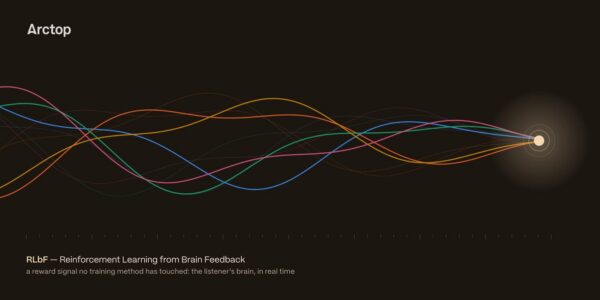
Arctop has published a companion article to its paper introducing Reinforcement Learning from Brain Feedback (RLbF), a framework that decodes real-time EEG into cognitive states such as workload and stress and uses them as reward signals to train large language models. Unlike RLHF, which depends on sparse, subjective feedback given after the fact, RLbF supplies continuous, involuntary signals that let a model sense in real time how its words land in a listener's brain, which the article says improves communication. It is the first use of brain signals to train a language model and is already running in Arctop's Isaac app, though it adapts on a single dimension, cognitive workload, and technical details are not fully public.
Why it matters RLbF moves the alignment reward from what users report afterward to what their brains do mid-conversation, a real shift in where training signal comes from, though the evidence so far is a company-published article and a single-dimension deployment rather than peer-reviewed benchmarks.

Gaze-Plus-Motor-Imagery BCI Reaches 100% Accuracy With 16-Channel EEG

Motor imagery BCIs have long faced two problems: wide variation between users and only a small number of distinguishable commands. In this study, users first select a target by looking at it, then confirm the choice with imagined movement, merging the two steps into one. In tests with 15 healthy participants using 16-channel EEG, the hybrid paradigm outperformed motor imagery alone in every channel configuration, reaching up to 100% accuracy. The researchers also found that fixating on the target made EEG responses more stable, which supports using fewer electrodes and lowering the hardware barrier.
Why it matters The significance lies less in the 100% figure than in the confirmation chain: pairing gaze with motor imagery turns a BCI that could handle only a few commands into a scalable multi-command system. More practically, a small number of channels matched the full array, so devices can be lighter and quicker to put on, a real difference for users who need long-term communication support. Testing so far involved only 15 healthy people; performance in patients has yet to be verified.

Brain-Spine Interfaces Remain Supported by Limited Clinical Evidence

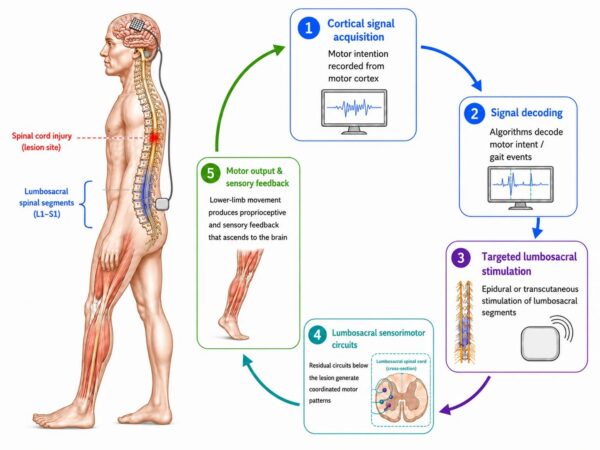
A review in *Neurosurgical Review* finds encouraging motor outcomes from early preclinical work and highly selected clinical studies of brain-spine interfaces, but concludes that the evidence remains preliminary. Safety, durability, patient selection, access, long-term functional benefit, technical complexity, ethics and specialist training all remain barriers to routine care.
Why it matters Widely shared demonstrations can make brain-spine interfaces appear clinically mature; this review provides a necessary check on the small, selected evidence base behind them.

Phase-sliding oscillation lifts async BCI to 94.2%

Phase mismatch between live EEG and fixed templates has long been the weak point of asynchronous steady-state visual evoked potential (SSVEP) brain-computer interfaces, which are seen as a promising route to real-world control. A new method, PSO-AC, exploits a phase-sliding oscillation phenomenon the authors observed and validated. Offline, 22 participants produced a mean control/non-control accuracy of 94.2% from just two seconds of EEG data, a result the authors say outperforms a state-of-the-art baseline; 9-class decoding also kept its edge across different time delays. Online, in robotic-arm experiments, the method delivered more stable command triggering and higher control efficiency, with the command cost per successful trial falling from 4.30 to 1.14. The paper was published in the International Journal of Neural Systems on August 21, 2026.
Why it matters Asynchronous operation is what lets BCIs support continuous control in real settings, and phase mismatch between live EEG and fixed templates has been a stubborn weak point. PSO-AC turns a newly documented phase-sliding oscillation into a stable discriminator, with offline and online robotic-arm evidence reinforcing each other. The method is described in enough detail to reproduce, which is why it deserves a place in the archive.

Teacher Support Was the Strongest Predictor of Student BCI Adoption

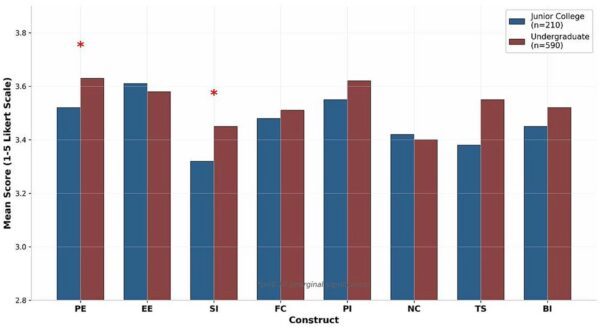
A survey of 800 students at 10 Chinese universities found teacher support was the strongest predictor of willingness to use BCI technology (beta=0.337), while performance expectancy was not significant (beta=0.059). Neuroethical concern was also non-significant in the structural model, yet 28 of 40 interviewees named privacy as their leading worry, suggesting concern may reflect engagement rather than rejection before adoption.
Why it matters The study provides rare empirical data on BCI acceptance among young users in China and shows why a non-significant ethics coefficient should not be read as indifference.

© 2026 BCIwiki.com Digest Topics Tips Subscribe Revisions About