/ EN

BCIwiki — Brain-computer interface news, research and industry database

Latest

August 2026

Cochrane Review Finds Small, Low-Certainty Gains for BCI Stroke Rehabilitation

A Cochrane review of 43 randomized trials involving 1,628 participants found that BCI training may produce a small improvement in post-stroke upper-limb motor function compared with conventional rehabilitation, while effects on lower-limb function and activities of daily living were limited or uncertain. No clear advantage emerged over sham BCI, and certainty was low to very low because of bias risk, small samples, heterogeneity and possible publication bias.
Why it matters The review offers a rigorous counterweight to claims of marked recovery and a useful benchmark for judging one of the fastest-growing clinical applications of BCI technology.
EFS-Net Fuses EEG and fNIRS for Hybrid BCI Decoding

Researchers proposed EFS-Net, an end-to-end network that aligns fast EEG activity with slower fNIRS haemodynamic signals through temporal, spatial and cross-modal branches. In subject-specific leave-one-session-out validation, the model reached 77.71% accuracy on a word-generation dataset and 81.69% on a mental-arithmetic dataset.
Why it matters The architecture directly tackles the temporal and spatial mismatch at the heart of EEG-fNIRS hybrid BCIs and reports comparable results on public datasets.

BELT Runs Motor-Imagery BCI Decoding on an ARM Chip in 6.75 Milliseconds

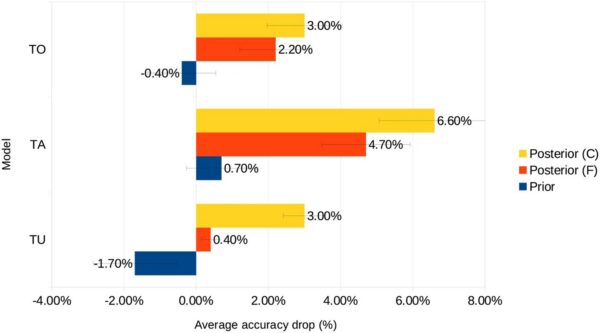
Researchers proposed BELT, a modular Bayesian edge-cloud architecture that combines user-specific adaptation, lightweight classification and compressed data transfer. BELT-lite achieved 87.9% and 80.6% mean accuracy on the BCI Competition IV-2b and IV-2a datasets, respectively, and processed each sample in 6.75 milliseconds on an ARM Cortex-A7—21% faster than EEGNet but about 2.7 percentage points less accurate.
Why it matters The study makes the edge-deployment trade-off explicit: lower latency and less raw EEG sent to the cloud come at a measurable cost in accuracy.

Chinese Academy of Sciences Team Releases BCIJelly Toolchain Unifying 18 BCI Datasets

BCI research has long been slowed by inconsistent data formats, divergent decoder implementations and incompatible deployment toolchains. BCIJelly standardizes 18 BCI datasets into inputs ready for AI training and integrates 15 benchmark decoders and 80 reusable modules. Its automated architecture search generates task-specific decoders without manual design and can extend into a large language model-driven closed-loop mode that supports single-task, multitask and cross-species decoder design; the system also offers interactive visualization software that requires no coding. A single-command pipeline compiles trained decoders onto neuromorphic hardware, cutting power consumption 30- to 50-fold while maintaining decoding performance. The work has been validated in humans, macaques and mice across five paradigms: motor, visual, speech, emotion and auditory. It is a preprint that has not been peer reviewed.
Why it matters The bottleneck in BCI research is often not the electrode but datasets and decoders that are each built their own way. BCIJelly puts 18 datasets, 15 decoders and 80 modules into a single workflow and also connects it to deployment on neuromorphic hardware, where the 30- to 50-fold power reduction is the most concrete number. It is a preprint that has not been peer reviewed, and whether its cross-species validation can be reproduced by other labs remains to be seen.

Review Maps How Closed-Loop BCIs May Support Post-Stroke Recovery

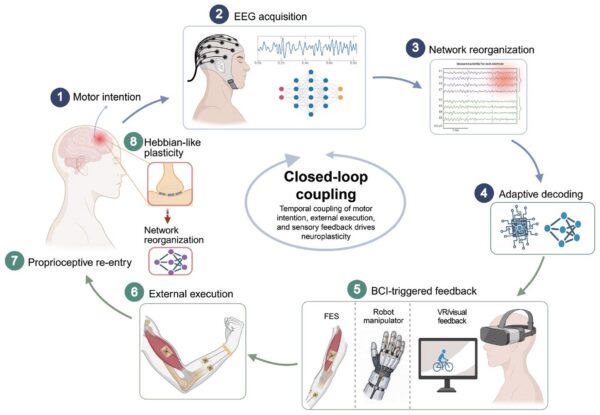
A review in *Frontiers in Neuroscience* describes closed-loop BCIs as systems that detect motor imagery, motor attempts or sensorimotor rhythms and trigger contingent electrical stimulation, robotic assistance, virtual reality, multisensory feedback or neuromodulation. The authors argue that restoring the timing between intent, assisted movement and sensory feedback may promote activity-dependent plasticity, while stressing that outcomes vary with patient selection, signal quality, dose, feedback modality and trial design.
Why it matters The review provides a clear entry point to the biological rationale and implementation choices behind one of the most active clinical areas in BCI rehabilitation.

Motion-Based Visual BCI Reaches 85.67% Accuracy Without Flicker

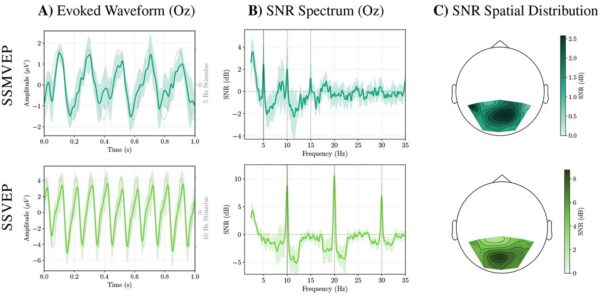
A code-modulated motion visual-evoked-potential paradigm replaced flickering targets with pseudo-random motion sequences. In a four-target online BCI, it achieved 85.67% mean accuracy with a 2.61-second selection time—below c-VEP and SSVEP, but above steady-state motion VEP—while participants reported no clear comfort preference between motion and flicker.
Why it matters The head-to-head results show that motion can reduce reliance on flicker while retaining usable performance, although it does not yet match the strongest visual-evoked-potential paradigms.

Subject-Specific Frequency Bands Improve Motor-Imagery EEG Decoding

Researchers at United International University in Bangladesh proposed SSLFF, a framework that selects frequency sub-bands for each user, fuses complementary spectral information and extracts time-localized features. The paper reports statistically significant accuracy gains over conventional methods and stable performance across parameter changes, although the abstract does not provide absolute accuracy figures.
Why it matters Personalizing frequency selection offers a relatively low-cost way to address the cross-user variability that weakens fixed-band motor-imagery decoders.

Review Proposes 'Brain-Inspired BCIs' for Low-Power, Closed-Loop Neurotech

A review published on August 20, 2026 in npj Biomedical Innovations proposes brain-inspired brain-computer interfaces (BI-BCIs), a framework that unifies neuromorphic computing with BCI design to make neurotechnology lower-power, smaller and capable of closed-loop operation. The authors, from Aarhus University, Stanford University, the University of Southern Denmark, the University of Genoa, Forschungszentrum Jülich and RWTH Aachen University, say the approach could advance neuroprosthetics and neuromodulation for neurological disorders.
Why it matters Power budget, not decoding accuracy, is the constraint that keeps fully implanted BCIs tethered to external hardware, and this review gives the neuromorphic answer to that problem a name and a research agenda — a framing paper to argue with, not new evidence.

Review Identifies Three Shared Bottlenecks Across DBS and BCIs

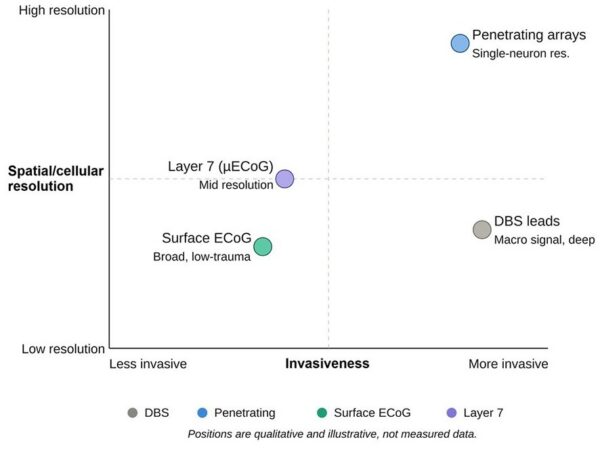
A mini-review places deep-brain stimulation, brain-computer interfaces and speech neuroprostheses within a shared closed-loop architecture of sensing, decoding, stimulation or output, power, telemetry and chronic validation. It identifies long-term stability, neural coding and equitable access as recurring constraints across all three fields and argues that governance must advance alongside engineering.
Why it matters The shared framework helps explain why apparently different implantable neurotechnologies face many of the same barriers to clinical translation.

Dual-View Network Reaches 67.74% on Handwriting-Imagery EEG

DRDNet separates spatial EEG features into two temporal views, models them with a bidirectional Mamba encoder and a Transformer, and then combines them through dynamic fusion and LSTM aggregation. On a public dataset, it reached 67.74% accuracy for imagined Chinese-character strokes and 62.51% for imagined pinyin vowels, outperforming seven EEG-decoding baselines.
Why it matters Handwriting imagery extends non-invasive BCI research beyond simple commands, and the reported accuracy and kappa values provide a clear basis for comparing this dual-view architecture with prior methods.

© 2026 BCIwiki.com Digest Topics Tips Subscribe Revisions About