/ EN
August 2026

EEG2MOTION: Full-Body Motion From Brain Signals

Researchers debut EEG2MOTION, billed as the first EEG-motion-text dataset for human motion synthesis, with nearly 20,000 paired samples across thousands of motions, plus a generative framework (EMMM) that couples an EEG encoder with a motion decoder to synthesize coherent full-body motions from non-invasive brain activity. Multimodal contrastive learning aligns non-invasive EEG embeddings with text, video and motion representations to decode high-level semantics. The team says it is the first work to generate diverse whole-body motions from non-invasive brain signals.

CNN bi-LSTM Hybrid Decodes Motor-Imagery EEG

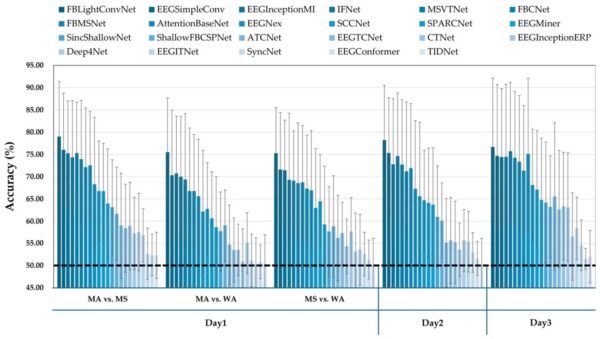
The preprint was posted to arXiv on August 13, 2026, proposing a hybrid deep-learning architecture that combines a convolutional neural network with a bidirectional long short-term memory network to decode motor-imagery EEG. The author notes that motor-imagery brain-computer interfaces are seen as a promising route to flexible communication between the brain and external devices, particularly for people affected by stroke or neurodegenerative disorders, but that reliable decoding remains difficult because EEG recordings carry substantial noise and relate to underlying brain activity in complex, weakly informative ways. In the proposed architecture, the CNN learns high-level spatial and temporal representations directly from raw MI-EEG recordings, while the bi-LSTM models temporal dependencies among the extracted features. The approach was evaluated on both a publicly available dataset and a privately acquired dataset collected with an EEG acquisition system, with robust performance reported on two- and three-class motor-imagery classification and promising subject-independent decoding across the methods compared. The work is a preprint and has not been peer reviewed.

Few-Shot Calibration Raises EEG Emotion Decoding Accuracy to 0.77

Researchers at Walailak University in Thailand tested EEG-based emotion recognition under auditory stimulation, scoring valence and arousal. Discrete wavelet transform features reached 0.88 accuracy when classifiers were trained and tested on the same subject, but leave-one-subject-out evaluation fell to near chance, exposing how far EEG emotion signatures differ between people. Few-shot adaptation closed part of that gap: with 75% of a new subject's calibration data, functional connectivity features reached 0.77.

SpikeGadgets Hardware Closes the Loop on Rat Hippocampus in Milliseconds

SpikeGadgets says its hardware, using low-latency Ethernet and the TrodesNetwork API, lets researchers detect a neural activity pattern and trigger a perturbation within milliseconds. Two UCSF studies show it in use: one continuously decoded hippocampal population activity in rats to run a neurofeedback system, training the animals to volitionally generate specific memory representations for reward; the other triggered theta-phase-specific optogenetic stimulation in real time and showed that theta rhythm and replay are mechanistically separable.

Crossmodal Congruency Test Tells Sensory Feedback Types Apart at the Knee but Not the Foot

A University of Pittsburgh team (Bose et al.) tested the crossmodal congruency effect (CCE) task in 15 able-bodied volunteers to see whether it can quantify how intuitive lower-limb sensory feedback feels. At the knee, the task distinguished more natural pneumatic stimulation from less natural electrical stimulation; at the foot, it could not tell the same stimuli apart. The study was posted to bioRxiv on August 10, 2026. Lower-limb amputees often have balance and gait problems because their prostheses give no somatosensory feedback; electrical-stimulation neuroprostheses can partly restore sensation, but there has been no way to quantify how intuitive that sensation is. The authors stress that external factors affecting the CCE must be identified before it can be used with amputees.

BLCU Team's Falsifiable Substitution Test Keeps 0.968 AUC After Target Events Are Removed

Brain-computer interface decoders can guess the right label using information unrelated to the target mental state. A team at the School of Psychology, Beijing Language and Culture University (BLCU), proposes a falsifiable substitution-test standard: candidate evidence must persist in disjoint data, survive capacity-matched substitutions of physical organization or listener templates, and remain testable after target events are excluded. Across six EEG datasets (41 participants), averaging four neural-speech margin metrics brought 5-second decoding to what the authors call a leading level; in two hierarchical interfaces, parent-stream error scores kept AUCs of 0.968 and 0.965 after all target-command events were excluded. The framework offers a test for attributing evidence in neuroscience and BCI.

P300 BCI Reads Silently Chosen Digits in a Granada Classroom

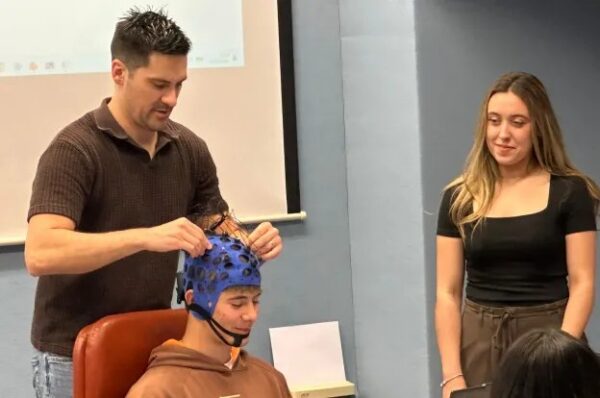
A team from the University of Granada in Spain took a P300 brain-computer interface into a secondary school classroom, using a Bitbrain Versatile EEG system to identify a digit a volunteer had silently chosen, in front of nearly a hundred students. The demonstration grew out of a thesis by industrial electronic engineering student Marta Rodríguez Comino, supervised by Dr. Joaquín T. Valderrama and Dr. Iván López Espejo. The water-based portable EEG system decoded the attention signals using principal component analysis and a support vector machine.

Utrecht Team Finds ECoG Grids Can Shrink up to 94% without Losing Decoding Accuracy

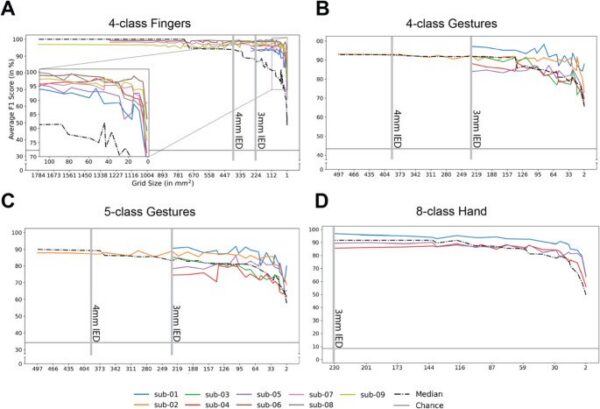
Researchers at University Medical Center Utrecht's Brain Center in the Netherlands and collaborators exhaustively tested every rectangular subgrid inside 32-, 64- and 128-channel ECoG arrays recorded from nine people with epilepsy. Grid area could be cut by 75% to 94% without meaningful loss of hand-movement classification accuracy, as long as the remaining electrodes sat over informative cortex; below a critical area of about 60 mm², performance fell sharply. The study appeared in the journal Neuroinformatics on August 7, 2026.

ReCIL: Rehearsal-Based Class Incremental Learning for Cross-Subject Motor Imagery Classification

Researchers propose ReCIL, a rehearsal-based class incremental learning method for cross-subject motor imagery classification that lets a model learn new MI classes sequentially without retraining from scratch. Using Euclidean alignment to reduce cross-subject EEG distribution shift and global-local replay to preserve earlier-task knowledge, ReCIL achieved a good balance between plasticity and stability across three public MI datasets. The authors report it as the first study of cross-subject class incremental learning for MI classification.

Air Force Medical University Releases Multi-Day fNIRS Stroop Dataset from 55 Adults

Researchers at Air Force Medical University have published a functional near-infrared spectroscopy (fNIRS) dataset in Scientific Data: frontal hemoglobin responses from 55 young adults, each recorded across three color-word Stroop sessions spread over about two weeks, with more than 30 trials per condition. The authors offer it for work on conflict inhibition, for building decoders for neurofeedback training, and for training large-scale cross-subject fNIRS models.

BiGSTF-Net: Inter-Modal Mutual Guidance and Intra-Modal Spatio-Temporal Fusion for EEG-fNIRS Cognitive Classification

The study proposes BiGSTF-Net, a multimodal architecture that exploits the complementary properties of EEG and functional near-infrared spectroscopy (fNIRS) for cognitive-state decoding: heterogeneous spatio-temporal extractors capture each modality's representations, a modal residual interaction unit provides bidirectional cross-modal guidance, and a spatio-temporal gating unit fuses intra-modal features. Under cross-session evaluation on multiple BCI datasets, BiGSTF-Net consistently outperformed representative multimodal fusion baselines; ablations validated each component and visualizations matched the known neurophysiological features of the two signals.

Preprint: NeuroPB Scales Neural Decoding with Pretrained Behavioral Representations

A preprint introduces NeuroPB, a framework that scales neural decoding by transferring pretrained behavioral representations: a motion encoder is first pretrained on large-scale motor behavior data, then limited paired neural-behavior recordings align neural activity to the behavioral representation space, and a neural encoder with a lightweight motor decoder reconstructs continuous movement. The researchers report that behavioral pretraining lifted center-out trajectory decoding R² by 11% and random-target task performance by 8%, that pretraining on robotic trajectories matched macaque-trajectory performance, and that only 10% calibration was needed to match training from scratch. The study is a preprint and has not been peer-reviewed.

Preprint: OSPDIM Online Source-Free Adaptation for Class-Imbalanced EEG

A preprint introduces OSPDIM, a source-free online unsupervised domain adaptation framework for class-imbalanced label shift in online EEG brain-computer interfaces. The study argues that Riemannian alignment methods such as the Riemannian centering transform handle covariate shift but implicitly assume balanced class priors, so shifting label distributions in real online use geometrically misalign the target data; OSPDIM adds a manifold-constrained bias parameter in the Riemannian tangent-space mapping, optimized by information maximization, and estimates and corrects the geometric bias online rather than relying on global batch statistics. 2D SPD matrix simulations showed OSPDIM correcting misalignment that standard centering fails on, and across multiple motor imagery datasets it significantly outperformed standard Riemannian baselines, especially online. The study is a preprint and has not been peer-reviewed.

Synergistic EEG Signal Processing for BCIs Using Hybrid MothCray Optimization and Deep Learning

The study presents an EEG brain-computer interface signal-processing framework that combines hybrid MothCray channel-selection optimization — fusing moth-flame and crayfish optimization — with deep learning. After notch filtering, independent component analysis (ICA) and time-window segmentation, the MothCray algorithm identifies the most informative channels and a deep neural network adapted to EEG spatio-temporal features classifies. The model reached 93.92% accuracy on BCI Competition IV dataset IIa, ahead of existing methods.

AutoMI: Hands-Free Motor Imagery EEG Classification via LLM Multi-Agents

The study presents AutoMI, a framework that uses LLM multi-agents to automatically and rapidly iterate on motor imagery EEG classification models, combining a Q-learning policy with deterministic rules and integrating planning, execution and output agents with predefined tools, plus experience tracking and rollback. Models built by AutoMI reached 77.62%, 78.08% and 83.02% accuracy on the IV2a, OpenBMI and ECUST-MI datasets — up 18.42%, 9.27% and 19.25% over automated optimization algorithms.

Integrated Decoding of Local and Prospective Spatial Representations for Future Decision Prediction

The study recorded hippocampal CA1 population activity in rats performing a sequential spatial decision task in a modified T-maze, dividing the decision into initiation, running and approach phases. Local theta sequences consistently over-represented the actual choice, while prospective representations driven by choice-arm place cells shifted from predicting the actual choice during running to representing potential paths more evenly at the choice point. Integrating local and prospective features improved decoding, reaching 74.4% accuracy for future choice prediction and 78.2% for upcoming trajectory decoding.

Preprint: Dendrite-Inspired Organic Interface Narrows Electrode-Neuron Shape Gap

Researchers at the Institute of Biological Information Processing at Forschungszentrum Jülich posted a preprint to bioRxiv on August 4, 2026, proposing hierarchical, dendrite-inspired organic bioelectronic interfaces built to integrate with neurons. Brain-computer interfaces depend on intimate electrical communication between living neurons and artificial materials, the authors write, yet conventional electrode architectures remain structurally unlike neural tissue, limiting stable cell-electrode coupling and long-term recording. The work is a preprint and has not been peer reviewed.
© 2026 BCIwiki.com Digest Topics Tips Subscribe Revisions About