中 / EN
October 2026

Araya Inc. Collaboration Finds EMG Associations Cannot Explain EEG Speech-Decoding Contributions

Researchers affiliated with Araya Inc. and Sincxpress Education SRL examined a model that predicts spoken words from ultra-high-density EEG to assess whether decoding reflects neural activity rather than electrical activity from speaking muscles. Electrode contributions could not be explained by their mutual information with EMG, and the periods contributing to EEG decoding differed from those supporting EMG-only decoding. Contributing periods partially overlapped between overt and minimally overt speech. Denoising increased contributions from electrodes in speech-related brain areas across all speech conditions. The authors interpret these findings as supporting neural speech decoding with appropriately preprocessed EEG.
Review Traces Implantable BCI Materials from Rigid Substrates to Stretchable Scaffolds

A review traces implantable BCI substrates from rigid materials such as silicon to bendable but inextensible polymers and then intrinsically stretchable elastomers. It focuses on the mechanical mismatch between microelectrodes and soft brain tissue, which can cause persistent injury and foreign body responses that compromise long-term use. The authors highlight electrospun nanofibrous microelectrodes, which combine stretchability with an interconnected, highly permeable three-dimensional network. They argue that this structure helps address the metabolic limitations of dense films. The review also discusses high-density manufacturing, biochemical modulation, and untethered integration rather than presenting human efficacy testing of a new device.

Huazhong University of Science and Technology Aligns Cross-User Visual EEG With One Labeled Trial per Class

Researchers at Huazhong University of Science and Technology proposed KDHNet, a hybrid network combining analytical signal processing with neural networks to decode steady-state visual evoked potentials, stable brain responses to visual stimulation, with limited individual calibration data. Across three public datasets, it achieved the highest mean accuracy and information transfer rate among the compared methods in 14 of 15 analysis-window settings and all ten calibration-ratio settings in within-subject evaluation. In cross-subject evaluation, performance ranked first or second, with generally larger gains when less calibration data were available. These dataset results do not establish real-world plug-and-play operation.

Tongji and Collaborators Cut Token Use 64.02% in EEG Agent Experience-Reuse Test

Authors affiliated with Tongji University, Ant Group, Shanghai Jiao Tong University and collaborating institutions introduced the NeuroAct EEG research agent. In an experience-reuse experiment, BCIC-IV-2a balanced accuracy rose from 34.66% to 50.81% while LLM token use fell 64.02%. The preprint also evaluates general analysis, cross-task optimization, single-task research and collaborative prediction.

Motor Imagery EEG Framework Classifies Signals Across Two Datasets

Researchers developed a motor imagery EEG classification framework, tested it on two competition datasets, and deployed it on an NVIDIA Jetson Nano. Subject-dependent accuracy reached 93.67% on BCIC III IVa and 79.14% on BCIC IV 2a. Under leave-one-subject-out evaluation, which tests generalization to a person excluded from training, average accuracy was 76.49% and 55.50%, respectively. Deployment tests also measured complete pipeline latency and throughput. These findings describe dataset classification performance and device processing speed, not demonstrated improvements in motor impairments.

New Framework Improves Motor Imagery Decoding with Missing EEG Channels

Researchers proposed TriRouter to classify motor imagery when EEG channels are sparse or corrupted, allocating contributions from different processing paths according to channel availability. On BNCI2014-001, accuracy exceeded the study's strongest corrupted-EEG baseline by 3.68, 4.02, and 6.46 percentage points at nominal missingness settings of 25%, 50%, and 75%, respectively. The authors also report effectiveness under structured regional missingness and in an additional low-channel dataset evaluation. These dataset results do not directly establish BCI performance in practical use.

Compact Model Converts Brain Signals to Text in Two Benchmark Tests

Researchers proposed BEST, a two-stage method that converts neural activity into text, to examine whether speech brain-computer interfaces need large models. On the Brain-to-Text '24 and '25 benchmarks, BEST achieved word error rates of 6.19% and 1.62%, respectively, using only 3.85% of the parameters required by comparable methods. Word error rate measures errors relative to reference text; lower values indicate fewer errors. The authors argue that larger decoders do not consistently perform better and that alignment between neural signals, speech, and text matters more than model size. These benchmark results do not directly establish everyday communication performance.

Study Links Income and Product Features to Interest in Mind-Writing Pens

A study of individuals with disabilities examined purchase intention and price acceptance for mind-writing pens. Income was significantly positively associated with both outcomes, while age showed no significant overall association. Battery life and head-mounted design were associated with greater purchase intention; weight and recognition accuracy were positively associated with price acceptance, although this does not establish a preference for lighter or heavier devices. Price acceptance declined as prices rose and was highest below 1,000 yuan. Subgroup analyses identified differences in priorities across age and income groups. These findings concern purchasing preferences, not verified product performance or clinical benefits.

Review Examines Energy, Latency and Accuracy Trade-Offs in Edge-AI BCIs

Moving BCI computation from the cloud onto devices still requires trade-offs among energy use, response latency, and accuracy. A systematic review surveys edge-AI accelerators for brain-computer interfaces and emphasizes joint algorithm and chip design to reduce both computational demands and data-movement overhead. It discusses algorithmic compression, compute-in-memory, and neuromorphic architectures, identifying on-device adaptive learning as important for addressing neural signal variability across sessions. The author also proposes privacy-preserving hardware and multimodal sensor fusion as development directions, not as established evidence of clinical effectiveness or security.

Reconfigurable Microelectrode Array Supports Chemical Sensing and Neural Current Recording

Researchers developed a reconfigurable microelectrode array chip with 24,576 electrodes that supports neurotransmitter-related chemical sensing and neural current recording on the same hardware platform. Experiments demonstrated single-electrode electrochemical sensing, quantitative dopamine detection in prepared solution, and dynamic electrochemical imaging. The team also recorded spontaneous extracellular biocurrent from primary neurons. Chemical and electrical recording support 24 and 384 simultaneous output channels, respectively, rather than simultaneous readout from every electrode. The authors propose the platform for studying interactions between chemical and electrical signaling; the reported validation is at the sample and cellular levels.

Study Tests Cross-Subject Upper-Limb Motor Imagery Decoding With Few Electrodes

Researchers proposed an upper-limb motor imagery EEG decoding framework and tested its subject-independent performance on three datasets. The method combines relationships between electrodes, handcrafted time-frequency features, and spatial and temporal feature learning. For three upper-limb classes in PhysioNet, five electrodes yielded 96.01% accuracy under leave-one-subject-out validation. On BCI IV-2b, three electrodes yielded 93.35% under the same validation protocol. The authors report competitive performance against representative graph-based methods with fewer trainable parameters and EEG electrodes. These dataset evaluations do not establish online control performance or clinical benefit.

Treated Parkinson's Patients Show Differences in Brain Activity Timing During Walking

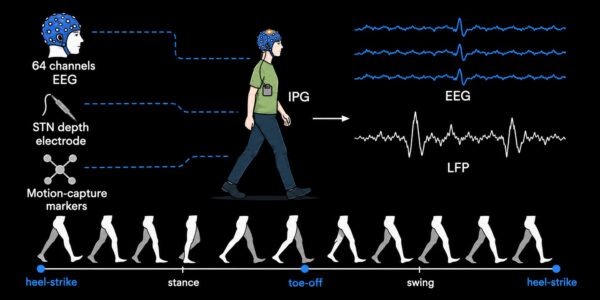
A study of 10 people with Parkinson's disease and 10 healthy controls found differences in how brain activity varied across walking phases while patients were on medication and receiving deep brain stimulation at their usual clinical settings. Researchers simultaneously recorded EEG, subthalamic nucleus signals, and whole-body movement, analyzing only straight walking segments. Group differences were limited in averaged spectra, but step-by-step analysis revealed prominent high-beta and gamma timing differences and gait-cycle modulation in the subthalamic nucleus. These signals are not yet established biomarkers of impaired gait; their relationships with walking speed, stride length, and step-to-step variability still need testing. This study is a preprint and has not been peer reviewed.

Textured Flicker Improves BCI Viewing Comfort as Decoding Performance Varies by Frequency

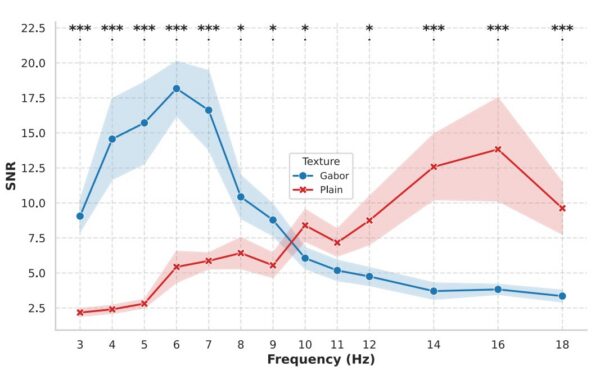
A study in healthy adults compared flickering disks filled with Gabor textures against plain flickering disks. An initial frequency sweep involved 24 participants; analysis of a five-target task two months later included 18 of them. Textured flicker produced higher EEG signal-to-noise ratios at 3-9 Hz and was rated more comfortable and less fatiguing at every tested frequency. In offline classification of the five-target task, textured flicker performed well at 5-7 Hz, while plain flicker was more reliable at 14-16 Hz. Accuracy was comparable within each stimulus's preferred band. Better comfort therefore did not mean better decoding at every frequency.

Perspective Proposes Living-Cell Neuroprostheses for Long-Term Neural Integration

A perspective paper proposes designing neural implants as functional tissues made of living cells, rather than solely as electrodes connecting to nerves. Called Cybertissue Neuroprosthetics, the concept aims for structural and functional integration with the host nervous system to support long-term neuromodulation and information exchange. It optionally incorporates minimal nanoelectronics, nanomaterials, or genetic modifications while seeking to reduce foreign materials and use cellular signaling mechanisms. The author proposes this approach to address interface deterioration during long-term implantation, but lifetime integration remains a goal, not an established device capability or clinical outcome.

Study Aligns EEG With Text to Decode Imagined Speech

Researchers aligned EEG recorded during imagined speech with text representations to exploit semantic relationships beyond fixed intent labels. Evaluated on five subjects and 39 intent categories in the Chisco dataset, the framework performed comparably to a task-optimized closed-set classifier. Maximum EEG-text similarity identified held-out trial subsets with higher Top-1 and Top-5 accuracy. Mean agreement exceeded the 50% chance reference on all five semantic dimensions. Comparisons with unseen candidate sentences were qualitative demonstrations, not evidence of unrestricted imagined-sentence decoding.

Researchers Detect Events and Their Boundaries in Continuous EEG

Researchers proposed NeuroDETR, a framework that identifies event classes and estimates their onsets and offsets directly from continuous EEG, without predefined event boundaries at inference time. It combines information across temporal scales and spatial relationships among EEG channels, using predicted event presence to guide feature processing. The authors report state-of-the-art performance on eight EEG datasets spanning diverse paradigms. These dataset experiments address event recognition for continuous interaction and monitoring; they do not directly establish performance in deployed brain-computer interface systems.

Imagined Speech Decoders Perform Near Chance Across People in Three EEG Corpora

Researchers analyzed three public corpora to test whether imagined speech decoders trained on one person's scalp EEG could work for another. Across 482 ordered participant pairs, none remained significant after multiple-comparison correction; mean transfer accuracy was within 0.006 of chance in every corpus. A signal distinguishing the imagery task from pre-stimulus rest instead reflected a post-stimulus state. Only the competition corpus exceeded the within-subject threshold for every participant, but its frequency profile failed an artifact audit. The findings apply to these corpora and the representations examined, not to all imagined speech decoding.

Study Finds Muscle Signals Dominate Overt-Speech Controls in EEG Decoding

Researchers audited three public corpora and found that decoding overt speech may not establish a pipeline's ability to recognize brain-derived speech signals. In ds003626, two lip electrodes achieved an accuracy of 0.7430, compared with 0.4231 for the 128-channel scalp montage; no decodable signal remained in the 8-30 Hz band. By injecting effects of known amplitude into real recordings, the team also measured detection floors and found differences between methods. The authors conclude that muscle signals dominate the overt-speech positive controls in these corpora and recommend reporting band-limited performance, artifact-channel accuracy, and measured detection floors.

Review Maps Functional Ultrasound BCI Applications and Highlights Response Delays

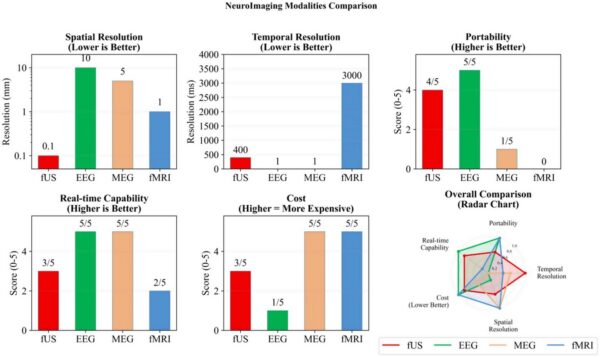
A review examines the principles of functional ultrasound brain-computer interfaces and their research uses and potential clinical value in stroke assessment, epilepsy monitoring, and early identification of neurodegenerative diseases. Functional ultrasound detects cerebral blood volume changes through the relationship between neural activity and blood flow, with a spatial resolution of approximately 100 μm. Although imaging frames are acquired at intervals of 200–500 ms, the hemodynamic response limits effective temporal resolution to 1–2 s. The author notes that bidirectional closed-loop systems combining acquisition and neuromodulation remain at the proof-of-concept stage. The biosafety of chronic ultrasound exposure is still unclear, and decoding reliability under pathological conditions needs improvement.

Beijing Sport University Model Gains Lose Significance Under Broader Statistical Correction

Researchers at Beijing Sport University developed a motor imagery EEG decoding model and evaluated it offline on three public datasets using subject-specific and cross-subject protocols. Against the baseline with the highest mean accuracy, subject-specific gains on two datasets were 3.56 and 1.62 percentage points; another cross-subject comparison showed a 2.08-point difference. These three comparisons had statistical support after correction within their respective settings, but none remained significant under a broader correction covering 56 comparisons. The findings offer limited support for integrating local and longer-range EEG information in stages, rather than establishing benefits for online control or clinical use.

Stage-Aware EEG Window Selection Improves Motor Imagery Decoding in Benchmark Tests

Researchers propose an adaptive EEG window-selection framework for motor imagery classification. Instead of independently retaining or discarding each segment, it considers event phases and relationships between successive windows. Each window receives a Discard, Onset, Sustain, or Offset role, with constraints blocking selections that violate phase order. The authors report consistent decoding improvements across multiple benchmark datasets in both cross-session and cross-subject settings. Visualizations further suggest that the learned policy aligns with neurophysiological principles. These dataset experiments do not establish equivalent gains during online BCI use. This study is a preprint and has not been peer reviewed.

EEG Transform Reduces Cross-Session Identity Recognition at a Cost to Motor Imagery Decoding

Researchers developed an EEG transform that requires no trained privacy model to reduce features linking recordings from the same person across sessions. Tests on two public datasets used five attackers spanning four covariance-space representations. The strongest attacker's accuracy fell from 90.8% to 15.6% on BCI Competition IV-2a and from 90.8% to 9.9% on OpenBMI. Relative to the 8-30 Hz input, motor imagery decoding accuracy decreased by 7.0 and 2.1 percentage points, respectively. The transform was fitted on one session and applied unchanged to a held-out later session. This study is a preprint and has not been peer reviewed.

Caltech Collaboration Separates Touch Intensity From Perception in Single-Neuron Recordings From Three Participants

A collaboration involving Caltech recorded single-neuron activity in three participants with tetraplegia while applying vibration to a sensate upper-limb region. Primary somatosensory cortex responses tracked stimulus amplitude more closely, while posterior parietal activity was more strongly associated with perception and confidence. Only two participants provided confidence ratings. The preprint distinguishes associations with physical input and subjective perception; it does not establish that one brain region alone generates conscious touch.

Study Screens Lattice Structures for Lightweight, Compliant BCI Helmet Pads

The study proposes generating finite element models directly from voxels to screen BCI helmet-pad structures for lower material use and greater compliance under compression. It generated 200 gyroid triply periodic minimal surface models, of which 199 yielded valid mechanical results, and used regression that predicts both outcomes and uncertainty to support screening. Under simulated flat-plate compression, the authors report that a representative structure increased compliance by approximately 12 times while reducing material usage by approximately 75%. These structural simulation results do not directly establish improved wearing comfort or EEG contact quality.

Nimbus Studio Reproduces Reference BCI Decoding Results on Public Datasets

A validation study compared the visual BCI experiment platform Nimbus Studio with independent, hand-written reference implementations. It tested six decoding pipelines on three public datasets spanning motor imagery and P300 tasks, using within-subject session holdout and cross-subject evaluation. Deterministic pipelines matched exactly across all 54 session-holdout subject-runs and all CSP/MDM grouped cross-validation folds, with a maximum difference of 0.00 points. The remaining grouped-CV cells differed by at most 0.06 points. Stochastic deep models agreed within seed-to-seed training variability. The study assessed computational agreement with reference implementations, not clinical efficacy. This study is a preprint and has not been peer reviewed.

Study Unifies Image and Video Reconstruction from Brain Activity

Researchers introduced Neurons++, a framework for reconstructing static images and dynamic videos from functional magnetic resonance imaging recordings while examining how the outputs relate to brain signals. It uses image-fMRI pretraining followed by subject-specific fine-tuning for image and video reconstruction separately. The authors report state-of-the-art video reconstruction and competitive image reconstruction on standard benchmarks. Neural perturbation tests, cortical-feature sensitivity analyses, and brain-region-guided semantic modulation probe how outputs respond to neural signals. These model-level analyses do not establish that generated content faithfully reproduces a person's visual experience. This study is a preprint and has not been peer reviewed.

Language Descriptions Improve Speech-Decoding Accuracy by Up to 17.15 Percentage Points

Researchers used natural-language class descriptions to help models learn the correspondence between brain signals and target classes, evaluating the approach in visual, motor, and speech decoding. The study tested seven encoder architectures with independently trained models using scalp and intracranial recordings. Speech-decoding accuracy improved by up to 17.15 percentage points over matched class-label-supervision baselines. The learned representations also supported candidate-set reuse and label-supervised subject and session adaptation. In steady-state visual evoked potential tasks, the method enabled unseen-frequency decoding under specific conditions. These findings do not establish a single model that performs every task or adapts to new subjects without labels. This study is a preprint and has not been peer reviewed.

Soft Interface Tracks Injury in Rabbit Brain Surgery

Researchers developed a soft monitoring system that conforms to the brain surface and validated it in rabbit brain tumour excision models. It measures contact pressure during surgery while recording neural electrical signals and temperature. The study found a correlation between somatosensory evoked potentials, a type of neural electrical signal, and pressure-induced damage to cortical neural pathways. Evans blue staining and magnetic resonance imaging showed that contact pressure above 80 kPa caused irreversible craniocerebral injury under the experimental conditions studied. The system uses a temperature-responsive hydrogel interface. The pressure finding comes from animal experiments and does not establish a safety threshold for human surgery.
© 2026 BCIwiki.com Digest Topics Tips Subscribe Revisions About