

August 2026
Embodiment and Simulator Sickness Map to Distinct EEG Patterns in XR-BCI
Kunming Team Maps Why BCI Performance Has a Ceiling, and How to Push It
A team at Kunming University of Science and Technology, in southwestern China's Yunnan province, has published a paper in the Journal of Biomedical Engineering analyzing how inherent limitations set the capability boundaries of brain-computer interfaces (BCIs). Dynamic neural coding, inter-individual variability, low signal-to-noise ratio, partial observability and paradigm dependence jointly impose upper limits on decoding accuracy, information transfer rate, complex intention decoding, user experience and system stability. The authors propose information enhancement, adaptive decoding, human-machine collaboration and system optimization, arguing that gains will come from extracting more from the neural signal rather than from overcoming the underlying limits.
UC Berkeley Team Proposes DustNet, a Wireless Network of Ultrasonic Neural Implants
Tianjin University's MTGNet Denoises EEG, Lifting Fatigue Detection by Over 6 Points
EEG signals are only microvolts strong, so blinks, jaw clenching and muscle activity easily contaminate them. Researchers at Tianjin University and Tiangong University in northern China proposed MTGNet, a framework that suppresses these artifacts while preserving the information downstream tasks need. On the public EEGDenoiseNet dataset, it cut spectral relative root-mean-square error by 18.9%, 31.5% and 14.0% for EMG, EOG and mixed artifacts respectively; on a real-world fatigue EEG dataset, it raised classification accuracy by 6.20 to 6.69 percentage points over unprocessed input. Adapting the framework to a new task takes only 0.33 million low-rank adaptation (LoRA) parameters and no paired clean EEG reference.
Post-Quantum Encryption Adds Just 0.45 ms of Latency to a BCI Link
BCI Society Workshop Tackles Outcome Measures for Pivotal Trials
A workshop at the BCI Society Meeting 2025, run with the Implantable BCI Collaborative Community (iBCI-CC), took up how clinical outcome assessments (COAs) for pivotal BCI trials should be selected, developed and validated. Participants pointed to patient heterogeneity, the absence of widely validated COAs, and the difficulty of capturing outcomes that matter in home and daily-life settings. The discussion lays groundwork for the iBCI-CC Clinical Study Endpoints Workgroup to build a transparent process for identifying meaningful aspects of health and concepts of interest, in support of regulatory approval and reimbursement.
DMG-GCN Decodes Air Traffic Controller Workload From EEG at 80.30% Accuracy
LibriBrain100 Releases Over 100 Hours of MEG Data, Some 80 From One Subject
LibriBrain100, a magnetoencephalography (MEG) dataset released on August 25, 2026, contains more than 100 hours of high-quality recordings, about 80 of them from a single subject, the deepest within-subject collection of its kind. It is meant as a standardized benchmark for neural speech decoding and ships with open-source tooling and an online competition; a further 32 subjects contribute roughly 40 minutes each to offset thin per-subject data. Using an existing decoding model, the team reported state-of-the-art results on a word-classification benchmark, which it takes as evidence of both data quality and the value of deep within-subject recording.
Preprint: VN-SST Decodes Motor Cortex Signals With Less Training Data
A preprint introduces the von Neumann State-Space Transformer (VN-SST), a neural decoding model that is more data-efficient than a modern Transformer across three motor-cortex decoding benchmarks, with the largest gains where training data is scarce.
BCIs Move into Orthopedic Rehab, Targeting Muscle Inhibition after Surgery
Brain-computer interfaces are moving out of neurology and into orthopedic rehabilitation, according to a review arguing that BCIs can raise corticospinal excitability and induce neuroplasticity by decoding movement-related neural signals and closing a feedback loop between central and peripheral systems. The target is postoperative muscle inhibition caused by insufficient central motor drive; available evidence suggests motor imagery-based BCI training improves quadriceps voluntary activation and limits strength loss after ACL reconstruction, though the authors cite thin mechanistic evidence, patient heterogeneity and a lack of standardized protocols as barriers to translation. The review, by researchers at the First Affiliated Hospital of Jinan University in southern China's Guangzhou and other institutions, was published on August 25, 2026, in the Chinese Journal of Reparative and Reconstructive Surgery.
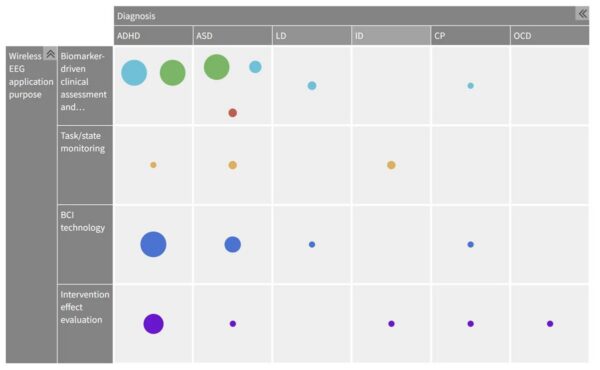
Wireless EEG Use Climbs in Children With Developmental Disabilities, BCI at 28.1%
Interpretable BCI Framework Pairs Emotion Recognition With Thought-to-Speech Decoding
A new study proposes an interpretable brain-computer interface framework that combines affective state recognition with EEG decoding to enable emotion-aware thought-to-speech. Tested on public imagined-speech EEG datasets in subject-independent settings and scored on accuracy, precision, recall, F1-score, inference speed and interpretability, the framework improved decoding reliability over conventional opaque models and produced clinically meaningful explanations, the authors report. They present it as a practical basis for assistive communication tools for people with paralysis, amyotrophic lateral sclerosis, locked-in syndrome and other conditions that disrupt natural speech.
Tianjin University Team Cuts EEG Channels Without Losing Decoding Accuracy
A team at Tianjin University in northern China has built a graph neural network framework that jointly optimizes EEG channel selection and classification, picking a small subset of channels for motor imagery decoding while holding accuracy close to that of the full electrode set. Reported in the journal Chaos, the method was validated on three datasets — BCI Competition IV 2a, High Gamma and a newly collected set — and could cut system complexity for uses such as neurorehabilitation.
Preprint: Quantum-Inspired Circuits Lift Neural Decoding Accuracy in 3 of 4 Seeds
A preprint bolts parameterized quantum circuits onto a ResNet-50 backbone as residual sidecar modules and tests them on 31-class decoding of neural population activity from imagined handwriting. The backbone-gradient variant improved accuracy in three of four seeds and consistently lowered linear CKA similarity to the baseline features, which the authors read as a structural reorganization of the learned representation. They claim no quantum advantage.
Arctop Unveils RLbF, Which Trains LLMs on Real-Time EEG Feedback
Gaze-Plus-Motor-Imagery BCI Reaches 100% Accuracy With 16-Channel EEG
Motor imagery BCIs have long faced two problems: wide variation between users and only a small number of distinguishable commands. In this study, users first select a target by looking at it, then confirm the choice with imagined movement, merging the two steps into one. In tests with 15 healthy participants using 16-channel EEG, the hybrid paradigm outperformed motor imagery alone in every channel configuration, reaching up to 100% accuracy. The researchers also found that fixating on the target made EEG responses more stable, which supports using fewer electrodes and lowering the hardware barrier.
Phase-sliding oscillation lifts async BCI to 94.2%
Phase mismatch between live EEG and fixed templates has long been the weak point of asynchronous steady-state visual evoked potential (SSVEP) brain-computer interfaces, which are seen as a promising route to real-world control. A new method, PSO-AC, exploits a phase-sliding oscillation phenomenon the authors observed and validated. Offline, 22 participants produced a mean control/non-control accuracy of 94.2% from just two seconds of EEG data, a result the authors say outperforms a state-of-the-art baseline; 9-class decoding also kept its edge across different time delays. Online, in robotic-arm experiments, the method delivered more stable command triggering and higher control efficiency, with the command cost per successful trial falling from 4.30 to 1.14. The paper was published in the International Journal of Neural Systems on August 21, 2026.
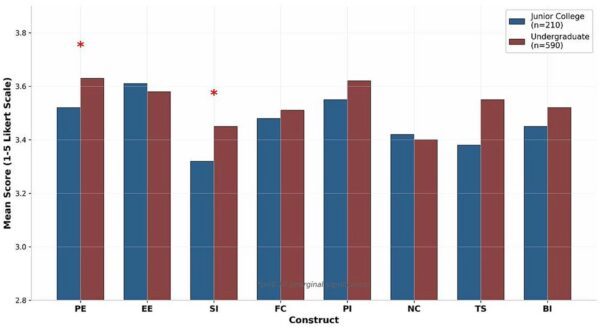
Teacher Support Was the Strongest Predictor of Student BCI Adoption
EFS-Net Fuses EEG and fNIRS for Hybrid BCI Decoding
Researchers proposed EFS-Net, an end-to-end network that aligns fast EEG activity with slower fNIRS haemodynamic signals through temporal, spatial and cross-modal branches. In subject-specific leave-one-session-out validation, the model reached 77.71% accuracy on a word-generation dataset and 81.69% on a mental-arithmetic dataset.
BELT Runs Motor-Imagery BCI Decoding on an ARM Chip in 6.75 Milliseconds
Chinese Academy of Sciences Team Releases BCIJelly Toolchain Unifying 18 BCI Datasets
BCI research has long been slowed by inconsistent data formats, divergent decoder implementations and incompatible deployment toolchains. BCIJelly standardizes 18 BCI datasets into inputs ready for AI training and integrates 15 benchmark decoders and 80 reusable modules. Its automated architecture search generates task-specific decoders without manual design and can extend into a large language model-driven closed-loop mode that supports single-task, multitask and cross-species decoder design; the system also offers interactive visualization software that requires no coding. A single-command pipeline compiles trained decoders onto neuromorphic hardware, cutting power consumption 30- to 50-fold while maintaining decoding performance. The work has been validated in humans, macaques and mice across five paradigms: motor, visual, speech, emotion and auditory. It is a preprint that has not been peer reviewed.
Motion-Based Visual BCI Reaches 85.67% Accuracy Without Flicker
Subject-Specific Frequency Bands Improve Motor-Imagery EEG Decoding
Researchers at United International University in Bangladesh proposed SSLFF, a framework that selects frequency sub-bands for each user, fuses complementary spectral information and extracts time-localized features. The paper reports statistically significant accuracy gains over conventional methods and stable performance across parameter changes, although the abstract does not provide absolute accuracy figures.
Review Proposes 'Brain-Inspired BCIs' for Low-Power, Closed-Loop Neurotech
A review published on August 20, 2026 in npj Biomedical Innovations proposes brain-inspired brain-computer interfaces (BI-BCIs), a framework that unifies neuromorphic computing with BCI design to make neurotechnology lower-power, smaller and capable of closed-loop operation. The authors, from Aarhus University, Stanford University, the University of Southern Denmark, the University of Genoa, Forschungszentrum Jülich and RWTH Aachen University, say the approach could advance neuroprosthetics and neuromodulation for neurological disorders.
Review Identifies Three Shared Bottlenecks Across DBS and BCIs
Chemical Treatment Extends Estimated Neural-Interface Bond Life at Least 40-Fold

Study reviews invasive and non-invasive BCI use
A systematic review of BCI medical applications published on August 17, 2026 in Theoretical and Natural Science covers literature review, comparative case analysis of invasive vs non-invasive techniques, and interdisciplinary assessment. It reports that invasive BCIs reach 80% to 100% task success rates in robotic arm control but are limited by surgical hazards, progressive signal deterioration and costs above $250,000, while non-invasive BCIs are safer and more widely deployed in community neurorehabilitation with about 70% effectiveness for post-stroke upper-limb recovery, yet suffer poor signal-to-noise ratios, a BCI illiteracy rate near 30% and low information transfer speeds. The review also addresses neural data privacy, autonomy paradoxes and inequitable access.
MRieHy Framework for Online MI-BCI Adaptation
Researchers propose MRieHy, a multi-feature Riemannian hypergraph framework for online test-time adaptation of motor imagery BCI decoding. It aligns multi-day distributions via Riemannian means of covariance matrices, builds one hypergraph with Riemannian distance and a second with cosine similarity, fuses them with adaptively learned weights, and decodes buffered online samples after Riemannian alignment. On a private four-class ECoG dataset and two public four-class EEG datasets, MRieHy shows notable gains over state-of-the-art baselines, targeting the cross-day transferability and online operation that clinical MI-BCI still lacks.
Implantable Motor BCIs Need a Unified Clinical Outcomes Framework
A paper in *Neurorehabilitation and Neural Repair* examines the outcome measures needed as implantable motor BCIs move from safety and feasibility studies toward regulatory approval, reimbursement and sustained clinical use. It calls for valid and reliable assessments that satisfy regulators and payers while reflecting activities that matter to people with severe motor impairment.