中 / EN
September 2026

BCI-Adaptive Learning Platform Lifts Retention in 90-Learner Study

Researchers divided 90 learners into two groups: one used a BCI platform that read attention, cognitive load and mental fatigue in real time and adjusted content and pacing accordingly; the other followed a conventional online course. The BCI group showed stronger sustained engagement and better knowledge retention. The mixed-methods design combined quantitative data (pre- and post-test scores, task completion rates and neural activity indicators) with surveys and semi-structured interviews on perceived engagement, usability and the overall learning experience. The participants came from English House Language Center, the European University of Armenia and Mesrop Mashtots University. The authors also flag unresolved privacy, ethical and accessibility questions around collecting and using neural data in education.
Synchron Stent Electrode Beats Scalp EEG per Channel in One ALS Patient

A participant with severe upper-limb paralysis caused by amyotrophic lateral sclerosis (ALS) wore an endovascular stent-electrode array and a scalp EEG cap at the same time, in the same session, while attempting ankle flexion and extension. Both recordings changed markedly during attempted movement, but the stent array showed stronger per-channel motor modulation and was unaffected by skull attenuation. Scalp EEG was more susceptible to eye blinks and jaw-muscle activity, while the stent array picked up prominent cardiac signals. Neither method reliably distinguished left from right ankle movement, leaving spatial localization an open problem.

Bio-MF Generates fNIRS From EEG in One Step, 857 Times Faster Than Diffusion

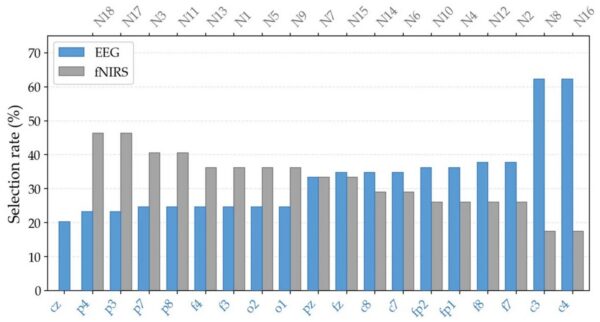
Hybrid motor-imagery brain-computer interfaces combine EEG with functional near-infrared spectroscopy (fNIRS) to exploit complementary electrical and blood-flow signals, but wearing two headsets is cumbersome and costly, and earlier diffusion-based methods for generating one signal from the other need about a thousand iterative steps, too slow for real-time use. Researchers from the Key Laboratory of Modern Teaching Technology (Ministry of Education) at Shaanxi Normal University and Microsoft (Beijing) propose Bio-MF, which predicts fNIRS waveforms directly from EEG in a single step. On one RTX PRO 6000 GPU it produces a trial in 7 ms, 857 times faster than a 1,000-step diffusion model. Adding the synthetic fNIRS to EEG raised classification accuracy over EEG alone by 3.37 to 4.15 percentage points on one dataset, and by 2.50 to 2.98 points on a second dataset with an unseen 64-channel EEG layout. All validation was offline; the work is a preprint and has not been peer reviewed.

Study Compares AI Command Execution With External Gating in BCIs

Researchers tested five language models as AI agents using 1,065 episodes from 47 people with amyotrophic lateral sclerosis. At matched execution coverage, providing reconstructed decoder confidence never reduced unfaithful execution below a deterministic gate; two models performed significantly worse. Apparent safety improvements mainly reflected less frequent action. A subsequent test gave ten models the same command vocabulary as a deterministic resolver. No direct agent arm improved on the resolver's risk-coverage frontier. However, a hybrid architecture that let models propose semantic corrections while an external gate controlled admission extended coverage in five of ten models without observed unfaithful executions.

Chinese Team Proposes Unified Theory Framework for BCIs

BCI hardware and decoding algorithms have advanced quickly, but basic questions such as how much intent can be read from brain signals and how low decoding error can go still lack a systematic theoretical answer. This paper treats a BCI as a closed-loop stochastic process: a user forms an intention, the brain encodes it as neural activity, the device observes the signal, an algorithm decodes it statistically, and feedback returns to the user. Using information theory and statistical decision theory, the authors derive theorems on when intent is decodable, the upper bound of observable information, the lower bound of optimal decoding error, and the convergence of closed-loop learning, plus laws describing constraints from signal-to-noise ratio, class separability and non-stationary co-adaptation. A four-class SSVEP-BCI, in which users gaze at targets flickering at different frequencies, serves as a theoretical case study. The work is theoretical and reports no new experimental data.

Study Finds Distinct Neural Populations Encode Imagined Grasps and Object Properties

In three participants with tetraplegia imagining object manipulation, neural activity across several brain regions represented the configuration of the whole hand during imagined grasps. The posterior parietal cortex simultaneously encoded grasp and object properties, largely through distinct neuronal subpopulations. Grasp-related activity varied with motor planning versus imagined execution and with object presence versus absence; some regions also represented object shape during planning. The authors suggest that separating grasp and object information could support more stable BCI grasp control. However, the motor imagery task does not establish restored hand function or improved robotic grasp performance. The study is a preprint that has not been peer reviewed.

New Analysis Identifies Opposing Neural Wave Modes in Marmoset and Human Recordings

Researchers introduced a framework for analyzing neural traveling waves and identified oppositely directed propagation modes in marmoset electrocorticography and human EEG recordings. The waves were concentrated in specific spatial and temporal frequency ranges, involving alpha and low-beta activity, with propagation speeds the authors considered physiologically plausible. The framework analyzes temporal frequency, spatial frequency, and propagation direction, accommodates irregular sensor layouts, and helps distinguish traveling from standing waves. The study also introduces a single-trial detection method. These findings concern animal and human neural signal analysis, not demonstrated improvements in BCI control or clinical outcomes. The work is a preprint that has not been peer reviewed.

CoME Framework Scores How Mobile an EEG Study Really Is

A participant walking on a treadmill and one walking freely outdoors with a recorder on their back can both be described as doing mobile EEG, yet their freedom of movement differs enormously. The CoME framework, proposed in 2017, scores a study on four dimensions (device mobility, participant mobility, system specification and channel count) in a format such as (2D, 4P, 17S, 32C). Device and participant mobility have to be scored separately: a head-mounted system used for resting-state recording earns a high device score but still rates 0P for participant mobility. The framework is not a product ranking, and a higher score does not mean a better system.

EEG-to-Text Results Overstated as Random Noise Fools Some Decoders

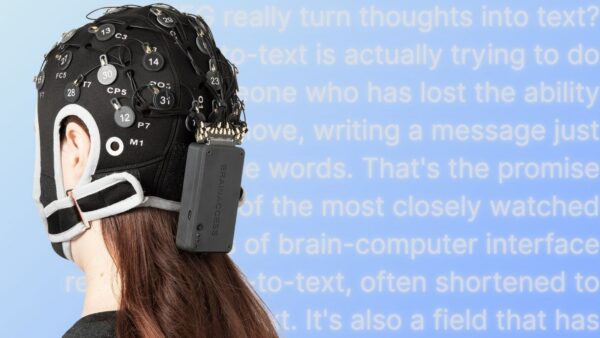
Translating scalp EEG directly into free-form text has long been seen as one of the most ambitious goals for non-invasive brain-computer interfaces. But when researchers fed random noise instead of real EEG into several published decoders, some models still produced fluent sentences and scored about as well as they did on real brain data, suggesting the language model was doing most of the work. The field has since made noise-baseline tests and decoding without teacher forcing standard validation practice, and has used magnetoencephalography (MEG) as a comparison to quantify how far EEG trails cleaner signals.

iMINDBench Sets a Shared Cross-Institution Test for Intracranial EEG Decoding

Intracranial EEG (iEEG), recorded by electrodes implanted inside the brain, is widely regarded as an ideal signal for decoding intent, but differing datasets and preprocessing pipelines make it hard to tell whether models are actually improving. A research team built iMINDBench, a benchmark that brings together naturalistic movie-watching data from three institutions, 15 decoding tasks, standardized preprocessing and fixed evaluation splits. Pretrained systems generally beat baselines within their own preprocessing pipeline, but classic spectral baselines remained competitive on other institutions' data. Scaling up supervised data from other subjects or institutions to 25 times the volume yielded only limited, task-dependent gains over training on data from the same session.

SPAR-EEG Single-Channel Denoiser Lifts P300 Speller Accuracy by 7.8 Points

Wearable neurotechnology and BCI applications, from assistive interfaces to clinical monitoring, favor single-channel EEG because it needs few electrodes and is light to wear. But muscle, eye and motion artifacts are hard to remove from a single channel, especially without auxiliary channels, artifact labels or hand-picked clean baseline segments. SPAR-EEG needs none of these: it applies three artifact-specific attenuation passes to each EEG segment, one based on variational mode decomposition for high-frequency muscle bursts and two based on singular spectrum analysis for blink-like ocular transients and slow motion drift. It achieved the best artifact-region SNR improvement at all 26 SNR levels tested and raised final accuracy by 7.8 percentage points in a P300 speller task using only the FP1 and FP2 leads.

AI Should Read Intent in BCI Exoskeletons While Controllers Enforce Limits, Review Says

A brain-computer interface can read neural activity tied to movement, while a powered exoskeleton supplies the force needed to carry it out. But EEG is noisy, muscle signals shift with fatigue and recovery, and the right level of assistance depends heavily on the user and the task, so AI's main value lies in handling several changing signals at once rather than relying on a single fixed input. The review surveys how EEG, EMG and mechanical sensing are combined for exoskeleton control and contrasts two applications with very different goals: stroke rehabilitation and healthy users. The author argues that higher classification accuracy alone is not enough, since latency, calibration, fatigue, uncertainty and physical safety also determine whether a system is truly usable.

Review of 129 EEG-BCI Papers Finds 61.2% State Data Availability, Only 20.9% Share Code

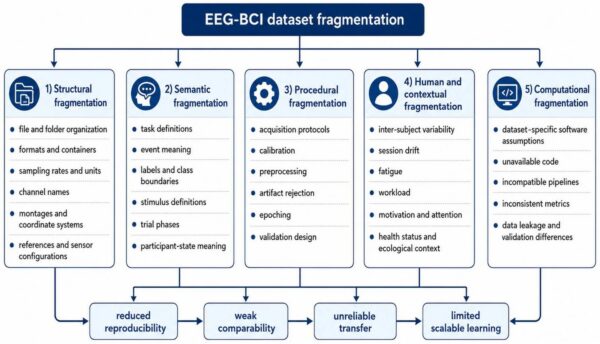
Public datasets for EEG-based brain-computer interfaces (BCIs) keep multiplying, but electrode layouts, task definitions, preprocessing and participant records differ from study to study, making the data hard to reuse across datasets and the results hard to replicate. This review screened 16,920 records down to 129 publications, mapped the fragmentation across structural, semantic, procedural, human/contextual and computational layers, and scored reporting transparency against 10 criteria, with a median score of 9. Data availability was stated in 61.2% of the papers; code or pipeline availability in just 20.9%. Existing standards, ontologies, software platforms and transfer-learning methods each solve part of the problem, the authors conclude, but none yet delivers full semantic interoperability.

Low-Cost 8-Channel EEG and VR Headset Reach Up to 90% Accuracy in Single-Subject Test

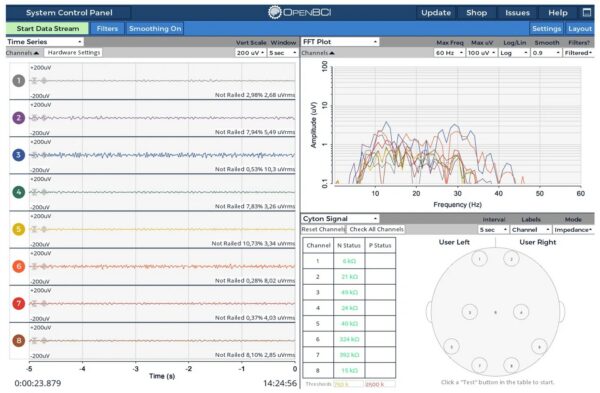
Researchers paired an 8-channel OpenBCI Cyton board and an EEG cap laid out on the international 10-20 system with a Meta Quest 2 headset to capture motor imagery and attention signals, reaching up to 90% subject-specific online classification accuracy with the EEGNet model when the signal was stable. The work targets cognitive control training for attention-deficit/hyperactivity disorder (ADHD), building EEG sensing into a virtual reality (VR) serious game so users can regulate their mental state in real time; earlier approaches mostly relied on hardware-heavy multichannel systems and did not combine motor imagery with attention levels. The team also documented artifacts from high impedance, channel saturation and mechanical tension from the headset strap, showing that a low-cost setup is usable only once skin-electrode impedance and mechanical interference are under control. This is a single-subject feasibility study with no clinical evaluation.

4,096-Channel μECoG Array Maps Brain Function During Surgery With 91.3% Channel Yield

During removal of a right parafalcine meningioma, surgeons placed four Layer 7 μECoG arrays, 4,096 electrodes in total, on either side of the central sulcus and recorded somatosensory evoked potentials under 5 contralateral stimulation conditions. Using a 2 MΩ impedance cutoff, 3,739 channels were usable, a 91.3% yield; phase-reversal latencies were 19, 21, 25, 26 and 25 ms, consistent with the standard intraoperative mapping performed in the same operation. The researchers caution that the setup provides dense spatial sampling rather than submillimeter physiological resolution: measured responses were correlated across roughly 3–4 mm of cortex.

Adding fNIRS to EEG Fails to Improve Brain-Controlled Stimulation in 16-Person Trial

Combining EEG with functional near-infrared spectroscopy (fNIRS) did not make brain-controlled electrical stimulation more accurate in a blinded randomized trial of 16 healthy volunteers. The hybrid and EEG-only groups showed no statistically significant differences in real-time three-class recall, sense of agency, attention or physical comfort; median recall was 53.5% in the hybrid group and 57.3% with EEG alone. The researchers also released the full EEG-fNIRS dataset.

Adaptive BCI Decoders Concentrate Task Information in Fewer Monkey Motor Neurons

After days of practicing a brain-computer interface with adaptive decoders, rhesus macaques needed significantly fewer motor cortex neurons to reach 80% task classification accuracy than in early sessions (p = 9.8 x 10^-4). Fixed decoders produced no such compaction. A neural network model suggests the adaptive decoders directly contribute to these more compact representations; the authors propose this may be because the decoders alter the error information used for credit assignment. The finding implies that assistive algorithms do not merely boost immediate BCI performance but actively reshape how the brain learns over time -- a consideration for real-world decoder design. The study used 128-channel microwire arrays in motor and premotor cortices of two monkeys and has not been tested in humans.

EEG and MEG Decoding Reaches 79.4% Median Motor Imagery Accuracy

Researchers developed FUSE, a two-phase learning framework that combines simultaneous EEG and MEG recordings for motor imagery classification, and evaluated it on data from 20 participants. Learned representations increased median classification accuracy from 0.734 with conventional handcrafted spectral features to 0.794. The combined approach also exceeded MEG alone at 0.680 and EEG alone at 0.765, although the gain over EEG was modest. In transfer tests, more than half of cross-subject models performed within 0.01 accuracy of their subject-specific counterparts. These findings concern signal classification and representation transfer, not clinical efficacy. This study is a preprint and has not been peer reviewed.

Researchers Predict Brain-Region Waveforms From Signals Recorded Elsewhere

Researchers introduced NeuroGate, a cross-regional signal translation framework that predicts an unrecorded brain region's waveform from a recorded region. Across 56 pathways spanning rodent local field potentials, human stereo-EEG and electrocorticography, and scalp EEG, its waveform predictions were more accurate than those of 13 deep-learning and linear baselines. To test directionality, the researchers silenced piriform-cortex output. Piriform-to-bulb predictions collapsed in all 8 folds, while reverse predictions were preserved. The authors interpret this as consistent with monosynaptic anatomy and demonstrate applications in assessing recording redundancy and testing directional translation. This study is a preprint and has not been peer reviewed.

Low-Cost EEG Decodes Imagined Steering Direction

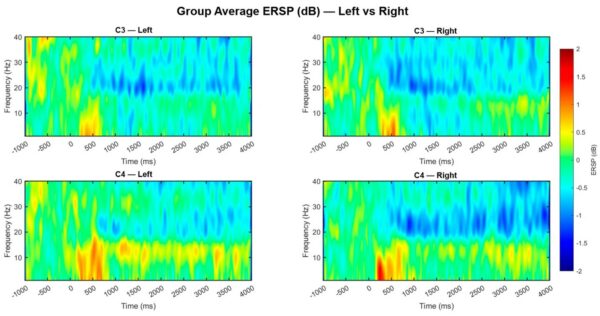
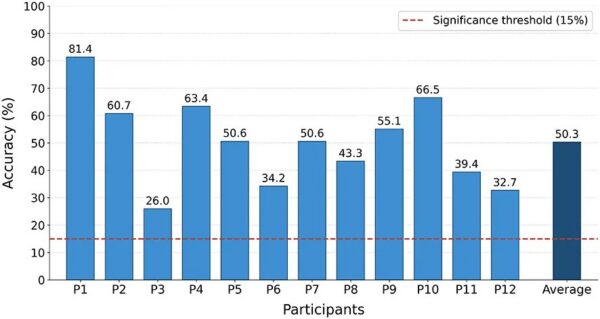
Can an EEG headset tell whether a driver is imagining a left or a right turn of the wheel? A team from Wuhan University of Technology and Guangxi Normal University designed a motor imagery task built around the actual steering action: participants imagined turning a wheel left or right with the right hand only. Using a low-cost OpenBCI device with 8 electrodes, they recorded EEG from 12 participants and found steering-direction differences over the central scalp. Their SMB-TCSAN decoding model reached an average classification accuracy of 66.80% on the steering-direction dataset. The authors describe the work as a preliminary feasibility check for driving-assistive BCI, not a working system.

Preprint: Self-Updating Models Predict All Seizures in 75% of Patients Amid Drift

Researchers showed that seizure-prediction methods lose much of their accuracy in continuous use, with mean AUROC dropping from 90% offline to 57.9% online across 664.9 hours of intracranial EEG from 16 patients with drug-resistant epilepsy, because brain signals drift over time. An online evolutionary framework that keeps selecting and updating models on the data stream predicted every seizure in 75% of patients and missed only one in 87.5%. Reading only contacts in the epileptogenic network cut the required contacts by 79.12%. The team has released the dataset. The study is a preprint and has not been peer reviewed.

Tsinghua Team Launches TrustBCI to Share BCI Data Without Moving It

Training accurate BCI models depends on large, diverse EEG datasets, but that data is usually locked inside individual hospitals and labs, stored in inconsistent formats and restricted by privacy rules, which makes it hard to share. TrustBCI brings three functions into one platform: turning raw BCI datasets into assets that can be exchanged, using incentives to keep institutions contributing data, and letting users run computations without access to the raw records. The platform demonstrates two workflows, controllable data synthesis, which generates new datasets, and privacy-preserving query, which returns only query results. That suggests BCI models could be trained jointly across institutions without first pooling the data in one place.

LLMs Cut P300 Speller Keystrokes by More Than 62%, Review Finds

This review traces the evolution of P300 brain-computer interfaces from classic spellers to AI agents. The P300 is a positive brain potential that appears about 300 milliseconds after a rare stimulus, and systems use it to determine which character a user wants to select. According to the review, recent systems such as ChatBCI and MindChat, which pair P300 spellers with large language models, cut keystrokes by more than 62% and nearly triple communication speed. The author also proposes an end-to-end architecture: an EEG headset and a real-time CNN detector, topped by an AI-agent layer made up of an LLM planner and IoT control interfaces.

Anisotropic Hydrogel Electrode Records P300 and SSVEP Signals

Electrodes for non-invasive brain-computer interfaces have long traded off conductivity, conformity to the skin and durability. A conductive hydrogel made by in situ directional freezing copolymerization forms vertically aligned ion channels and an interconnected nanoporous network, giving it higher conductivity than conventional hydrogel electrodes. In preliminary P300 and steady-state visual evoked potential (SSVEP) experiments, it recorded signals comparable in quality to conventional wet- and dry-electrode benchmarks, while also offering a tissue-matched compressive modulus, high stretchability, skin adhesion and rapid self-healing. The paper presents these experiments as a feasibility demonstration and reports no data on long-term wear stability, scaled-up fabrication or human clinical trials.

Pretraining Cuts Labeled Data Needed for BCI Decoding by Over 90%

Training a decoder to read brain signals usually means collecting a large labeled dataset from every new subject, which is slow and a burden on patients. The proposed method, MAPA, first runs self-supervised pretraining on unlabeled intracranial EEG recordings pooled across subjects, then transfers to new ones. The difficulty is that electrode contact placement and neuroanatomy vary from person to person, so MAPA adds two spatial encodings, an anatomical region embedding and a relative positional encoding, to a standard masked autoencoder. In cross-subject tests, about 164 labeled trials were enough to reach the accuracy that otherwise takes 3,500. The team reports that MAPA set new best results on the Neuroprobe benchmark in all three settings, within-session, cross-session and cross-subject, without fine-tuning, suggesting that calibration for implanted BCIs could become much shorter.

fMRI-Guided Training Lifts EEG Individual-Finger Decoding Accuracy to 74.53%

Because the fingers' representations sit close together in the motor cortex, telling individual finger movements apart from scalp EEG has long been difficult. Researchers first learned a set of spectral projections from simultaneously recorded EEG and functional MRI (fMRI), then used the class geometry derived from fMRI to correct EEG predictions. In tests on 12 healthy participants, group average accuracy for two-class movement execution rose from 66.93% to 74.53%, and for three-class execution from 44.83% to 56.58%; for two-class motor imagery it rose from 80.78% to 85.63%. At inference the system uses EEG alone, with no paired fMRI data required.

Memorial University Team Combines Two Mental Images to Push EEG BCI to 8 Classes

Researchers in the Department of Electrical and Computer Engineering at Memorial University of Newfoundland in Canada had participants perform two imagery tasks at once, imagining singing while imagining moving one hand or both feet, to expand the number of states an active brain-computer interface can distinguish. Using EEG from 14 healthy participants, filter-bank common spatial pattern features and regularized linear discriminant analysis, they separated these dual-imagery tasks from their single components and from rest. Peak accuracies reached 64.1% for 3 classes and 63.0% for 4 classes; at 7 and 8 classes, average accuracies of about 55% and 50% far exceeded chance levels of 14.3% and 12.5%. The authors acknowledge the accuracy is not yet sufficient for a practical multi-command BCI but say combined imagery is feasible.

Passenger EEG Helps Self-Driving AI Spot Road Risks Early With 95.3% Balanced Accuracy

Researchers recorded passengers' EEG as they watched driving scenes in a highly automated vehicle, then trained models to judge whether a risk lay ahead and where the hazard appeared. A 3D-CRNN reached 95.3% ± 2.7% balanced accuracy in risk prediction and raised hazard identification from 80.9% to 85.0%. In cross-subject tests on passengers the model had not seen, balanced accuracy fell to 64.9% ± 8.5%, showing the approach is still some way from deployment.

EEG Motor-Imagery BCI Steers Wheelchair Prototype, With SVM Decoding at 90.7%

A research team built an EEG motor-imagery brain-computer interface and connected its decoder to a physical differential-drive wheelchair prototype, offering people with severe motor impairments a non-invasive means of control, though the uncertainty of EEG decoding has long hindered such systems from driving physical actuators. Using Filter Bank Common Spatial Pattern features on a public dataset, the team compared support vector machine (SVM), k-nearest neighbors and linear discriminant analysis classifiers; SVM reached 90.7% mean accuracy, and 85.9% when replayed on an independent dataset through a hardware-in-the-loop setup. Confidence-based command validation raised accuracy among accepted commands to 97.6%, at the cost of accepting only 60.7% of them. Layered safeguards (confidence gating, self-terminating steering, transition braking, communication timeout supervision and a hardware emergency cutoff) limit the consequences of decoding errors.

Random Forest Tells Real From Imagined Movements, Even on Consumer-Grade EEG

Can a machine tell from EEG alone whether a person is actually moving or only imagining the movement? A preprint study tested a Random Forest classifier on consumer-grade and research-grade EEG systems and found it could separate the two kinds of activity and identify which body part was involved. EEG is a basic tool for studying the brain's electrical activity during movement, and BCIs use that activity to build assistive technologies, particularly for people with physical disabilities; because extracting features and patterns from the signal remains complex, the task is often handed to machine learning. The study also found that differences in EEG between individuals drag down classification accuracy, meaning a model that works for one person may perform worse on another. The work is a preprint and has not been peer reviewed.
© 2026 BCIwiki.com Digest Topics Tips Subscribe Revisions About