
中 / EN

Papers

462 entries
October 2026

Study Aligns EEG With Text to Decode Imagined Speech

Researchers aligned EEG recorded during imagined speech with text representations to exploit semantic relationships beyond fixed intent labels. Evaluated on five subjects and 39 intent categories in the Chisco dataset, the framework performed comparably to a task-optimized closed-set classifier. Maximum EEG-text similarity identified held-out trial subsets with higher Top-1 and Top-5 accuracy. Mean agreement exceeded the 50% chance reference on all five semantic dimensions. Comparisons with unseen candidate sentences were qualitative demonstrations, not evidence of unrestricted imagined-sentence decoding.
Researchers Detect Events and Their Boundaries in Continuous EEG

Researchers proposed NeuroDETR, a framework that identifies event classes and estimates their onsets and offsets directly from continuous EEG, without predefined event boundaries at inference time. It combines information across temporal scales and spatial relationships among EEG channels, using predicted event presence to guide feature processing. The authors report state-of-the-art performance on eight EEG datasets spanning diverse paradigms. These dataset experiments address event recognition for continuous interaction and monitoring; they do not directly establish performance in deployed brain-computer interface systems.

Imagined Speech Decoders Perform Near Chance Across People in Three EEG Corpora

Researchers analyzed three public corpora to test whether imagined speech decoders trained on one person's scalp EEG could work for another. Across 482 ordered participant pairs, none remained significant after multiple-comparison correction; mean transfer accuracy was within 0.006 of chance in every corpus. A signal distinguishing the imagery task from pre-stimulus rest instead reflected a post-stimulus state. Only the competition corpus exceeded the within-subject threshold for every participant, but its frequency profile failed an artifact audit. The findings apply to these corpora and the representations examined, not to all imagined speech decoding.

Study Finds Muscle Signals Dominate Overt-Speech Controls in EEG Decoding

Researchers audited three public corpora and found that decoding overt speech may not establish a pipeline's ability to recognize brain-derived speech signals. In ds003626, two lip electrodes achieved an accuracy of 0.7430, compared with 0.4231 for the 128-channel scalp montage; no decodable signal remained in the 8-30 Hz band. By injecting effects of known amplitude into real recordings, the team also measured detection floors and found differences between methods. The authors conclude that muscle signals dominate the overt-speech positive controls in these corpora and recommend reporting band-limited performance, artifact-channel accuracy, and measured detection floors.

Review Maps Functional Ultrasound BCI Applications and Highlights Response Delays

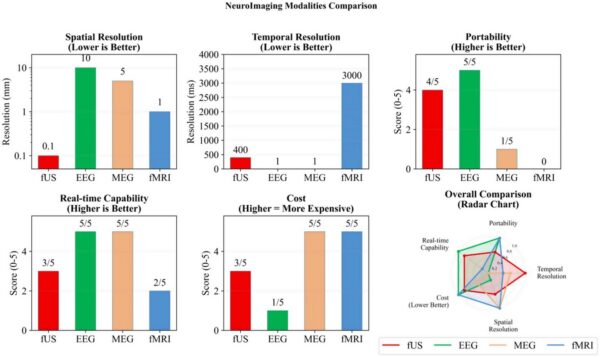
A review examines the principles of functional ultrasound brain-computer interfaces and their research uses and potential clinical value in stroke assessment, epilepsy monitoring, and early identification of neurodegenerative diseases. Functional ultrasound detects cerebral blood volume changes through the relationship between neural activity and blood flow, with a spatial resolution of approximately 100 μm. Although imaging frames are acquired at intervals of 200–500 ms, the hemodynamic response limits effective temporal resolution to 1–2 s. The author notes that bidirectional closed-loop systems combining acquisition and neuromodulation remain at the proof-of-concept stage. The biosafety of chronic ultrasound exposure is still unclear, and decoding reliability under pathological conditions needs improvement.

Beijing Sport University Model Gains Lose Significance Under Broader Statistical Correction

Researchers at Beijing Sport University developed a motor imagery EEG decoding model and evaluated it offline on three public datasets using subject-specific and cross-subject protocols. Against the baseline with the highest mean accuracy, subject-specific gains on two datasets were 3.56 and 1.62 percentage points; another cross-subject comparison showed a 2.08-point difference. These three comparisons had statistical support after correction within their respective settings, but none remained significant under a broader correction covering 56 comparisons. The findings offer limited support for integrating local and longer-range EEG information in stages, rather than establishing benefits for online control or clinical use.

Stage-Aware EEG Window Selection Improves Motor Imagery Decoding in Benchmark Tests

Researchers propose an adaptive EEG window-selection framework for motor imagery classification. Instead of independently retaining or discarding each segment, it considers event phases and relationships between successive windows. Each window receives a Discard, Onset, Sustain, or Offset role, with constraints blocking selections that violate phase order. The authors report consistent decoding improvements across multiple benchmark datasets in both cross-session and cross-subject settings. Visualizations further suggest that the learned policy aligns with neurophysiological principles. These dataset experiments do not establish equivalent gains during online BCI use. This study is a preprint and has not been peer reviewed.

EEG Transform Reduces Cross-Session Identity Recognition at a Cost to Motor Imagery Decoding

Researchers developed an EEG transform that requires no trained privacy model to reduce features linking recordings from the same person across sessions. Tests on two public datasets used five attackers spanning four covariance-space representations. The strongest attacker's accuracy fell from 90.8% to 15.6% on BCI Competition IV-2a and from 90.8% to 9.9% on OpenBMI. Relative to the 8-30 Hz input, motor imagery decoding accuracy decreased by 7.0 and 2.1 percentage points, respectively. The transform was fitted on one session and applied unchanged to a held-out later session. This study is a preprint and has not been peer reviewed.

Caltech Collaboration Separates Touch Intensity From Perception in Single-Neuron Recordings From Three Participants

A collaboration involving Caltech recorded single-neuron activity in three participants with tetraplegia while applying vibration to a sensate upper-limb region. Primary somatosensory cortex responses tracked stimulus amplitude more closely, while posterior parietal activity was more strongly associated with perception and confidence. Only two participants provided confidence ratings. The preprint distinguishes associations with physical input and subjective perception; it does not establish that one brain region alone generates conscious touch.

Study Screens Lattice Structures for Lightweight, Compliant BCI Helmet Pads

The study proposes generating finite element models directly from voxels to screen BCI helmet-pad structures for lower material use and greater compliance under compression. It generated 200 gyroid triply periodic minimal surface models, of which 199 yielded valid mechanical results, and used regression that predicts both outcomes and uncertainty to support screening. Under simulated flat-plate compression, the authors report that a representative structure increased compliance by approximately 12 times while reducing material usage by approximately 75%. These structural simulation results do not directly establish improved wearing comfort or EEG contact quality.

Adult Study Links BCI Learning to Reading Gains in Dyslexia Research

Researchers developed a non-invasive EEG brain-computer interface combining auditory input with visual feedback to support phonological processing relevant to developmental dyslexia, then tested it first in adults with and without dyslexia. Participants completed 16 sessions and underwent pre- and post-training assessments of phonological awareness, single-word reading and non-word reading. Among participants who learned the BCI, offline learning scores were significantly associated with non-word reading gains in both groups. BCI learning was also significantly associated with improvements in real-word reading and amplitude rise time discrimination. These associations do not establish that training caused the gains or demonstrate benefits in infants or children.

Nimbus Studio Reproduces Reference BCI Decoding Results on Public Datasets

A validation study compared the visual BCI experiment platform Nimbus Studio with independent, hand-written reference implementations. It tested six decoding pipelines on three public datasets spanning motor imagery and P300 tasks, using within-subject session holdout and cross-subject evaluation. Deterministic pipelines matched exactly across all 54 session-holdout subject-runs and all CSP/MDM grouped cross-validation folds, with a maximum difference of 0.00 points. The remaining grouped-CV cells differed by at most 0.06 points. Stochastic deep models agreed within seed-to-seed training variability. The study assessed computational agreement with reference implementations, not clinical efficacy. This study is a preprint and has not been peer reviewed.

Study Unifies Image and Video Reconstruction from Brain Activity

Researchers introduced Neurons++, a framework for reconstructing static images and dynamic videos from functional magnetic resonance imaging recordings while examining how the outputs relate to brain signals. It uses image-fMRI pretraining followed by subject-specific fine-tuning for image and video reconstruction separately. The authors report state-of-the-art video reconstruction and competitive image reconstruction on standard benchmarks. Neural perturbation tests, cortical-feature sensitivity analyses, and brain-region-guided semantic modulation probe how outputs respond to neural signals. These model-level analyses do not establish that generated content faithfully reproduces a person's visual experience. This study is a preprint and has not been peer reviewed.

Language Descriptions Improve Speech-Decoding Accuracy by Up to 17.15 Percentage Points

Researchers used natural-language class descriptions to help models learn the correspondence between brain signals and target classes, evaluating the approach in visual, motor, and speech decoding. The study tested seven encoder architectures with independently trained models using scalp and intracranial recordings. Speech-decoding accuracy improved by up to 17.15 percentage points over matched class-label-supervision baselines. The learned representations also supported candidate-set reuse and label-supervised subject and session adaptation. In steady-state visual evoked potential tasks, the method enabled unseen-frequency decoding under specific conditions. These findings do not establish a single model that performs every task or adapts to new subjects without labels. This study is a preprint and has not been peer reviewed.

Soft Interface Tracks Injury in Rabbit Brain Surgery

Researchers developed a soft monitoring system that conforms to the brain surface and validated it in rabbit brain tumour excision models. It measures contact pressure during surgery while recording neural electrical signals and temperature. The study found a correlation between somatosensory evoked potentials, a type of neural electrical signal, and pressure-induced damage to cortical neural pathways. Evans blue staining and magnetic resonance imaging showed that contact pressure above 80 kPa caused irreversible craniocerebral injury under the experimental conditions studied. The system uses a temperature-responsive hydrogel interface. The pressure finding comes from animal experiments and does not establish a safety threshold for human surgery.

Precision Maps Neural Signals From 70 Patients

Precision Neuroscience announced a human central nervous system atlas combining high-resolution surface electrical recordings from 70 patients at 12 academic medical centers. It spans multiple cortical regions as well as brainstem and spinal cord structures. The company says the atlas includes more than 180 hours of synchronized neural and behavioral data and demonstrates motor decoding, spoken-word classification, and classification of eight facial expressions. The manuscript describes a 70-patient cohort; the broader total of patients implanted with the company's system had surpassed 100 by the announcement. These are distinct counts. The findings were disclosed by the company in connection with a preprint that has not been peer reviewed.

Study Uses Cognitive Inference to Recover Stable States from Changing Neural Signals

The study proposes inferring cognitive states using brain-intrinsic prior constraints rather than simply mapping neural signals to predefined external labels. Across five neural recording modalities and three cognitive domains—motor, perception and internal mentation—the method reorganized neural representations. The resulting high-level semantic representations showed consistent geometric relationships across tasks and enabled recovery of stable cognitive states from variable observations. The authors interpret these findings as suggesting that relatively stable cognition may be maintained through inference without fixed neural activity patterns; this interpretation is distinct from the experimental observations.

Ulsan Finds Motor Imagery Information Rises Fastest 0.60–0.75 Seconds After a Cue

A University of Ulsan study analyzed two independent public datasets to examine when brain rhythms begin to weaken across regions during cue-paced motor imagery and when information distinguishing imagined movements emerges. Regional changes followed an ordered sequence. Class-discriminative information rose most steeply 0.60-0.75 seconds after the cue and saturated within a further 0.3 seconds. In every participant across both datasets, this transition was closer to sensorimotor desynchronization onset than to cue presentation. However, windows centered on each region's own onset classified equivalently to reassigned windows. The authors interpret the sequence as a timing landmark for analysis rather than a directly decodable feature.

Semi-Dry Smarting Mobile EEG Matches Gel Lab System on Individual Auditory ERPs

An independent study found that a 24-channel wireless Smarting EEG cap with saline-sponge electrodes detected individual-level N100 and P300 auditory responses, which appear about 100 and 300 milliseconds after a sound, in 34 of 36 tests, versus 34 of 40 for a 64-channel wired gel BioSemi system in the same shielded lab. Participants heard a sound sequence containing occasional target and novel tones. The Smarting group had only 9 participants, and the researchers caution that this is not a strict hardware comparison.

Contextual Prior Lifts MEG Accuracy, Hides Errors

A contextual prior can raise overall accuracy in MEG speech decoding while making some correctable errors more confident, a preprint reports. Tracking candidate scores across two magnetoencephalography datasets, the authors describe a reversal: when the correct candidate starts near the top of the local ranking, a larger fused margin makes a repair more likely, but when it starts lower, a larger margin makes the error more likely to persist. On MEG-MASC, pooled correctness AUROC is 0.87, while the AUROC separating repairs from residual errors falls from 0.70 to 0.39; errors starting beyond rank 20 account for 46.6% of post-fusion errors. The authors argue confidence should retain local and contextual evidence rather than fused scores alone; reading the two scores separately lifts decoder coverage to 74.5% of windows from 56.7%. The study is a preprint and has not been peer reviewed.

Rat Study Tracks ICMS Thresholds Over 30 Weeks

Rats implanted with microwire arrays showed an exponential-like fall in intracortical microstimulation (ICMS) perception thresholds from weeks 5 to 12, then held near a fitted asymptote of about 1.1 nC/ph per electrode across 10 stimulating electrodes through week 30 in animals that retained detectable percepts. Correct responses to the conditioned stimulus stabilized at roughly 90%. Neither the arrays' electrophysiological nor their electrochemical properties explained the threshold trend across animals. Gene expression in implanted tissue showed elevated Gfap and Cd68 alongside reduced NeuN and Bdnf, consistent with earlier neuroinflammation findings. Two animals lost sensation over the 30-week period.

Researchers Map Human Factors Agenda for BCIs

Brain-computer interfaces (BCIs) face human factors bottlenecks such as reliability and usability as they move toward real-world use, yet human factors engineering has mostly studied overt behavior and peripheral physiology rather than brain activity as a control input. This conceptual review proposes Human Factors Engineering for BCIs as an interdisciplinary direction, centered on user neurocognitive traits, brain-computer co-adaptation, multimodal feedback and context, with 3 core scientific questions and ethics, privacy and user rights as an overarching dimension.

New Method Aligns EEG Across Users Without Labels

EEG-based brain-computer interfaces lose accuracy when the user or session changes, because the signal distribution shifts, and users usually have to sit through labeled calibration. SPDAlign tackles this without labels. The researchers show theoretically that shifts caused by the forward process, linked to factors such as head geometry, can be recovered solely through linear transformations on the Symmetric Positive Definite manifold. The framework aligns domain-specific means, then corrects global rotations with an optimal transport technique called Wasserstein Procrustes. The authors report competitive performance on public EEG datasets and say the method can identify relevant frequency ranges and spatial patterns. The study is a preprint and has not been peer reviewed.

German Team Decodes Listener Attention With Ear EEG, but Walking Adds Artifacts

Researchers in Germany fitted participants with lightweight EEG electrodes around the ear and a portable hearing aid research platform, then tested auditory attention while they sat and walked. Speech reconstructed from the EEG followed earlier lab findings: most accurate for a single talker, then the attended talker of two, and least for the ignored one. Walking introduced a speech-synchronized artifact, possibly from hearing aid cables touching the electrodes, which affected accuracy; the researchers conclude feasibility is shown only for stationary settings.

Online Updates Beat Drift in 13 of 14 BCI Models

EEG signals drift, so a brain-computer interface model calibrated in the lab often loses accuracy in everyday use. This preprint puts Common Spatial Patterns (CSP) and Riemannian covariance-based pipelines through the same time-ordered evaluation: predict first, then update after the true label arrives. Across 4 public datasets, label-revealed updates lifted accuracy in 13 of 14 model/dataset pairs on the 2 largest streams, up to about 18% over a frozen model. A Shapley-based valuation gave the most recent time block the highest mean value in all 3 datasets analyzed, while older blocks retained positive value.

Involuntary Facial Muscle Activity Contributes to EEG Emotion Decoding During Imagined Vocalisation

Researchers recorded EEG during overt and imagined vocalisation to distinguish five emotion categories: anger, happiness, neutral, sadness, and pleasure. The overt experiment involved 14 participants and the imagined experiment involved 21, yielding single-trial decoding accuracies of 78.1% and 36.4%, respectively, against 20% chance. Facial surface EMG recorded in five participants during imagined vocalisation indicated that involuntary muscle activity contributed to EEG spectral and spatial patterns used for classification. One lateral-channel pattern was stronger during imagined happy vocalisations. The results mean that decoding accuracy cannot be attributed entirely to brain-derived emotion information.

ISAE-SUPAERO Semi-Dry BCI Achieves 99.8% Accuracy in a 30-Participant Screen Typing Test

An ISAE-SUPAERO study tested a brain-computer interface combining semi-dry EEG acquisition with visual stimulation. Thirty participants completed an 11-class keypad typing task on a standard screen. With 33 s of calibration data, the system achieved 99.8% accuracy and a mean decoding time of 4.3 s. No spurious commands occurred during a 2-min video-viewing idle condition between two online typing sessions. A virtual reality proof of concept reached 100% online accuracy with a mean decoding time of 5.6 s. Participants reported high visual comfort and little peripheral distraction in both conditions, but greater fatigue in VR. The short idle test does not establish long-term performance.

EEG Intention Matrix Drives Rehab Lower-Limb Exoskeleton

Researchers built a control framework, the Intention Matrix, that classifies brain-wave signals to infer a user's intended leg movement and fuses that with data from the exoskeleton's own sensors to generate low-level control commands. Intention reading begins after the user initiates the limb movement. The authors say the results show preliminary feasibility for supporting the EXOS-1 exoskeleton in therapy; the abstract reports no participant numbers or accuracy figures.

Network Decodes Motor Intent From New Users' EEG

EEG signals vary between people and drift over time, so a brain-computer interface usually has to be recalibrated for each new user. Researchers at Hangzhou Dianzi University built TSMD-Net, which learns from several existing subjects without any data from the new user, then pools what it learned about each one into a single classifier. It reached mean accuracies of 70.21%, 77.82% and 79.53% on three public EEG datasets.

Stretchable EEG Cap Holds Signal Quality Through Hair

A stretchable EEG platform called MindStretcH maintained stable scalp contact through hair over prolonged use, with no measurable drop in recording quality across repeated online brain-computer interface sessions, researchers at The University of Texas at Austin reported. The system combines a kirigami-patterned elastomer mesh, liquid-metal interconnects and detachable hydrogel electrodes. The abstract does not disclose participant numbers or session duration.
© 2026 BCIwiki.com Digest Topics Tips Subscribe Revisions About