/ EN

Papers

257 entries
August 2026

BELT Runs Motor-Imagery BCI Decoding on an ARM Chip in 6.75 Milliseconds

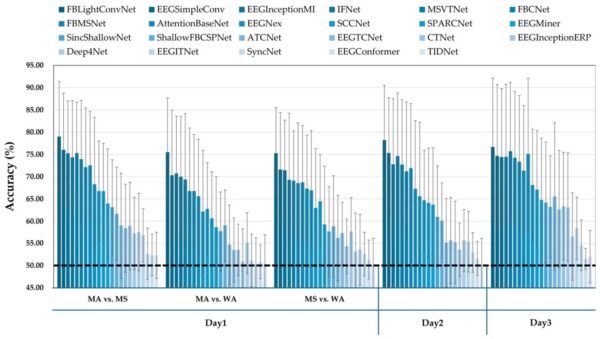
Researchers proposed BELT, a modular Bayesian edge-cloud architecture that combines user-specific adaptation, lightweight classification and compressed data transfer. BELT-lite achieved 87.9% and 80.6% mean accuracy on the BCI Competition IV-2b and IV-2a datasets, respectively, and processed each sample in 6.75 milliseconds on an ARM Cortex-A7—21% faster than EEGNet but about 2.7 percentage points less accurate.

Chinese Academy of Sciences Team Releases BCIJelly Toolchain Unifying 18 BCI Datasets

BCI research has long been slowed by inconsistent data formats, divergent decoder implementations and incompatible deployment toolchains. BCIJelly standardizes 18 BCI datasets into inputs ready for AI training and integrates 15 benchmark decoders and 80 reusable modules. Its automated architecture search generates task-specific decoders without manual design and can extend into a large language model-driven closed-loop mode that supports single-task, multitask and cross-species decoder design; the system also offers interactive visualization software that requires no coding. A single-command pipeline compiles trained decoders onto neuromorphic hardware, cutting power consumption 30- to 50-fold while maintaining decoding performance. The work has been validated in humans, macaques and mice across five paradigms: motor, visual, speech, emotion and auditory. It is a preprint that has not been peer reviewed.

Review Maps How Closed-Loop BCIs May Support Post-Stroke Recovery

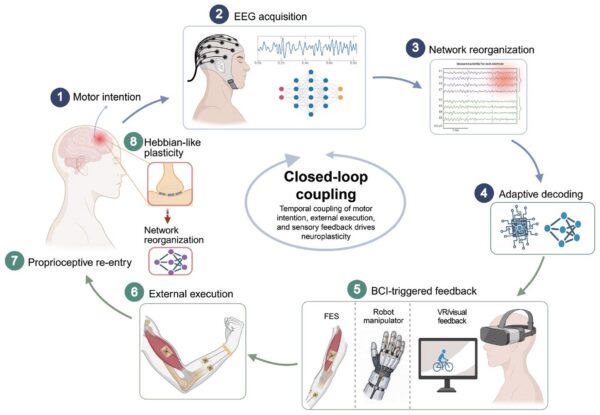
A review in *Frontiers in Neuroscience* describes closed-loop BCIs as systems that detect motor imagery, motor attempts or sensorimotor rhythms and trigger contingent electrical stimulation, robotic assistance, virtual reality, multisensory feedback or neuromodulation. The authors argue that restoring the timing between intent, assisted movement and sensory feedback may promote activity-dependent plasticity, while stressing that outcomes vary with patient selection, signal quality, dose, feedback modality and trial design.

Subject-Specific Frequency Bands Improve Motor-Imagery EEG Decoding

Researchers at United International University in Bangladesh proposed SSLFF, a framework that selects frequency sub-bands for each user, fuses complementary spectral information and extracts time-localized features. The paper reports statistically significant accuracy gains over conventional methods and stable performance across parameter changes, although the abstract does not provide absolute accuracy figures.

Review Proposes 'Brain-Inspired BCIs' for Low-Power, Closed-Loop Neurotech

A review published on August 20, 2026 in npj Biomedical Innovations proposes brain-inspired brain-computer interfaces (BI-BCIs), a framework that unifies neuromorphic computing with BCI design to make neurotechnology lower-power, smaller and capable of closed-loop operation. The authors, from Aarhus University, Stanford University, the University of Southern Denmark, the University of Genoa, Forschungszentrum Jülich and RWTH Aachen University, say the approach could advance neuroprosthetics and neuromodulation for neurological disorders.

Review Identifies Three Shared Bottlenecks Across DBS and BCIs

A mini-review places deep-brain stimulation, brain-computer interfaces and speech neuroprostheses within a shared closed-loop architecture of sensing, decoding, stimulation or output, power, telemetry and chronic validation. It identifies long-term stability, neural coding and equitable access as recurring constraints across all three fields and argues that governance must advance alongside engineering.

Dual-View Network Reaches 67.74% on Handwriting-Imagery EEG

DRDNet separates spatial EEG features into two temporal views, models them with a bidirectional Mamba encoder and a Transformer, and then combines them through dynamic fusion and LSTM aggregation. On a public dataset, it reached 67.74% accuracy for imagined Chinese-character strokes and 62.51% for imagined pinyin vowels, outperforming seven EEG-decoding baselines.

BCI emerges as hotspot in post-stroke motor rehab

Published in Neural Regeneration Research on August 18, 2026, the study conducted a bibliometric analysis of 3173 articles from the Web of Science Core Collection on post-stroke limb motor dysfunction and functional recovery from 2016 to 2025, by authors from Beijing Rehabilitation Hospital, Capital Medical University. The field is in a period of rapid expansion, with technology-assisted rehabilitation as the dominant trend and robot-assisted training and virtual reality as the two major technological keywords. Burst literature analysis revealed three hotspot phases, with the recent phase (2020 to present) covering neuromodulation (brain-computer interface and non-invasive brain stimulation), global disease burden and public health policy. Highly cited studies focus on comparative efficacy, robot-assisted training, brain-computer interfaces, vagus nerve stimulation and prediction of rehabilitation outcomes.

Sixth-Finger BCI Neurofeedback Aids Stroke

Researchers report that a BCI-controlled sixth-finger neurofeedback intervention improved motor function in stroke: after 8 sessions (2 weeks) of motor-imagery BCI training, 14 patients gained an average of 7.9 points on FMA-UE and 7.1 on the Barthel Index, with 9 of 14 reaching the 6.6-point minimally clinically important difference. EEG tracking across the full intervention showed a two-phase ERD trend that strengthened in week one and narrowed to the contralateral sensorimotor area in week two, and resting-state functional connectivity rose afterward, correlating with motor gains. The authors say the work offers longitudinal evidence on neuroplasticity in stroke rehabilitation.

Study reviews invasive and non-invasive BCI use

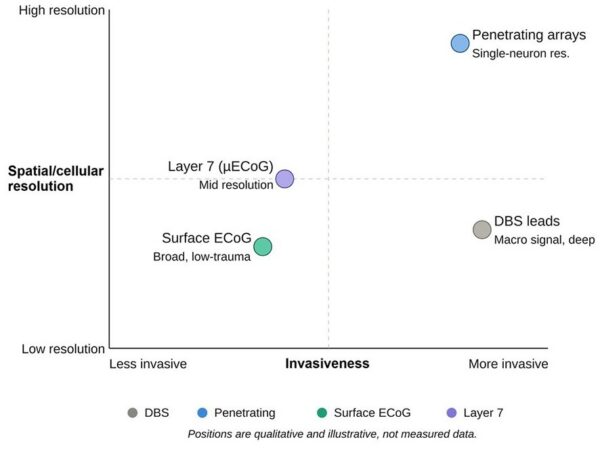
A systematic review of BCI medical applications published on August 17, 2026 in Theoretical and Natural Science covers literature review, comparative case analysis of invasive vs non-invasive techniques, and interdisciplinary assessment. It reports that invasive BCIs reach 80% to 100% task success rates in robotic arm control but are limited by surgical hazards, progressive signal deterioration and costs above $250,000, while non-invasive BCIs are safer and more widely deployed in community neurorehabilitation with about 70% effectiveness for post-stroke upper-limb recovery, yet suffer poor signal-to-noise ratios, a BCI illiteracy rate near 30% and low information transfer speeds. The review also addresses neural data privacy, autonomy paradoxes and inequitable access.

MRieHy Framework for Online MI-BCI Adaptation

Researchers propose MRieHy, a multi-feature Riemannian hypergraph framework for online test-time adaptation of motor imagery BCI decoding. It aligns multi-day distributions via Riemannian means of covariance matrices, builds one hypergraph with Riemannian distance and a second with cosine similarity, fuses them with adaptively learned weights, and decodes buffered online samples after Riemannian alignment. On a private four-class ECoG dataset and two public four-class EEG datasets, MRieHy shows notable gains over state-of-the-art baselines, targeting the cross-day transferability and online operation that clinical MI-BCI still lacks.

Stanford's Palanker Wins Defense Health Agency Award for PRIMA Retinal Implant

Daniel Palanker, a Stanford professor and affiliate of the university's Wu Tsai Neurosciences Institute, has won the U.S. Defense Health Agency's Outstanding Research Accomplishment award for the PRIMA retinal implant, designed to restore central vision after photoreceptor loss. A 2-mm chip sits beneath the retina and is driven by infrared light from augmented-reality glasses, converting that light into current that stimulates the next layer of neurons. A 2025 paper in the New England Journal of Medicine reported that the device let legally blind patients with advanced dry age-related macular degeneration read letters and words, and the award recognizes its potential for military personnel with laser-damaged retinas.

Implantable Motor BCIs Need a Unified Clinical Outcomes Framework

A paper in *Neurorehabilitation and Neural Repair* examines the outcome measures needed as implantable motor BCIs move from safety and feasibility studies toward regulatory approval, reimbursement and sustained clinical use. It calls for valid and reliable assessments that satisfy regulators and payers while reflecting activities that matter to people with severe motor impairment.

Wearable BCI Hits 79.38% Online Decoding Accuracy

The study was published in ITM Web of Conferences on August 14, 2026, addressing the demand for portable, real-time brain-computer interface systems in stroke rehabilitation by completing the physical integration and online experimental validation of a wearable system. The system uses a specialized EEG headset with miniaturized acquisition circuits secured via pogo pins, featuring 10 core recording channels positioned over the sensorimotor cortex. During the evaluation phase, the research team recruited 6 healthy subjects and 2 stroke-affected hemiplegic patients for closed-loop experiments based on motor imagery and motor attempts. Common Spatial Pattern was used for spatial feature extraction and Linear Discriminant Analysis for intention classification, with personalized sub-band optimization applied to further improve recognition. The authors report an average offline recognition rate of 84.91% and a classification accuracy of 79.38% in the more challenging online real-time testing. Analysis of spatiotemporal spectra and R² value distributions validated activation patterns in the sensorimotor areas during motor intention triggering, which the authors present as support for advancing the technology from laboratory settings toward community rehabilitation.

EEG2MOTION: Full-Body Motion From Brain Signals

Researchers debut EEG2MOTION, billed as the first EEG-motion-text dataset for human motion synthesis, with nearly 20,000 paired samples across thousands of motions, plus a generative framework (EMMM) that couples an EEG encoder with a motion decoder to synthesize coherent full-body motions from non-invasive brain activity. Multimodal contrastive learning aligns non-invasive EEG embeddings with text, video and motion representations to decode high-level semantics. The team says it is the first work to generate diverse whole-body motions from non-invasive brain signals.

MIT Microscope Captures Whole-Brain Voltage in Zebrafish 200 Times a Second

MIT engineers have adapted a light-sheet microscope to image the electrical activity of neurons across a zebrafish's entire brain, scanning the whole brain 200 times a second — once every five milliseconds. Calcium imaging, the usual proxy for neural activity, resolves activity only on the order of seconds and cannot capture single spikes, while genetically encoded voltage indicators report membrane potential directly but had previously been limited to small, localized populations. Faster camera acquisition and remote refocusing pushed volumetric imaging to rates that resolve individual neuronal impulses, revealing brain-wide activity patterns evoked by ultraviolet light; the study appears in Nature Methods.

CNN bi-LSTM Hybrid Decodes Motor-Imagery EEG

The preprint was posted to arXiv on August 13, 2026, proposing a hybrid deep-learning architecture that combines a convolutional neural network with a bidirectional long short-term memory network to decode motor-imagery EEG. The author notes that motor-imagery brain-computer interfaces are seen as a promising route to flexible communication between the brain and external devices, particularly for people affected by stroke or neurodegenerative disorders, but that reliable decoding remains difficult because EEG recordings carry substantial noise and relate to underlying brain activity in complex, weakly informative ways. In the proposed architecture, the CNN learns high-level spatial and temporal representations directly from raw MI-EEG recordings, while the bi-LSTM models temporal dependencies among the extracted features. The approach was evaluated on both a publicly available dataset and a privately acquired dataset collected with an EEG acquisition system, with robust performance reported on two- and three-class motor-imagery classification and promising subject-independent decoding across the methods compared. The work is a preprint and has not been peer reviewed.

Endovascular Electrodes Evoke Cortical Responses

The study was published in Journal of neural engineering on August 13, 2026, presenting the first strength-duration characterization of cortical evoked potentials elicited by endovascular stimulation adjacent to the cerebellum. The authors note that electrical stimulation and neural recording underpin neural prostheses for restoring function and treating neurological disorders, but that clinical adoption is limited by the invasiveness of implantation, while the Endovascular Neural Interface offers an alternative by accessing intracranial targets through the cerebral vasculature. A polymer-based stent-electrode array was deployed into the left transverse sinus of an ovine model, and biphasic current pulses targeting the cerebellum were delivered via the stent electrodes while a subdural electrocorticography grid recorded cortical responses. Endovascular stimulation consistently evoked time-locked cortical potentials with early and late components at approximately 40 ms and 100 ms post-stimulation, and impedance monitoring confirmed electrode functionality and stability throughout. Strength-duration analysis revealed rheobase and chronaxie values, providing a quantitative basis for parameter selection and comparison with established intracranial stimulation modalities.

Few-Shot Calibration Raises EEG Emotion Decoding Accuracy to 0.77

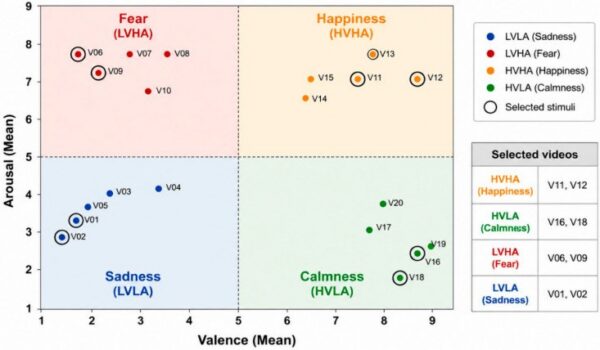
Researchers at Walailak University in Thailand tested EEG-based emotion recognition under auditory stimulation, scoring valence and arousal. Discrete wavelet transform features reached 0.88 accuracy when classifiers were trained and tested on the same subject, but leave-one-subject-out evaluation fell to near chance, exposing how far EEG emotion signatures differ between people. Few-shot adaptation closed part of that gap: with 75% of a new subject's calibration data, functional connectivity features reached 0.77.

SpikeGadgets Hardware Closes the Loop on Rat Hippocampus in Milliseconds

SpikeGadgets says its hardware, using low-latency Ethernet and the TrodesNetwork API, lets researchers detect a neural activity pattern and trigger a perturbation within milliseconds. Two UCSF studies show it in use: one continuously decoded hippocampal population activity in rats to run a neurofeedback system, training the animals to volitionally generate specific memory representations for reward; the other triggered theta-phase-specific optogenetic stimulation in real time and showed that theta rhythm and replay are mechanistically separable.
© 2026 BCIwiki.com Digest Topics Tips Subscribe Revisions About