
中 / EN

BCIwiki — Brain-computer interface news, research and industry database

Latest

July 2026

Ruthenium Oxide Electrode Coating Supports 25 Weeks of Intracortical Stimulation

Researchers evaluated ruthenium-oxide-coated amorphous silicon-carbide microelectrode arrays during 25 weeks of intracortical microstimulation in rodents. Perception thresholds stabilized at about 0.4 nC per phase per electrode by week nine, behavioral performance remained around 91%, and reliable sensation persisted through week 25.
Why it matters The study provides quantitative behavioral and electrochemical evidence for a coating designed to address the long-term durability bottleneck in sensory neuroprostheses.
Multi-User Speech BCI Model Needs Fewer Than 200 Sentences for a New User

UC Davis researchers trained a transformer-based speech decoder across six people with intracortical BCIs. The pooled model cut relative word error rates by more than 50% on average compared with subject-only models and, after fine-tuning on fewer than 200 sentences from an unseen user, achieved a word error rate below 7%. The bioRxiv preprint has not been peer reviewed.
Why it matters Reducing the amount of per-patient calibration data addresses one of the main barriers to scaling speech neuroprostheses and suggests that useful neural structure can transfer across users.

BrainAccess Rebuilds Its Board App Interface and Adds AI Assistant Jena

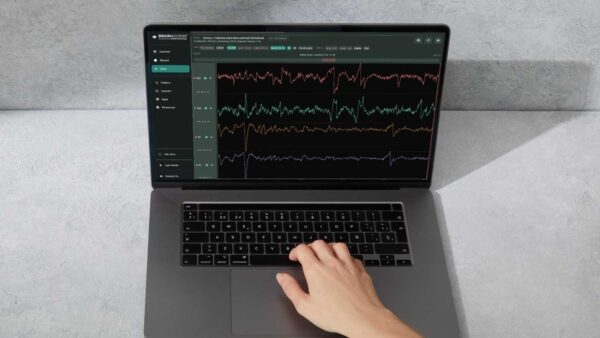
BrainAccess released a major update to its desktop application BrainAccess Board on July 27, 2026, featuring a rebuilt interface, improved functionality and a new AI assistant called Jena that monitors device and signal quality in real time. The company, which supplies EEG devices and software for neuroscience research and clinical use, said the update is aimed at ease of use and data management during EEG acquisition and analysis.
Why it matters Bundling signal-quality checking into an in-app assistant points to where research-grade EEG vendors now compete, which is setup workflow and data handling rather than electrode hardware.

Random Forest Model Hits 92.49% Accuracy in EEG Eye-State Detection

Researchers paired interquartile-range clipping for outlier removal with a random forest classifier on the UCI machine learning repository's EEG-Eye-State dataset, classifying eyes-open versus eyes-closed at 92.49% accuracy with a ROC-AUC of 0.9791. Cross-validation put mean accuracy at 92.86%. The authors present the pipeline as a stable, interpretable option for BCI uses such as drowsiness monitoring and assistive technology.
Why it matters Eye-state detection is a well-worn problem where published numbers are rarely comparable, so a fully specified preprocessing-and-classifier pipeline on a public dataset is valuable as a baseline others can reproduce rather than as a new capability.

Paradromics Implants Connexus BCI in Patient With Motor Neuron Disease

Surgeons in Michigan have implanted Paradromics' Connexus brain-computer interface in a patient with motor neuron disease who had lost most of her ability to speak. Connexus records from individual neurons through 421 microelectrodes seated 1.5 millimeters into the motor cortex; the signals pass to a transceiver in the patient's chest, where AI converts them into text on a screen. Austin, Texas-based Paradromics received FDA approval in the fall of 2025 to begin the clinical trial.
Why it matters The first human implant moves Paradromics out of the preclinical pack and into the small group of companies with intracortical electrodes in a living patient, where its channel-count and speech-decoding claims can finally be tested against clinical data rather than animal work.

Can a BCI boost attention in older adults? UT Austin launches trial

The University of Texas at Austin has registered a study on ClinicalTrials.gov to explore whether an EEG-based brain-computer interface (BCI) decoding the P300 event-related potential in real time, combined with non-invasive interventions such as mindfulness relaxation or transcranial electrical stimulation, can enhance attention and memory neural markers—proxies for cognitive reserve—in healthy older adults and those with mild cognitive impairment (MCI). The trial is recruiting and aims to test whether targeted modulation of attention-related brain activity can support cognitive reserve.
Why it matters This study extends BCI applications from motor decoding to cognitive enhancement, using the P300 as an attention marker and combining mindfulness or transcranial electrical stimulation to test whether cognitive reserve can be strengthened through training. It is an early-stage trial worth following for those interested in non-invasive BCIs for aging and mild cognitive impairment.

Preprint: SSCDL Enhances Neural Decoding Generalization in Brain-Machine Interfaces

A preprint proposes SSCDL, a self-supervised consistency-enhanced disentangled learning framework that decomposes motor signals into velocity, direction, and speed to capture representations invariant to neural drift and significantly enhance cross-day decoding generalization for invasive BMIs. The researchers report state-of-the-art decoding performance with high robustness and cross-day stability across extensive experiments; the work has not yet been peer reviewed.
Why it matters Neural drift is a central barrier to long-term invasive BCI deployment, and a self-supervised framework that disentangles velocity, direction, and speed targets it directly — though, as a preprint, the reported state-of-the-art results still await peer review.

EEG Decodes Picture Categories More Reliably Than Word Categories

UC Irvine researchers tested an EEG category-decoding task in 30 participants viewing pictures and words from five semantic groups. All picture-category pairs were statistically separable, but only one word-category pair was; parietal and left-temporal electrodes contributed more to picture decoding than frontal and right-temporal sites. The bioRxiv preprint has not been peer reviewed.
Why it matters The head-to-head design quantifies how presentation modality limits semantic decoding from EEG and provides a reusable task and analysis pipeline.

BCI Decoder Rankings Change When Accuracy Is Not the Only Metric

University of British Columbia researchers released BEND-BCI, an open benchmark comparing 23 neural decoders across 16 real or synthetic recordings in motor, visual, speech and spatial tasks. Rankings often changed when robustness, computational cost and cross-recording representation consistency were considered alongside held-out accuracy, and simpler baselines sometimes matched or beat much larger deep networks. The bioRxiv preprint has not been peer reviewed.
Why it matters BCI deployment depends on robustness, compute requirements and transfer across recordings as much as headline accuracy, making this multidimensional benchmark a more practical guide to model selection.

ATCNet-CIAM Hits 87.96% on BCI IV-2b in Multi-Session Motor Imagery Decoding

ATCNet-CIAM, a decoder pairing temporal convolution and channel attention with a CIAM module, reached 86.32% accuracy on BCI IV-2a and 87.96% on BCI IV-2b under the standard protocol, its authors report, along with 89.46% and 83.64% on the within-session two-class and three-class WBCIC-MI tasks. Motor imagery EEG is the workhorse signal for non-invasive brain-computer interfaces, but decoding it robustly across sessions and subjects remains the central obstacle. The manuscript was posted to arXiv on July 26, 2026 and has not been peer reviewed; it has been accepted for the International Conference on Intelligence Systems and Robotics for Sustainable Development (ISRSD) 2026.
Why it matters One more entry in a crowded field of BCI Competition IV results, worth logging because it reports multi-session and within-session performance for the same architecture, which is what makes a baseline reusable.

© 2026 BCIwiki.com Digest Topics Tips Subscribe Revisions About