中 / EN

BCIwiki — Brain-computer interface news, research and industry database

Latest

July 2026

Multi-Layer Brain-Mimicking Phantom for Neural Interface Implantation Testing

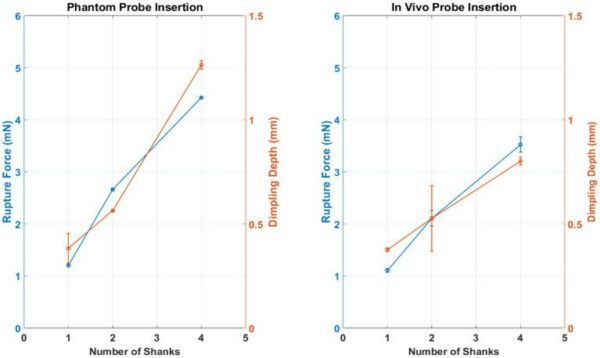
Researchers developed a reproducible multi-layer brain-mimicking phantom that replicates the dimpling and rupture forces of rodent pia mater and dura mater during neural interface implantation, built from a 0.5% agarose skin layer, a 1.01% agarose pia layer and a pre-stretched PVC dura layer assembled in a simple benchtop process. Tested with a cantilever force system on microwires of 12–100 µm diameter (tungsten and stainless steel, various tip geometries) and segmented silicon probes, the phantom produced results within the range of in vivo Sprague-Dawley rat data with significantly lower insertion variability than in vivo testing. The authors say its modular design — layer thickness and stiffness can be tuned for different species or devices — makes it a low-cost early screening platform that can accelerate neural implant development while reducing animal use.
Why it matters A reproducible, tunable benchtop phantom lets developers screen electrode designs cheaply and with less animal use before committing to in vivo work, which could shorten the iteration cycle that currently slows neural implant development.

New Platform Maps Long-Term Brain Connectivity

University of Washington Seattle researchers combine optogenetic stimulation with micro-ECoG in a semi-chronic implant, enabling stable causal connectivity measurement in macaques over weeks to years.
Why it matters The platform enables years-long stable tracking of causal connectivity in the primate brain, offering researchers a durable experimental tool for probing circuit dynamics relevant to motor and cognitive function and informing chronic neural implant design

Theory Explains Optimal Neural Decoding Timescale

UC Riverside researchers propose a theoretical framework explaining why mesoscale temporal integration is often optimal for information representation in neural decoding.
Why it matters The study offers the first theoretical explanation for why mesoscale temporal integration is often optimal in neural decoding, giving BCI decoding algorithm designers a derivable, testable basis for choosing binning and smoothing parameters

32-Channel Event-Based Analog Front End Compresses Neural Signals Adaptively

Researchers have built a 32-channel event-based analog front-end chip in 180 nm CMOS that encodes biosignals in two modes, pulse frequency modulation and adaptive asynchronous delta modulation. The chip retunes its output data rate in real time to the envelope of the incoming signal, giving high compression and, the authors argue, a route to wireless transmission and online processing of neural signals in brain-computer interfaces.
Why it matters Radio bandwidth and power, not electrode count, are what cap channel counts in wireless neural implants, so a front end that discards quiet samples before they reach the transmitter is attacking the harder half of the scaling problem.

Federated Graph Framework Fuses EEG and EMG to Decode Motor Intent

A team writing in Computing and Informatics has proposed FSDFGL, a federated graph learning framework that folds EMG into EEG when the graph is built and then shares only structural information between clients, avoiding the accuracy loss that comes with exchanging heterogeneous features. The design targets three problems in hybrid BCI work at once: the low spatial resolution of EEG, datasets that are small and privacy-sensitive, and the uneven data distributions federated learning has to cope with. Experiments on the TAN dataset show an advantage in identifying complex motor intentions.
Why it matters Sharing graph structure instead of features is the move worth noting: it would let hospitals pool hybrid EEG-EMG models without moving patient signals, which is the practical obstacle to assembling BCI datasets large enough to matter.

Preprint: Event-Based Neural Decoding for Neuroprosthetic Motor Control

A preprint proposes an event-based neural decoding method for neuroprosthetic motor control, arguing that deep-network-driven prostheses are limited by high latency, energy use and space — wired links restrict mobility and wireless links restrict information throughput, while spiking networks trade off task performance for low-power inference. The authors' event-based gated recurrent unit generates a sparse communication pattern with graded spikes, outperforming classical spiking neural networks on task performance, and pairs with efficient training and sparse inference to enable on-device neural decoding under latency, energy and space constraints. The study has not been peer reviewed.
Why it matters The proposal sits at a real deployment pain point: closing the gap between spiking networks' energy efficiency and deep models' accuracy would make power- and space-constrained neuroprosthetic control practical on-device rather than tethered.

University Hospital, Grenoble Registers Chronic BCI Study for Speech Rehabilitation in Locked-In Syndrome

Grenoble University Hospital has registered a clinical study (NCT07698496) assessing the feasibility and effectiveness of a chronic brain-computer interface for speech rehabilitation in people with locked-in syndrome (LIS), where non-invasive communication carries high cognitive load and existing invasive speech BCIs still rely on percutaneous connectors with infection risk. Using an intracranial epidural BCI paired with a speech synthesizer, the SpeechBCI protocol will test two complementary approaches in the same subject — a speech BCI (primary objective, the BCI_PAROLE device) and a cursor BCI (secondary), both running on the WIMAGINE intracranial epidural system. The trial is in the registration stage and has no clinical results yet.
Why it matters The registration matters because it targets a documented gap — a fully implantable, wireless, real-time speech BCI suitable for long-term home use — and its NCT07698496 identifier makes the study trackable as the field shifts from percutaneous, hospital-bound speech implants toward home-deployable systems.

Preprint: Learning Residual Kinematic Corrections for Continuous Neural Decoding via Reinforcement Learning

A preprint proposes a two-stage CNN-LSTM-RL framework that uses reinforcement learning to apply residual kinematic corrections to the output of a CNN-LSTM continuous motor imagery decoder. The RL agent is trained offline, without direct EEG input, to optimize motion accuracy against a target trajectory. Compared with CNN-LSTM alone, CNN-LSTM-RL lifted the 2D mean correlation from 0.5076 to 0.7181 and the VR-scene correlation from 0.6420 to 0.7780, cutting RMSE by 40.2% and 38.2% respectively. The authors say correcting kinematic error through offline residual RL strengthens 3D BCI motor imagery decoding without additional neural data; the study has not been peer reviewed.
Why it matters The notable trick is that the correction layer learns offline without consuming extra neural data, so it retrofits an accuracy jump onto existing decoders — a cheap, data-efficient way to sharpen continuous decoding for rehabilitation, prosthetics and virtual interaction.

China Integrates BCI in Rehabilitation Device Innovation

Chinese authorities recently issued a three-year action plan for the rehabilitation assistive-device industry that integrates brain-computer interface (BCI), artificial intelligence and flexible electronics with rehabilitation device development, and pursues medical-engineering collaboration to drive technical breakthroughs in materials and components.
Why it matters By naming brain-computer interface a key common enabling technology for expanding and upgrading the rehabilitation assistive-device industry, the policy marks BCI's formal entry into China's national rehabilitation-industry strategy.

China Prioritizes BCI Research in Health Plan

The State Council's National Health 15th Five-Year Plan (2026–2030) explicitly lists brain-computer interface (BCI) as a priority direction for basic research in the health sector, positioning it as a key technological breakthrough for major national science and technology projects in medical devices and biomedicine.
Why it matters By naming brain-computer interface a priority health-sector research direction in the National Health 15th Five-Year Plan, the State Council formally brings BCI into China's national science and technology strategy.

© 2026 BCIwiki.com Digest Topics Tips Subscribe Revisions About