
中 / EN

BCIwiki — Brain-computer interface news, research and industry database

Latest

July 2026

Diffusion Latents Boost Neural Speech Decoding

University of Toronto researchers use diffusion latent representations as an intermediate layer for neural speech decoding, with word error rate varying sharply by timestep.
Why it matters The study reframes neural decoding as a representation-learning problem and systematically compares decoding performance across diffusion timesteps, giving BCI speech-decoding researchers a quantified basis for choosing intermediate representations

ECoG Network Features Predict Seizure Risk

Nova Southeastern University researchers combine intracranial ECoG network features with a support vector machine and Bayesian updating for real-time continuous seizure risk forecasting.
Why it matters The study proposes a lightweight, interpretable real-time seizure risk forecasting method based on intracranial EEG network features, offering a potential algorithmic approach for the seizure-warning function of closed-loop neuromodulation devices

Guangzhou Workshop to Demonstrate EEG-Driven Closed-Loop TMS in July

Clinicians and researchers in Guangzhou, southern China, will get hands-on time with closed-loop systems that trigger transcranial magnetic stimulation from real-time EEG analysis at a workshop on July 17, 2026. Shenzhen Yingchi Technology, one of the supporting companies, will bring EEG-driven closed-loop TMS devices and near-infrared brain function imaging equipment. The session is organized by the Professional Committee on Brain Function Detection and Regulation Rehabilitation of the Chinese Association of Rehabilitation Medicine, alongside the committee's 2026 annual conference and the 8th Brain Function Detection and Regulation Rehabilitation Forum.
Why it matters Closed-loop EEG-to-TMS has so far been mostly a research configuration, and a national rehabilitation society staging hands-on training with vendor hardware on the table marks the point at which it starts competing for routine clinical use.

Lower-Limb Motor Imagery Shows Lateralized EEG

An EEG study finds that unilateral lower-limb motor imagery and motor execution elicit similar lateralized neural activity patterns, extending a lateralization pattern long known in the upper limb to the lower limb.
Why it matters Among the first to systematically confirm a shared lateralized neural basis between lower-limb motor imagery and execution, the study fills a gap left by lateralization research focused on the upper limb, and its event-related potential and functional-connectivity findings offer guidance for feature selection in lower-limb motor-imagery BCIs.

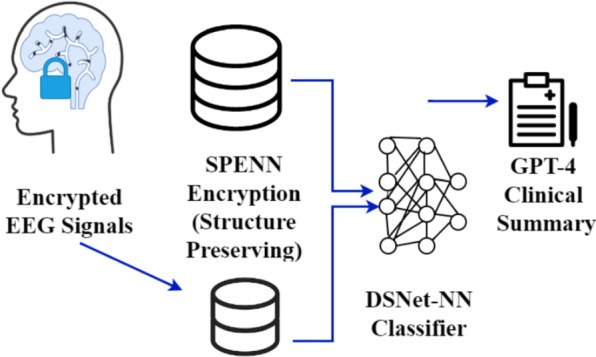
A Novel Deep Learning Approach for Privacy-Preserving Encoded EEG-Based BCIs with Clinical LLM Applications

The study presents DSNet, a deep denoising structure-preserving neural encoding network that classifies privacy-preserving encoded EEG without decryption. Common spatial pattern (CSP) features are converted to irreversible neural codes — an irreversible neural transformation designed for privacy rather than a formal cryptographic guarantee — and two deep-learning architectures (a feedforward network and a recurrent RNN) classify in the encoded feature space. On public datasets, DSNet-NN exceeded 87% accuracy for every subject, outperforming the RNN variant and baselines while staying resilient to simulated privacy attacks; the study also integrated GPT-4 to generate clinical-style summaries from model outputs.
Why it matters Classifying on irreversible, privacy-preserving EEG codes without decryption — while still topping 87% per subject — attacks the privacy-versus-utility trade-off that has kept raw neural data out of clinical pipelines.

Passive BCI Decodes VR Intent With Eye Gaze

Researchers combined electroencephalography (EEG)-based passive brain-computer interface (BCI) with eye tracking to decode users' interaction intent in real time during dynamic VR gameplay, reaching 69.64% accuracy in the online closed-loop phase.
Why it matters Most VR interaction still depends on explicit controller input; this is the first real-time demonstration of EEG-based passive BCI combined with eye tracking decoding interaction intent during dynamic VR gameplay, with online closed-loop accuracy well above chance — a step toward more natural immersive human-computer interaction.

BIOSerenity Trains EEG Models on Jean Zay, Finds Scaling Diverges From Language AI

French neurotech company BIOSerenity ran three months of large-scale EEG AI training experiments on Jean Zay, France's most powerful supercomputer for research, including a 300-million-parameter model trained on 110,000 hours of EEG data across 64 GPUs. It also fully trained two model families, Mercury and Neptune, in three sizes each, from about 13 million to 100 million parameters and on about 5,000 to 40,000 hours of data. Neptune improved as it scaled up while Mercury did the opposite, its smallest version performing best, a sign that brain-signal AI does not scale the way language models do; the results have not been peer-reviewed.
Why it matters A rare public scaling study on EEG, and the result cuts against the default assumption that foundation-model recipes carry over to brain signals, since architecture rather than data volume decided the outcome here.

Nuclear Electromagnetic Pulse Inhibits Rat Primary Motor Cortex LFP Bands

A study examining the potential brain risk of BCI electrodes exposed to strong electromagnetic fields applied nuclear electromagnetic pulse (NEMP) irradiation to rats with implanted brain electrodes and recorded local field potentials (LFPs) in the primary motor cortex (M1). At 200 kV/m, NEMP inhibited the alpha and delta LFP bands in resting rats, an effect linked to front-gate coupling between the pulse and the electrode, with the coupled current stimulating the brain and affecting its state of consciousness; the authors frame the work as early animal data for BCI electromagnetic protection.
Why it matters Electromagnetic safety is an under-studied risk for implanted BCIs in high-field environments, and this early animal data on how NEMP affects cortical activity gives the field its first reference point for electromagnetic protection.

Implanted Neural Interfaces Track Glioma Progression in Mice

Researchers at Coherence Neuro Global, Inc. and other institutions have used implanted neural interfaces to track glioma growth in freely behaving mice over time. Across several mouse strains and glioma models, tumor progression went with elevated gamma-band activity in the tumor microenvironment, and machine learning models read tumor burden off the chronic recordings, with gamma trajectories predicting individual growth rates. The work was posted to bioRxiv on July 9, 2026, and has not been peer reviewed.
Why it matters This inverts the usual purpose of an implanted array, using it as an in-body oncology sensor rather than a movement decoder, and a continuously measurable growth signal is something neither imaging cadence nor biopsy can supply, provided the gamma correlation holds outside mouse models.

Preprint: Facial Movements in Rodents Predict Cortical Activity and BCI Performance

Harvard Medical School researchers report that spectral analysis of facial movements in rodents predicts both cortical activity and performance on brain-machine interface tasks, a possible biological basis for better neural prosthetic control. The work is a preprint and has not been peer reviewed.
Why it matters A methods flag for decoder benchmarking: if facial movement spectra alone track cortical activity and task performance, some of what BCI decoders are credited with reading may be behavior rather than intent — though the evidence is rodent-only and not yet peer reviewed.

© 2026 BCIwiki.com Digest Topics Tips Subscribe Revisions About