/ EN

China

188 entries
June 2026

OYMotion and MicroPort NeuroScientific Partner on Endovascular BCI Rehab System

OYMotion and MicroPort NeuroScientific signed a strategic cooperation agreement on May 28, 2026 to jointly develop an interventional brain-computer interface rehabilitation system. The first product will be a multi-channel endovascular BCI that threads a signal-recording stent through the blood vessels to a target brain region, capturing intracranial electrical activity without opening the skull. MicroPort NeuroScientific will build the BCI system as a whole and OYMotion the limb side, with the pair targeting medical rehabilitation and human-machine interaction.

Anhui Splits BCI Work Across Three Cities

The General Office of China's Anhui Provincial People's Government issued the Action Plan for Accelerating Brain-Computer Interface Technology and Industry Development in Anhui (2026-2030) on June 15, 2026, document number Wan Zheng Ban Mi [2026] No. 24. Its spatial layout assigns Hefei the role of innovation origination and talent attraction, Bengbu the fabrication and validation of key components on the strength of its smart sensor industry plus a new Longhu Laboratory, and Wuhu clinical translation through a national regional medical centre and a brain science institute at Wannan Medical College. The first main task backs the University of Science and Technology of China in leading a research institute with Chinese Academy of Sciences partners. Targets fall in 2028 rather than 2027, covering at least ten application scenarios, three approved invasive clinical trials, five systems and three backbone firms.

NeuroXess Says Two Paralyzed Patients Played Brain-Controlled Chess 800 km Apart

NeuroXess said two people with high-level paralysis played chess against each other across about 800 kilometers, between Shanghai and Nanchang in eastern China, using its "Triple-Full" (三全) brain-computer interface: one selected and placed pieces on a virtual board by thought, with the commands relayed in real time to a robot stand-in that moved the pieces at the other end, where the second participant gripped physical pieces through a brain-controlled exoskeleton glove. The company said the first participant was implanted at Huashan Hospital, Fudan University, in October 2025, moved a cursor by thought on the fifth day after surgery and reached 5.2 bits per second after 17 days of training, while the second was implanted at the First Affiliated Hospital of Nanchang University in December 2025 and was eating, drinking and writing with a brain-controlled exoskeleton one month after surgery. The outcomes come from the vendor's own account and have not been validated in peer-reviewed publication.

China's Neuracle Files for Shanghai IPO, Seeking RMB 2.5 Billion

The Shanghai Stock Exchange accepted an IPO application from Neuracle, which is seeking RMB 2.5 billion for BCI product development, industrialization and working capital. The filing shows an established non-invasive neurophysiology equipment business alongside invasive products that still require clinical, regulatory and commercialization spending. Acceptance starts the review process and is not approval to list.

Northwestern Polytechnical University Registers BCI Stroke Rehabilitation Trial With 4 Arms

A newly registered trial tests a brain-computer interface in post-stroke rehabilitation across 4 parallel arms: full cross-domain (emotion-cognition-motor) adaptive training, integrated cognitive and motor task training, single-dimension motor training, and conventional rehabilitation. Each arm plans 22 participants, 88 in total. It enrolls patients aged 30 to 80 with a first cerebral infarction or hemorrhage 3 months to 1 year earlier, unilateral hemiplegia, and upper-limb Brunnstrom stage II to IV. The primary outcome is a motor function score; secondary outcomes include EEG motor imagery event-related synchronization/desynchronization, prefrontal theta/alpha power ratio, and EEG-fNIRS coupling.

Suzhou Hospital Registers Closed-Loop BCI Trial Using fNIRS and rTMS for Female Overactive Bladder

Women with overactive bladder often rely on drugs and behavioral training, with limited relief. A newly registered trial at The First Affiliated Hospital of Soochow University takes a different route: patients perform a task while functional near-infrared spectroscopy reads prefrontal brain activity, and an algorithm decides when to deliver transcranial magnetic stimulation, closing the loop. The interventional, parallel-design trial plans to enroll 66 women aged 18 to 75, 33 in the experimental arm and 33 in a control arm that receives open-loop sham stimulation, with the overactive bladder symptom score as the primary endpoint. No device model or results are disclosed in the registration, and recruitment has not yet started.
May 2026

Tianjin Plans 10bn Yuan BCI Fund Cluster

The General Office of China's Tianjin Municipal People's Government issued the Action Plan for Promoting Innovative Development of Brain-Computer Interfaces in Tianjin (2026-2030), document number Jin Zheng Ban Fa [2026] No. 8, dated May 26, 2026 and released on May 28. All product targets sit on the non-invasive track, while invasive systems are covered only by milestones for entering registration trials and winning market approval. By 2027 Tianjin wants two to three national-level innovation platforms, more than five non-invasive products in clinical use, more than ten new products across elderly care, education, entertainment, smart living and advanced manufacturing, 50 innovative firms, one to two national standards, and three to five industry funds. By 2030 it targets more than ten non-invasive products in large-scale clinical use, market approval for invasive products, and a fund cluster exceeding 10 billion yuan.

ChiCTR Registers Trial of Motor Imagery BCI for Lower-Limb Stroke Rehab

The Chinese Clinical Trial Registry (ChiCTR) has logged a study of how brain-computer interface training built on a motor imagery paradigm affects lower-limb motor function in stroke patients. Registered on May 28, 2026 as ChiCTR2600125562, the trial is recruiting; design, sample size and sponsor are absent from the record carried by the WHO International Clinical Trials Registry Platform (ICTRP) and must be read from the original ChiCTR entry.

Shanghai Trial to Test BCI-Driven Lower Limb Exoskeleton in 60 Stroke Patients

The randomized controlled trial plans to enroll 60 patients with lower limb motor impairment after stroke, with the intervention group receiving BCI-assisted exoskeleton rehabilitation training and the control group conventional walking training. Primary outcomes include lower limb surface electromyography, lower limb motor function, the Modified Barthel Index, a balance scale and functional ambulation, testing whether a BCI-driven exoskeleton adds functional benefit over conventional gait training. Punan Hospital, Pudong New Area, Shanghai is the sponsor, with first enrolment set for May 30, 2026. The trial is registered with the Chinese Clinical Trial Registry (ChiCTR) under number ChiCTR2600125531, with a registration date of May 28, 2026, and recruitment has not yet started.

Xuanwu Hospital Registers BCI Rehabilitation Trial Enrolling 58 Stroke Patients

The randomized controlled trial plans to enroll 58 patients with upper limb motor dysfunction after stroke. The test group will receive feedback-based rehabilitation training through brain-computer interface interaction, while the control group will undergo traditional upper limb circular motion training. The primary outcome is the Fugl-Meyer Motor Assessment-Upper Extremity (FMA-UE), with secondary outcomes covering motor function, daily living activities, quality of life and neurophysiological measures including EEG, transcranial magnetic stimulation and fNIRS. The trial was prospectively registered, with first enrolment set for June 1, 2026, and recruitment has not yet started.

Jiangxi Sets 10-Day Clock on BCI Ethics Review

The Jiangxi Provincial Health Commission in eastern China issued Guidelines for Ethics Review of Brain-Computer Interface Clinical Research Projects on May 26, 2026, document number Gan Wei Ke Jiao Fa [2026] No. 8, providing implementing detail for the mutual recognition mechanism proposed in the province's November 2025 BCI measures. For multicentre projects the lead institution's ethics committee conducts the first full review; participating institutions should finish within 10 working days of receiving complete materials and examine only local research conditions, staff qualifications and the informed-consent process; and the lead institution must file with the provincial medical ethics expert committee within 10 working days. Invasive projects treating neurological or psychiatric disease need provincial committee review within 20 working days, with an opinion issued within a further seven.

Xuanwu Hospital Registers Trial Combining Non-invasive BCI, Spinal Cord Stimulation and Exoskeleton for Spinal Cord Injury

Can a non-invasive brain-computer interface read motor intention and, combined with spinal cord stimulation and exoskeleton training, improve function after spinal cord injury? Xuanwu Hospital, Capital Medical University has registered a single-arm exploratory trial that plans to enroll 10 patients aged 18 to 65 with spinal cord injury. The intervention combines all three into one rehabilitation regimen. The primary outcome is the overall clinical efficacy rate 6 months after surgery; secondary outcomes include improvement in the Visual Analogue Scale for pain and the incidence of adverse events related to the trial devices.

Xi'an Jiaotong University Second Hospital Registers BCI Lower-Limb Stroke Trial for 222 Patients

The multicenter randomized controlled trial plans to enroll 222 patients who are 1 to 3 months past their first stroke and have motor impairment in the affected lower limb. The experimental group will receive 4 weeks of motor imagery-based BCI-driven active and passive lower limb training, while the control group gets 4 weeks of conventional training. The primary outcome is the Fugl-Meyer Assessment Lower Extremity Section, with balance, daily living ability and walking classification as secondary outcomes. First enrolment is set for May 31, 2026.

Xi'an Jiaotong University Second Hospital Registers BCI Ankle Rehabilitation Trial in 120 Stroke Patients

The multicenter randomized controlled trial pits closed-loop BCI ankle training against conventional active and passive ankle training in subacute stroke patients who are 4 to 12 weeks past onset and have less than 10 degrees of active ankle dorsiflexion. Primary endpoints are active ankle dorsiflexion range of motion and Manual Muscle Testing of the ankle; secondary endpoints include Functional Ambulation Classification, the Berg Balance Scale and the Fugl-Meyer Motor Assessment of the Lower Limb. The trial plans to enroll 120 patients, 60 per arm, with first enrolment set for May 31, 2026.

Enhancing Brain Signal Generation Through a Hybrid Approach Integrating Reinforcement Learning and Diffusion Models

The study introduces RLED, a reinforcement learning-enhanced EEG diffusion framework for adaptive data augmentation in endogenous EEG tasks such as motor imagery and emotion recognition. Reinforcement learning dynamically regulates the diffusion training process to balance temporal, spectral and category-related features. Across four datasets, the high-quality synthetic EEG signals it generated consistently improved classification performance.

China Registers Trial of Multimodal BCI for Early Alzheimer's Screening

A Chinese team has registered a clinical trial of a multimodal brain-computer interface system for intelligent diagnosis and treatment, aimed at early screening and non-invasive modulation of Alzheimer's disease. The entry, ChiCTR2600125240, was filed with the Chinese Clinical Trial Registry on May 22, 2026 and is carried by the WHO International Clinical Trials Registry Platform; recruitment has not begun.

Xi'an Jiaotong University First Affiliated Hospital Registers Multicenter Trial of SSVEP-BCI-Driven Stimulation for Post-Stroke Dysphagia

The trial tests whether a steady-state visual evoked potential (SSVEP) brain-computer interface can drive functional electrical stimulation of swallowing muscles more effectively than conventional neuromuscular electrical stimulation. It plans to enroll 90 patients, 45 per arm, all within 6 months of a first ischemic or hemorrhagic stroke and aged 18 to 80. The primary outcome is the Standard Swallowing Assessment, with secondary measures including the Functional Oral Intake Scale and the Penetration-Aspiration Scale. First enrollment is listed for June 1, 2026.

Shanghai Ninth People's Hospital Registers BCI Trial in Burning Mouth Syndrome, Plans 38 Participants

Burning mouth syndrome produces months or years of burning oral pain with no visible lesion on examination, and treatment options are limited, leaving patients shuttling between oral medicine and psychiatry. A randomized, sham-controlled interventional trial registered by Shanghai Ninth People's Hospital, Shanghai JiaoTong University School of Medicine, will apply transcranial direct current stimulation over the left dorsolateral prefrontal cortex while collecting resting-state brain function and structural imaging, tracking pain, anxiety, depression, sleep and salivary flow. The trial is funded by the hospital's Brain-Computer Interface Special Research Program and registered as ChiCTR2600124987 on May 20, 2026. It plans to enroll 38 participants, 19 in the active group and 19 in the sham group, with first enrollment set for June 1, 2026; recruitment has not yet started.

sEEG Study Finds Motor Imagery Activity Shifts by Task Stage and Frequency Band

Intracranial recordings from ten epilepsy patients show that neural activity during cued limb motor imagery changes with the phase of the task: low-frequency (8-30 Hz) activity was mostly suppressed during preparation and switched to activation once imagery began, while high-frequency (60-115 Hz) responses were stronger, more widely distributed, and at some contacts followed an activation-then-suppression sequence. The stereoelectroencephalography (sEEG) data indicate that responses are not uniform but shift with task stage and brain region, which the authors tie to stage-aware feature design for BCIs and to neurorehabilitation.

Chinese Trial Pairs Tactile-Feedback BCI With Motor Imagery for Stroke Arm Recovery

A trial combining tactile-feedback brain-computer interface training with motor imagery for upper-limb rehabilitation after stroke is recruiting in China. Registered with the Chinese Clinical Trial Registry as ChiCTR2600124911 on May 19, 2026 and carried by the WHO International Clinical Trials Registry Platform, the trial record is available through the WHO International Clinical Trials Registry Platform.

Trial Pairs iTBS With Motor Imagery BCI Training for Post-Stroke Arm Impairment

Guangdong Provincial Hospital of Traditional Chinese Medicine has registered a parallel-design interventional trial, ChiCTR2600124411, that plans to enroll 81 patients with unilateral upper-limb impairment after stroke in three groups of 27. Two groups receive intermittent theta-burst stimulation (iTBS) over the dorsolateral prefrontal cortex or the primary motor cortex, and one receives sham stimulation; all three undergo motor imagery BCI training. Primary outcomes are BCI decoding accuracy, the Fugl-Meyer Assessment and brain network topology. The trial was registered on May 12, 2026 and is not yet recruiting.

Binzhou Medical University Hospital Registers BCI Plus Electrical Stimulation Trial in Parkinson's Disease

The trial plans to enroll 40 patients with Parkinson's disease aged 40 to 80, randomized into 2 groups: one adds brain-computer interface rehabilitation training to functional electrical stimulation, the other receives functional electrical stimulation alone. Both arms train 20 minutes per day for the upper extremities and 20 minutes per day for the lower extremities, completing 12 treatment days within 2 weeks. The primary endpoint is a motor symptom rating scale, with diffusion tensor imaging, magnetic resonance spectroscopy, resting-state fMRI, and sleep, cognitive and mood scales as secondary endpoints, testing whether adding BCI training produces measurable change beyond motor symptoms.

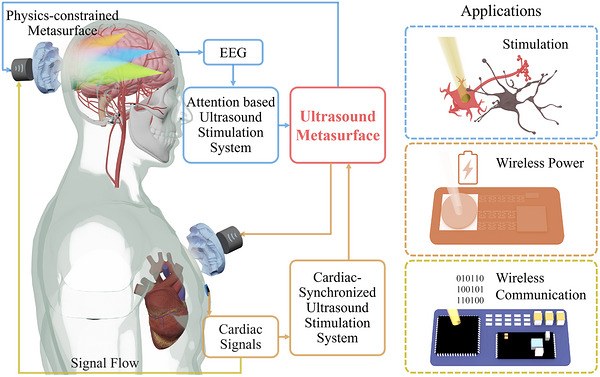
Integrated Ultrasonic Platform for Bioelectronic Control Through Biological Barriers Based on Metasurface

The study presents an integrated ultrasonic platform that delivers high-resolution, multi-point ultrasound energy through highly aberrating barriers such as the skull and ribs, with about ±6.5% intensity uniformity across foci, using a physics-constrained metasurface design framework, and demonstrates two adaptive stimulation paradigms — attention-gated and cardiac-synchronized stimulation. A dual-channel acoustic link sustains continuous transcranial wireless power and data streaming through a single ultrasonic metasurface, remaining robust even under a 400-fold power difference. The authors frame the platform as groundwork for next-generation ultrasound-based brain-computer interfaces (uBMI) and closed-loop bioelectronic therapies.

Xuzhou Rehabilitation Hospital Completes Stroke BCI Trial With Modified Constraint Therapy

A trial at Xuzhou Rehabilitation Hospital Affiliated to Xuzhou Medical University paired a motor imagery brain-computer interface with modified constraint-induced movement therapy to restore upper-limb function after stroke. The hospital is a rehabilitation specialty facility affiliated with Xuzhou Medical University, and the combined approach is meant to test whether a BCI adds benefit on top of established rehabilitation training. It planned 40 participants, 20 in the combined group and 20 in the control group, with the first patient enrolled on December 24, 2025; the registry now lists the study as completed. The primary endpoint is the Fugl-Meyer Assessment for Upper Extremity, with the Wolf Motor Function Test and modified Barthel Index as secondary measures. Funding comes from the New Round of Xuzhou "Pengcheng Talent Program" — High-level Healthcare Talent Recruitment and Development Project, project number 2025TD14. No results are posted, so whether the combined approach beats constraint therapy alone remains unknown.

ChiCTR Registers Trial of BCI Plus tDCS in Disorders of Consciousness

A trial testing a brain-computer interface (BCI) combined with transcranial direct current stimulation (tDCS) in patients with disorders of consciousness was registered with the Chinese Clinical Trial Registry (ChiCTR) on May 7, 2026 under the number ChiCTR2600124127, and is now recruiting. The design, sample size and sponsor are not given in the record and would have to be checked against the original registration.
April 2026

Bengbu Medical University Hospital Registers Multicenter Trial of MRI-Guided Temporal Interference Stimulation for Refractory Migraine

A randomized, sham-controlled trial will pair a non-invasive brain-computer interface with MRI-guided multichannel temporal interference stimulation in patients whose migraines resist medication. It plans to enroll 78 people aged 18 to 65, split evenly between real and sham stimulation, with headache frequency as the primary endpoint. The registration lists only design and bibliographic fields, so device details and actual enrollment remain unknown and efficacy has yet to be read out.
© 2026 BCIwiki.com Digest Topics Tips Subscribe Revisions About