/ EN

China

188 entries
July 2026

Nanjing Builds Full BCI Industry Chain

Nanjing has built end-to-end competitiveness across the brain-computer interface industry chain, People's Daily Online reported on July 28, 2026. According to the report, the city earlier issued an action plan to become a national hub for BCI industry innovation and has set up a 3+3+3 BCI industry innovation system, drawing on universities including Southeast University and Nanjing University of Aeronautics and Astronautics to build 3 provincial- and ministerial-level key laboratories, and landing three core platforms covering neural signal coding and decoding, dedicated chips and brain imaging. The 2026 national BCI conference was also held in Nanjing. The report summed up the city's strengths as research, medical resources, application scenarios and capital ecosystem.


Preprint: UnSPC Cyclic Adaptation-Generalization Framework for Long-Term BMIs

A preprint proposes UnSPC (uncertainty-guided self-paced cyclic learning), a framework that integrates domain adaptation (DA) and domain generalization (DG) in an iterative cycle to address neural drift in long-term invasive brain-machine interfaces, where drift erodes decoding performance and forces frequent recalibration and where existing methods rely on DA or DG alone. Under an uncertainty-guided, self-paced pseudo-labeling scheme with a noise-robust ranking strategy, UnSPC iteratively mines reliable pseudo-labeled samples and, through cyclic adaptation and generalization, gradually mitigates both global and sub-domain drift. Experiments on multiple neural decoding datasets validated its effectiveness and robustness; the authors say it is the first method to integrate DA and DG through a pseudo-label loop. The study has not been peer reviewed.

NeuroXess 'Sanquan' BCI Enters CMDE Innovative Medical Device Review Program

NeuroXess announced that its self-developed implantable brain-computer interface system for hand motor function compensation — the 'fully implanted, fully wireless, fully functional' ('Sanquan') system — has passed public notice and formally entered the innovative medical device special review program of the National Medical Products Administration's Center for Medical Device Evaluation (CMDE), commonly known as the green channel. The company describes it as the first subdural implantable flexible BCI product in China to enter the program. The system began a GCP registration clinical trial at Huashan Hospital, Fudan University on July 7, 2026, run as a multicentre study across 15 Class III hospitals nationwide, with trial data intended to support a Class III medical device registration application with the NMPA. The system remains in the review and clinical-trial stage and has not yet been approved for market; the registration timeline reflects company statements and remains subject to regulatory notice.

Preprint: SSCDL Enhances Neural Decoding Generalization in Brain-Machine Interfaces

A preprint proposes SSCDL, a self-supervised consistency-enhanced disentangled learning framework that decomposes motor signals into velocity, direction, and speed to capture representations invariant to neural drift and significantly enhance cross-day decoding generalization for invasive BMIs. The researchers report state-of-the-art decoding performance with high robustness and cross-day stability across extensive experiments; the work has not yet been peer reviewed.

Preprint: Position-Adaptive Time Scheduling for EEG Generation

A preprint proposes an adaptive EEG generation framework based on conditional flow matching to ease data scarcity in brain-computer interfaces and support large-scale neural modeling. Noting that existing flow methods assume one global time course across all channels and time segments, the framework adds position-adaptive time scheduling that tracks per-position reconstruction error to modulate each position's time course, plus decomposed spatiotemporal attention and a frequency-aligned multi-resolution spectral consistency loss to model cross-channel dependencies and compensate for EEG's power-law spectral bias. Across three EEG datasets with different acquisition protocols and task semantics, it consistently beat the strongest baselines, cutting TS-FID by up to 62.2% and lifting downstream classification accuracy by up to 6.77 percentage points. The study has not been peer reviewed.

NeuroXess Registers Fully Implanted Wireless Functional BCI Study for Upper-Limb Functional Replacement

NeuroXess registered a prospective, multicenter, single-arm trial (NCT07720882) enrolling people with tetraplegia caused by spinal cord injury to evaluate the safety and clinical efficacy of an implantable BCI system for compensatory hand movement and upper-limb functional replacement. The study is at the registration stage with no results yet.

Adding EMG to Hybrid BCI Expands Command Space from 15 to 60 Targets

Researchers have paired steady-state motion visual evoked potentials (SSMVEP) with electromyography (EMG) in a hybrid brain-computer interface, using a parallel architecture to expand the command space from 15 targets to 60. The multimodal setup reached an information transfer rate of 62.33 bits/min, against 42.49 bits/min for the best single-modality condition. Deep-learning decoding of the two signal streams held classification accuracy steady while lowering the effort required of users with severe motor impairment.

Ghost-LENet Tops 80% on Motor Imagery EEG Using a Few Thousand Parameters

Researchers have built Ghost-LENet, a lightweight convolutional network that classifies motor imagery EEG at 82.18% on the BCI Competition IV-2a dataset and 83.05% on IV-2b using only a few thousand trainable parameters. The design combines dilated temporal convolutions, a stationary wavelet transform, dynamic residual fusion and Ghost modules, holding accuracy while cutting model complexity for BCI hardware with little compute to spare.

Miniscope Enables Real-Time Neural Decoding

Beijing Normal University researchers developed a low-cost structured-illumination miniscope weighing less than 3 g. The system uses a Ronchi grating and time-multiplexed excitation for HiLo imaging, providing optical sectioning in freely behaving mice. It suppresses out-of-focus background fluorescence while retaining the speed, field of view, and accessibility of widefield miniscopes, and it supports optically sectioned multiplane imaging to increase neuronal yield. In hippocampal recordings, the researchers observed better region-of-interest signal quality and spatial-information readout. They also demonstrated a proof-of-principle closed-loop brain-machine interface supported by rapid online signal extraction and real-time neural decoding. The work is a bioRxiv preprint and has not been peer reviewed.

Inner Mongolia Opens First BCI Hospital Ward

The first brain-computer interface hospital ward in China's Inner Mongolia autonomous region was unveiled in Hohhot, CCTV.com reported on July 17, 2026. At the unveiling ceremony, Hurile, head of the rehabilitation medicine department at Inner Mongolia Medical University, delivered a briefing introducing the ward's construction, technical strengths and development plans, framing the ward as a starting point for building a new clinical rehabilitation ecosystem in the autonomous region. The report did not disclose the ward's bed capacity, equipment, patient scope or opening date, nor the full name of the hospital housing the ward.

Federated Graph Framework Fuses EEG and EMG to Decode Motor Intent

A team writing in Computing and Informatics has proposed FSDFGL, a federated graph learning framework that folds EMG into EEG when the graph is built and then shares only structural information between clients, avoiding the accuracy loss that comes with exchanging heterogeneous features. The design targets three problems in hybrid BCI work at once: the low spatial resolution of EEG, datasets that are small and privacy-sensitive, and the uneven data distributions federated learning has to cope with. Experiments on the TAN dataset show an advantage in identifying complex motor intentions.

China Integrates BCI in Rehabilitation Device Innovation

Chinese authorities recently issued a three-year action plan for the rehabilitation assistive-device industry that integrates brain-computer interface (BCI), artificial intelligence and flexible electronics with rehabilitation device development, and pursues medical-engineering collaboration to drive technical breakthroughs in materials and components.

Guangzhou Workshop to Demonstrate EEG-Driven Closed-Loop TMS in July

Clinicians and researchers in Guangzhou, southern China, will get hands-on time with closed-loop systems that trigger transcranial magnetic stimulation from real-time EEG analysis at a workshop on July 17, 2026. Shenzhen Yingchi Technology, one of the supporting companies, will bring EEG-driven closed-loop TMS devices and near-infrared brain function imaging equipment. The session is organized by the Professional Committee on Brain Function Detection and Regulation Rehabilitation of the Chinese Association of Rehabilitation Medicine, alongside the committee's 2026 annual conference and the 8th Brain Function Detection and Regulation Rehabilitation Forum.

Nuclear Electromagnetic Pulse Inhibits Rat Primary Motor Cortex LFP Bands

A study examining the potential brain risk of BCI electrodes exposed to strong electromagnetic fields applied nuclear electromagnetic pulse (NEMP) irradiation to rats with implanted brain electrodes and recorded local field potentials (LFPs) in the primary motor cortex (M1). At 200 kV/m, NEMP inhibited the alpha and delta LFP bands in resting rats, an effect linked to front-gate coupling between the pulse and the electrode, with the coupled current stimulating the brain and affecting its state of consciousness; the authors frame the work as early animal data for BCI electromagnetic protection.

Shandong Bids to Be China BCI Testing Hub

Sixteen departments in China's Shandong province, led by the Health Commission, issued the Work Plan for Accelerating Clinical Translation and Application Innovation of Brain-Computer Interfaces, document number Lu Wei Yi Zi [2026] No. 13, dated July 7, 2026 and released on July 8. It is the only provincial BCI document led by a health authority and Shandong's second after the science department's industry plan. The plan advances a positioning it summarises as validated in Shandong, applied globally, working through an alliance, scenarios, policy and industry follow-through. Targets rise in four steps: an operating clinical research alliance in 2026; about 20 core technology breakthroughs and 30 technology SMEs by 2027; at least 30 alliance members, more than 20 foreign and domestic teams setting up validation bases, more than 30 multicentre projects and a 2 billion yuan industry by 2028; and a national validation cluster by 2030.

MEGIN Opens Dual-MEG Hyperscanning Facility at Tsinghua to Record Two Brains at Once

MEG systems maker MEGIN says it has opened a side-by-side dual-MEG hyperscanning facility at Tsinghua University in Beijing, built with the Department of Neuroscience and Biomedical Engineering at Aalto University. Two MEGIN TRIUX neo systems sit in adjacent magnetically shielded rooms, which the company says allows simultaneous whole-head recording from two interacting participants with millisecond-level synchronization, opening a real-time window on how two brains interact during natural conversation, cooperation and play. MEGIN says the first scientific work from the facility will be presented at the BIOMAG 2026 conference in Beijing, running August 23 to 25, 2026; the announcement does not disclose what the facility cost, how long it took to build, or which research projects are already under way.

Chinese Rehabilitation Association Sets July Workshop on Closed-Loop EEG-TMS

The Chinese Association of Rehabilitation Medicine will hold a workshop on EEG-driven closed-loop TMS in Guangzhou, southern China, on July 17, 2026, staged under its Naoke China (脑客中国) series and run by its committee on brain function monitoring and modulation in rehabilitation. The technique reads EEG in real time and triggers a TMS pulse when a target brain state appears, a 'brain-state-dependent stimulation' approach that pairs the spatial precision of TMS with the temporal resolution of EEG, and the program is built around moving BCI work out of the laboratory into neurorehabilitation and the precision diagnosis of brain disorders. Shenzhen Yingchi Technology, a subsidiary of Hanix United, is among the supporting organizations, and registration closes on July 17.

Beihang and Tsinghua Team Fuses EEG, Video and Motion to Flag VR Cybersickness

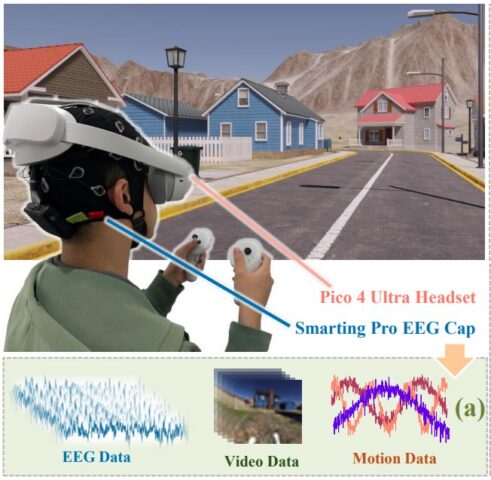
Researchers at Beihang University and Tsinghua University in Beijing built a multimodal contrastive learning framework that pairs EEG with synchronized video and motion data to detect cybersickness in virtual reality, representing the EEG as a connectivity graph and using an attention-based encoder to map the video and motion streams onto the same structure. Fusing all three signals separated cybersick from non-cybersick states more cleanly than any single modality or pair, and the model automatically pruned prefrontal connections unrelated to cybersickness. The setup used mBrainTrain's Smarting PRO 32-channel wireless EEG system and a Pico 4 Ultra headset, with 29 healthy adults navigating a VR scene under their own control.

Beijing Tongren Hospital Registers Observational Study of Clinical Needs for Invasive Visual BCI

The study involves no implant and tests no device. It asks 50 adults with acquired blindness what existing assistive devices get wrong, and what they would want from a vision-restoration implant. Outcomes span demographics and economics, quality of life, clinical features, satisfaction with current aids, and design requirements for an invasive visual brain-computer interface. Participants must be at least 18, have only weak or no light perception in both eyes, and have lost their sight after birth; congenital blindness is excluded.

China's MIIT and Six Ministries Issue BCI Industry Development Guidelines

Seven Chinese ministries led by MIIT issued guidelines targeting breakthroughs in core BCI technologies by 2027 — including electrodes, chips, and integrated devices at internationally competitive levels — with accelerated deployment in manufacturing, healthcare, and consumer markets. By 2030, the plan calls for cultivating 2–3 globally influential BCI companies and building an internationally competitive industry ecosystem.

Bio-Inspired Methods Target EEG Robustness

A perspective review published in Computers in biology and medicine examines EEG non-stationarity across sessions, people, and recording conditions. It asks whether mechanisms that help the brain maintain functional stability can improve the robustness of brain-computer interface models. The review covers synaptic plasticity, homeostatic regulation, neural oscillations, and spiking representations, comparing bio-inspired approaches with conventional machine learning and transfer learning. It also considers hybrid designs that combine biologically grounded mechanisms with artificial neural networks. The author proposes operational definitions for bio-inspired, bio-plausible, and bio-realistic modeling, together with a minimum specification for continual EEG benchmarks. Because direct EEG evidence remains limited for several proposed mechanisms, the review stresses the need to distinguish empirical findings from hypotheses and future research directions.
June 2026

Injectable Antifouling Adhesive Hydrogel Enables Robust Neural Interfaces for Stable ECoG Recording

Researchers propose an injectable, in-situ-gelling multifunctional hydrogel to address the failure modes of micro-ECoG cortical recording — dural barrier disruption, cortical micromotion that weakens device-tissue coupling, and biofouling that triggers a foreign-body response. Combining dopamine-grafted sodium alginate with branched polyethyleneimine, the hydrogel forms a quasi-zwitterionic network that resists nonspecific protein adsorption and provides catechol-mediated wet adhesion, gelling rapidly under surgical-compatible conditions through dual macromolecular crosslinking without diffusible small-molecule monomers. Integrated with a 128-channel flexible micro-ECoG mesh array, the platform reduced glial activation and fibrotic encapsulation and preserved stable, high-fidelity cortical recording over the 3-week early chronic period. The authors say co-designing barrier repair, interface adhesion and antifouling in a single material can improve long-term function.

Multi-View Contrastive Learning Improves Cross-Subject ERP Classification

MVCLDG combines raw EEG and Hilbert-derived phase information with domain-alignment and contrastive-learning constraints to improve classification across unseen users. It outperformed baseline and representative domain-generalization methods on a public error-related-negativity dataset and a semantic-syntactic-violation dataset without target-domain adaptation; ablation and activation-map analyses supported the contribution and neurophysiological plausibility of its components.

Anhui Hospital Registers 60-Patient BCI Trial for Post-Stroke Motor Dysfunction

The trial compares motor imagery BCI plus standard rehabilitation against standard rehabilitation alone in stroke patients with hemiplegia, tracking limb motor function and daily living ability. It planned to enroll 60 participants, 30 per arm, with the first participant enrolled on August 10, 2022; the registry now lists the study as completed. Beyond motor scales, the primary outcomes include functional connectivity and a lateralization index measured with fNIRS, probing brain-network changes rather than behavior scores alone.

Brain-to-Image Framework Splits Shared and Personal Features to Cut Calibration Data

Researchers at Lanzhou University, Zhejiang University, the University of Hong Kong and Sun Yat-sen University have built MindShow, a unified generative framework that reconstructs images from fMRI at cohort level rather than one subject at a time. A hierarchically conditioned mixture-of-experts encoder separates population-shared latent representations from subject-specific neural traits, so a new subject can be adapted with limited calibration data; a gated Perceiver bottleneck maps fMRI features into fixed-size image and text tokens, an optimal transport loss aligns them with a pretrained vision-language model, and a frozen diffusion model renders the image. The authors report better high-level reconstruction metrics with competitive structural fidelity, in a study published in Medical Image Analysis on June 20, 2026.
© 2026 BCIwiki.com Digest Topics Tips Subscribe Revisions About