中 / EN

BCIwiki — Brain-computer interface news, research and industry database

Latest

July 2026

Deep Learning Decodes Imagined Sounds and Images From MEG, Topping 70% for Visual Imagery

Researchers recorded magnetoencephalography (MEG) from 18 right-handed participants as they imagined sounds and pictures, then compared two decoders: a convolutional neural network (CNN) and a linear logistic regression model. The CNN decoded both tasks above chance and exceeded 70% accuracy for visual imagery. It still decoded significantly when trained only on cortical regions unrelated to the task, suggesting imagined content is spread across partially overlapping networks rather than confined to a single sensory area, an experimental basis for feeding auditory and visual information into BCI decoders together.
Why it matters By comparing imagined sounds and imagined images within one MEG dataset, the study shows their cortical representations overlap, with decodable information even in task-irrelevant regions; for BCI, that means future decoders need not fixate on a single sensory area and can let modalities complement each other, though with only 18 participants a usable system remains some way off.
Microsoft and INBRAIN Neuroelectronics Partner on AI-Driven BCI Therapeutics

Microsoft and INBRAIN Neuroelectronics said they will work together on AI-driven brain-computer interface therapeutics, pairing INBRAIN's graphene-based neural interfaces with Microsoft's cloud computing and data infrastructure to speed development of treatments for neurological disorders. INBRAIN, a Spanish neurotechnology company, says its system combines graphene electrodes with AI algorithms to read and modulate brain signals with high precision, on a platform it describes as bringing together neuroscience, bioelectronics and AI.
Why it matters Neuromodulation companies have been strong on electrodes and thin on the compute and data layer behind decoding; bringing in a hyperscaler puts a cloud vendor inside the therapeutic stack rather than alongside it, and sets a template other implant developers will be asked about.

INBRAIN and Microsoft Partner on AI for Real-Time BCI Adaptation

INBRAIN Neuroelectronics has announced a partnership with Microsoft to apply the software company's large language models and data analytics tools to make its brain-computer interfaces adapt in real time. INBRAIN builds graphene-electrode BCIs for neurological disorders, spanning invasive and non-invasive applications, and recently partnered with the Mayo Clinic to speed clinical development and commercialization of its BCI therapies, with investigator-led clinical research under way.
Why it matters The interesting part is the dependency rather than the AI: a BCI maker leaning on a hyperscaler's models for real-time adaptation would put a cloud vendor inside the decoding loop of an implanted device, raising latency, regulatory and data-governance questions that ordinary device partnerships do not.

INBRAIN and Microsoft Team Up on AI for Neurology and BCI

Barcelona-based INBRAIN Neuroelectronics said it will work with Microsoft on AI for neurology and brain-computer interfaces, combining INBRAIN's neuroscience, bioelectronics and AI work with Microsoft's cloud and AI infrastructure. INBRAIN's graphene-based neural interface is being developed as an adjunctive therapy for Parkinson's disease; it received FDA breakthrough device designation in 2023 and entered its first-in-human study in the fall of 2025.
Why it matters The value of the deal turns on stage: INBRAIN's graphene interface is already in first-in-human testing, so any gain from cloud-scale AI in closed-loop neuromodulation should show up in clinical data rather than in a roadmap.

Chinese Rehabilitation Association Sets July Workshop on Closed-Loop EEG-TMS

The Chinese Association of Rehabilitation Medicine will hold a workshop on EEG-driven closed-loop TMS in Guangzhou, southern China, on July 17, 2026, staged under its Naoke China (脑客中国) series and run by its committee on brain function monitoring and modulation in rehabilitation. The technique reads EEG in real time and triggers a TMS pulse when a target brain state appears, a 'brain-state-dependent stimulation' approach that pairs the spatial precision of TMS with the temporal resolution of EEG, and the program is built around moving BCI work out of the laboratory into neurorehabilitation and the precision diagnosis of brain disorders. Shenzhen Yingchi Technology, a subsidiary of Hanix United, is among the supporting organizations, and registration closes on July 17.
Why it matters Closed-loop stimulation has been a research topic in China rather than a taught clinical skill, so billing this as the country's first public workshop on EEG-triggered TMS puts it at the point where a technique starts moving to practicing rehabilitation clinicians.

Study Involving Hangzhou Dianzi University Achieves 1024-Channel Recording in Pig Cortex

A collaborative study involving authors from Hangzhou Dianzi University and other institutions developed a three-dimensional helical stretchable neural probe and achieved 1024-channel signal acquisition in the pig cerebral cortex. The researchers also report single-unit recordings with long-term stability in the mouse deep brain, while flexible planar microelectrode arrays recorded subcutaneous EMG signals in mice. The probe is fabricated using planar microfabrication followed by thermally driven helical shaping, expanding wiring space and accommodating tissue motion. Mechanical simulations and cyclic stretching tests examined strain mitigation and electrochemical stability, respectively. These device and animal results do not establish long-term performance in humans.
Why it matters The device forms and recording sites differ across experiments: planar arrays recorded mouse subcutaneous EMG, the helical probe recorded mouse deep-brain activity, and pig cortical testing demonstrated high-channel-count acquisition. These findings should not be combined into a claim of long-term validation at every site.

Beihang and Tsinghua Team Fuses EEG, Video and Motion to Flag VR Cybersickness

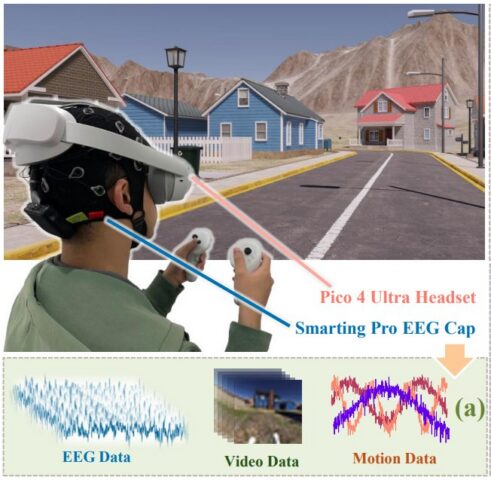
Researchers at Beihang University and Tsinghua University in Beijing built a multimodal contrastive learning framework that pairs EEG with synchronized video and motion data to detect cybersickness in virtual reality, representing the EEG as a connectivity graph and using an attention-based encoder to map the video and motion streams onto the same structure. Fusing all three signals separated cybersick from non-cybersick states more cleanly than any single modality or pair, and the model automatically pruned prefrontal connections unrelated to cybersickness. The setup used mBrainTrain's Smarting PRO 32-channel wireless EEG system and a Pico 4 Ultra headset, with 29 healthy adults navigating a VR scene under their own control.
Why it matters Cybersickness caps how long anyone will wear a headset, and the useful finding here is that EEG holds up during active navigation, where motion artifact usually degrades it — though with 29 healthy adults and no validation in a shipping product, this is a method result, not a feature.

Preprint: MRI Grey Matter Loss May Predict Who Can Control an ECoG BCI in ALS

A preprint from the Utrecht-BCI Lab at the UMC Utrecht Brain Center in the Netherlands, the invasive-BCI group led by Nick Ramsey, asks why some people with ALS control an implanted brain-computer interface (BCI) better than others. It found that preservation of grey matter in the motor cortex is associated with higher-quality brain signals, suggesting an MRI-based measure could help identify who is a suitable candidate for implantation. The preprint was posted to medRxiv on June 23, 2026 (DOI 10.64898/2026.06.23.26355654).
Why it matters ALS implant programs have no accepted way to predict who will actually be able to drive the device, so a structural MRI marker — if it survives peer review and a larger cohort — would change enrollment criteria before it changes surgery.

BIOSerenity's E1 Foundation Model Posts Strong Results on Four Clinical EEG Tasks

French medtech company BIOSerenity has built an EEG foundation model, BIOSerenity-E1, pre-trained self-supervised on more than 4,000 hours of recordings, and reports strong results on four clinical tasks: normal/abnormal classification, Alzheimer's disease detection, pediatric sleep staging and seizure detection. The normal/abnormal algorithm is already built into a CE-marked medical device, and the seizure-detection algorithm is in clinical evaluation. The work will be shown as a poster at the 8th Journées de Neurophysiologie Clinique in Grenoble, France.
Why it matters The four benchmarks matter less than the regulatory position: one head of this pretrained model already sits inside a CE-marked device, which puts foundation-model EEG on the clinical side of the line and, if it holds, cuts how much labelled data each new indication needs.

Beijing Tongren Hospital Registers Observational Study of Clinical Needs for Invasive Visual BCI

The study involves no implant and tests no device. It asks 50 adults with acquired blindness what existing assistive devices get wrong, and what they would want from a vision-restoration implant. Outcomes span demographics and economics, quality of life, clinical features, satisfaction with current aids, and design requirements for an invasive visual brain-computer interface. Participants must be at least 18, have only weak or no light perception in both eyes, and have lost their sight after birth; congenital blindness is excluded.
Why it matters Most visual BCI research starts from engineering or surgical questions. This one starts by asking patients what they want. It breaks demand down into quality of life, satisfaction with current aids, and design requirements, targets 50 participants, and excludes congenital blindness, signaling that the researchers care about expectations among people who lost sight after birth. Such data solve no technical problem, but they shape which functions a future device prioritizes.

© 2026 BCIwiki.com Digest Topics Tips Subscribe Revisions About