

July 2026
Study Involving Hangzhou Dianzi University Achieves 1024-Channel Recording in Pig Cortex
A collaborative study involving authors from Hangzhou Dianzi University and other institutions developed a three-dimensional helical stretchable neural probe and achieved 1024-channel signal acquisition in the pig cerebral cortex. The researchers also report single-unit recordings with long-term stability in the mouse deep brain, while flexible planar microelectrode arrays recorded subcutaneous EMG signals in mice. The probe is fabricated using planar microfabrication followed by thermally driven helical shaping, expanding wiring space and accommodating tissue motion. Mechanical simulations and cyclic stretching tests examined strain mitigation and electrochemical stability, respectively. These device and animal results do not establish long-term performance in humans.
Preprint: MRI Grey Matter Loss May Predict Who Can Control an ECoG BCI in ALS
BIOSerenity's E1 Foundation Model Posts Strong Results on Four Clinical EEG Tasks

Bio-Inspired Methods Target EEG Robustness
A perspective review published in Computers in biology and medicine examines EEG non-stationarity across sessions, people, and recording conditions. It asks whether mechanisms that help the brain maintain functional stability can improve the robustness of brain-computer interface models. The review covers synaptic plasticity, homeostatic regulation, neural oscillations, and spiking representations, comparing bio-inspired approaches with conventional machine learning and transfer learning. It also considers hybrid designs that combine biologically grounded mechanisms with artificial neural networks. The author proposes operational definitions for bio-inspired, bio-plausible, and bio-realistic modeling, together with a minimum specification for continual EEG benchmarks. Because direct EEG evidence remains limited for several proposed mechanisms, the review stresses the need to distinguish empirical findings from hypotheses and future research directions.
June 2026
Injectable Antifouling Adhesive Hydrogel Enables Robust Neural Interfaces for Stable ECoG Recording
Researchers propose an injectable, in-situ-gelling multifunctional hydrogel to address the failure modes of micro-ECoG cortical recording — dural barrier disruption, cortical micromotion that weakens device-tissue coupling, and biofouling that triggers a foreign-body response. Combining dopamine-grafted sodium alginate with branched polyethyleneimine, the hydrogel forms a quasi-zwitterionic network that resists nonspecific protein adsorption and provides catechol-mediated wet adhesion, gelling rapidly under surgical-compatible conditions through dual macromolecular crosslinking without diffusible small-molecule monomers. Integrated with a 128-channel flexible micro-ECoG mesh array, the platform reduced glial activation and fibrotic encapsulation and preserved stable, high-fidelity cortical recording over the 3-week early chronic period. The authors say co-designing barrier repair, interface adhesion and antifouling in a single material can improve long-term function.
Nanostructured Coatings on Soft-Polymer Neural Probes for Addressing Neuroinflammation
Researchers transferred dexamethasone-loaded titania nanotube arrays (TNA) onto a mechanically adaptive polymer nanocomposite (NC) substrate and, in a mouse model, compared four implants — silicon, NC, TNA-NC Empty and TNA-NC DEX (10 mice per group) — for neuroinflammation around intracortical microelectrodes at 2 and 4 weeks. At 2 weeks the gene-expression profiles were broadly similar, reflecting an early acute injury response; by 4 weeks the patterns diverged, with NC-based implants showing fewer differentially expressed neuroinflammatory genes than rigid silicon, led by TNA-NC Empty, while the dexamethasone group showed no additional benefit, suggesting drug delivery still needs optimization. The authors conclude that adding a TNA layer to flexible materials promotes resolution of the neuroinflammatory response at 4 weeks.
Multi-View Contrastive Learning Improves Cross-Subject ERP Classification
MVCLDG combines raw EEG and Hilbert-derived phase information with domain-alignment and contrastive-learning constraints to improve classification across unseen users. It outperformed baseline and representative domain-generalization methods on a public error-related-negativity dataset and a semantic-syntactic-violation dataset without target-domain adaptation; ablation and activation-map analyses supported the contribution and neurophysiological plausibility of its components.
Exploring Synergies in Brain-Machine Interfaces: Compression vs. Performance
Using implantable brain-machine interface (iBMI) data from a non-human primate two-dimensional finger task, the study tests whether brain-muscle synergies improve decoding performance and generalization. Principal component analysis (PCA), demixed PCA (dPCA) and non-negative matrix factorization (NMF) all compressed brain-muscle data effectively with minimal decoding-accuracy loss, but none improved performance through denoising or enhanced cross-task generalization. The authors conclude that extracting synergies alone does not yield a better or cleaner control space for linear decoding, and call for larger samples and more muscle channels.
Weizmann Calcium-Imaging BCI Lets Freely Moving Mice Control Same Neurons for Days
Researchers in the Department of Brain Sciences at Israel's Weizmann Institute of Science developed BAMBI, a brain-computer interface that uses a head-mounted miniature microscope to image calcium signals from active neurons in real time and deliver feedback. Because it realigns to the same field of view in each session, it tracks the same group of neurons over multiple days without retraining. Tested in head-fixed and freely moving mice across different behavioral paradigms, the animals learned to stably modulate specific hippocampal neurons for rewards over several days.
Brain-to-Image Framework Splits Shared and Personal Features to Cut Calibration Data
Researchers at Lanzhou University, Zhejiang University, the University of Hong Kong and Sun Yat-sen University have built MindShow, a unified generative framework that reconstructs images from fMRI at cohort level rather than one subject at a time. A hierarchically conditioned mixture-of-experts encoder separates population-shared latent representations from subject-specific neural traits, so a new subject can be adapted with limited calibration data; a gated Perceiver bottleneck maps fMRI features into fixed-size image and text tokens, an optimal transport loss aligns them with a pretrained vision-language model, and a frozen diffusion model renders the image. The authors report better high-level reconstruction metrics with competitive structural fidelity, in a study published in Medical Image Analysis on June 20, 2026.
Hybrid micro-ECoG for multi-scale neural recording
Published in Cell Reports Methods on June 12, 2026, the study presents high-density micro-electrocorticography arrays that integrate silicone elastomers (optical transparency, repeated penetration with intracortical arrays) and polyimide films (fine photolithographic feature definition) for multi-scale studies of brain activity. The combination facilitates high-throughput functional mapping to identify targets and insertion of intracortical arrays for dense local sampling. The authors demonstrated functional mapping in rats, cats and marmosets, guiding multi-area laminar recordings, and demonstrated local and feedforward optogenetic stimulation to investigate cortico-cortical interactions.
Researchers Find Non-Invasive BCI Learning Is Faster When Mappings Follow Brain Structure
Researchers have found that whether people can learn to control a device with their thoughts may depend on whether the control scheme follows the brain's own activity patterns. Participants lying in an MRI scanner controlled a video game avatar in real time by modulating activity in brain regions responsible for spatial navigation. When the researchers then changed the mapping between brain activity and avatar movement, participants could readjust and regain control if the new mapping fell along directions in which their brain activity already varied widely, known as the intrinsic manifold; when the mapping departed from that structure, they never learned it. The researchers say the principle could be used to design BCIs that are easier to learn.
May 2026
Researchers' ResDSNet Deep Residual Network Lifts Motor Imagery EEG Decoding Accuracy
Researchers proposed ResDSNet, a residual depthwise-separable network with a matching preprocessing module that filters noise while keeping motor imagery features, to break what they call the "depth barrier": deepening lightweight decoders fails when residual structures are poorly designed or mismatched with preprocessing. On 3 public datasets covering 127 subjects it reached 79.36%, 84.95% and 64.13% accuracy, 3.16%, 1.59% and 8.40% higher than the best existing methods. It was tested only offline on public data, not in real-time BCI systems or patients.
Enhancing Brain Signal Generation Through a Hybrid Approach Integrating Reinforcement Learning and Diffusion Models
The study introduces RLED, a reinforcement learning-enhanced EEG diffusion framework for adaptive data augmentation in endogenous EEG tasks such as motor imagery and emotion recognition. Reinforcement learning dynamically regulates the diffusion training process to balance temporal, spectral and category-related features. Across four datasets, the high-quality synthetic EEG signals it generated consistently improved classification performance.
Researchers Switch EEG Emotion Recognition Between Batch and Stream, Reaching up to 94%
Researchers have built a hybrid batch-stream framework for EEG-based emotion recognition, which until now has had to choose between accurate but slow offline batch processing and fast but less accurate real-time streaming. The system estimates whether the streaming module is currently reliable from its past performance, then decides probabilistically whether to use the batch or the streaming output. It achieved classification accuracies of 85%, 94% and 74% on the public DEAP, AMIGOS and SEED benchmarks, and was also tested under concept drift, when data distributions shift over time. Results come from offline evaluation on public datasets and have not been validated with real users.
sEEG Study Finds Motor Imagery Activity Shifts by Task Stage and Frequency Band
Intracranial recordings from ten epilepsy patients show that neural activity during cued limb motor imagery changes with the phase of the task: low-frequency (8-30 Hz) activity was mostly suppressed during preparation and switched to activation once imagery began, while high-frequency (60-115 Hz) responses were stronger, more widely distributed, and at some contacts followed an activation-then-suppression sequence. The stereoelectroencephalography (sEEG) data indicate that responses are not uniform but shift with task stage and brain region, which the authors tie to stage-aware feature design for BCIs and to neurorehabilitation.
ChatBCI-Assist: LLM-Powered P300 Speller Achieves Record Performance
ChatBCI-Assist integrates a locally deployed LLM with adaptive stopping, achieving record P300 speller online ITR of 105.2 bits/min and 30.7 CPM in semantic spelling.
Chongqing Team's Manifold Adversarial Network Cuts Per-User Calibration in EEG BCIs
Researchers in Chongqing, a municipality in southwestern China, have proposed SPD-DANN, a method that aims to decode motor imagery, the brain signals produced when a person imagines moving a hand or foot, in new users without per-person calibration. Because EEG varies between people and drifts over time, BCIs typically need fresh data from each new user. SPD-DANN represents EEG features on a symmetric positive definite (SPD) matrix manifold, a mathematical space that better fits their nonlinear structure, and uses adversarial learning to extract features shared across individuals. Tested on 4 BCI datasets, the method outperformed several existing unsupervised domain adaptation techniques, the researchers said. The abstract gives no accuracy figures, and all tests were offline.
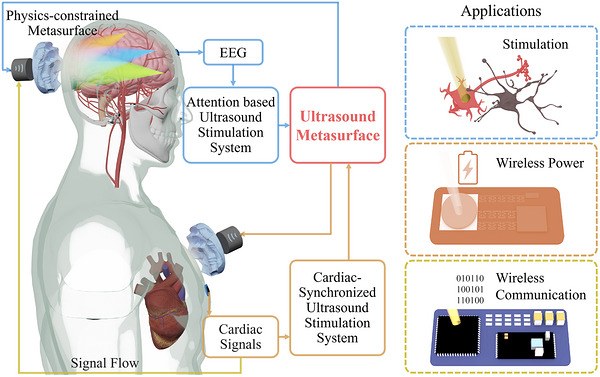
Integrated Ultrasonic Platform for Bioelectronic Control Through Biological Barriers Based on Metasurface
April 2026
Ultra-Flexible Arrays Record 719 Single Neurons in 11 Surgical Patients
A Nature Communications study tested ultra-Flexible Implantable Neural Electrode arrays during awake surgery in 16 patients. Valid single-unit recordings were obtained in 11 patients, yielding 719 isolated neurons and as many as 135 simultaneously, while five early cases failed because of operating-room noise or damaged insertion needles. The work was intraoperative and does not establish long-term implant performance.
Xidian Team Drops Transformer Encoder, MLP Decoder Holds 0.94–0.98 AUC
Researchers at Xidian University built DisCo-Former, a Transformer framework for single-trial rapid serial visual presentation (RSVP) EEG decoding with three components guided by neurophysiological priors, then found its attention consistently collapsed: attention maps went nearly uniform and value-projection weights shrank toward 0. Stripping out the Transformer encoder left DisCo-MLP, a pure multilayer perceptron that matched or beat the Transformer version across two datasets and three evaluation regimes, with within-subject mean AUCs of about 0.94 to 0.98. For RSVP-EEG, the authors argue, modeling the signal's structure matters more than architectural complexity. The study was published in the International Journal of Neural Systems on April 10, 2026.
Dynamic Source Domain Selection: An Adaptive EEG Transfer Learning Framework
To reduce negative transfer in motor imagery BCIs, the study presents an adaptive dynamic transfer learning framework that decomposes EEG time-frequency features via wavelet convolution, matches source and target samples through a dynamic transfer attention module, and uses a joint loss to shrink marginal and class-conditional differences. On BNCI2014001, BNCI2014002 and BNCI2015001 it reached 78.78%, 82.11% and 78.19% accuracy, averaging 0.13% to 27.7% above baseline algorithms.
Enhancing the Capability and Accuracy of Motor Imagery Classification: A Deep Neural Network-Powered Multifaceted Strategy Model
Researchers propose DPMS-Net, a deep network that uses dynamic convolution to mine discriminative cues across temporal, spatial and frequency dimensions, combines channel and temporal attention, and adds a spectral-domain analysis component to surface subtle oscillatory features hidden in the EEG spectrum. On the BCI Competition IV 2a and 2b datasets it reached subject-dependent accuracies of 83.93% and 88.38%, and 67.67% on a self-collected stroke-patient dataset. The authors say its efficient decoding and robustness suit neurorehabilitation BCI systems.
March 2026
Real-Time Channel Selection for Enhanced SSVEP Online Brain-Computer Interface Systems
The study presents MAPS-CS, an online SSVEP brain-computer interface that selects channels dynamically during the experiment. A multi-dimensional feature framework covering signal energy, stability and inter-channel correlation quantifies anomalies and generates scores that a hierarchical decision step combines into a channel-quality score to identify and remove bad channels — with no training required. Against the channel ensemble (CE) method, MAPS-CS lifted standard FBCCA accuracy by 3.5%, 4.1%, 4.4% and 6.5% at stimulus durations of 2 s, 1.5 s, 1 s and 0.5 s, the best among the CE, binary harmony search and TOP-K local optimization methods compared.
STAND-Net Spiking Network Removes EEG Artifacts With 97.98% Less Power Than DNNs
Researchers built STAND-Net, a spiking neural network that cleans blink, muscle and other artifacts from EEG and computes only when the signal changes, combining a leaky integrate-and-fire encoder-decoder, a dilated-convolution residual backbone and an attention mechanism that locates artifacts from neuron firing patterns. Against state-of-the-art methods it raised signal-to-distortion ratio by more than 3.7 dB across artifact types and used 97.98% less power than comparable deep neural networks; BCI classification on the cleaned signals was 6.64% more accurate. The results come from the paper's abstract, with no data from wearers.
February 2026
MSARFNet Tops 84% Accuracy on Two Motor Imagery Benchmarks
Researchers have proposed MSARFNet, a multi-scale attention-based reconstruction fusion network that reached average classification accuracies of 84.64% and 87.96% on the BCI Competition IV 2a and 2b motor imagery datasets, outperforming several existing methods. The network extracts spatio-temporal features through parallel multi-scale convolutional branches and fuses them with an attention mechanism to sharpen transient motor-imagery responses, targeting the non-stationary EEG signals and inter-subject variability that make MI decoding unreliable. The study was published on February 27, 2026, in IEEE Journal of Biomedical and Health Informatics.
Children With Cerebral Palsy Show Keen Interest in BCI-Controlled Boccia Ramp
Researchers designed an assistive Boccia ramp controlled by a brain-computer interface so that children with severe motor impairments who cannot speak can take part in the Paralympic sport. Six caregivers took part in semi-structured interviews and six children completed a newly developed 21-item survey; the children showed keen interest in playing Boccia with a BCI. The study also maps current barriers and facilitators to sport participation, and the issues that must be resolved before such technology can be rolled out.
Improved Spontaneous EEG Signal Decoding Efficiency by Function Predefined Convolutional Neural Network
Researchers propose a function predefined convolutional neural network (FPCNN) for decoding spontaneous EEG in brain-computer interfaces. Its learnable function predefined convolution (FPC) layer searches for the key spatial-frequency parameters of spontaneous EEG so the parameters carry clear physical meaning, and it builds trainable orthogonal detectors on the FPC to capture complex phase-varying signals. On three spontaneous EEG datasets, FPCNN outperformed state-of-the-art methods by 2.09%, 3.08% and 3.41%, with single-round training and testing taking just 67.96 and 19.36 seconds on non-GPU hardware, which the authors say makes it suited to EEG processing in diverse environments.
EEG-Based Emotion Recognition Using Spatial-Temporal Graph-Aware Network With Channel Selection
The study presents an EEG emotion recognition framework that couples discriminative channel selection with hierarchical spatial-temporal modeling. Wavelet coherence and mutual information adaptively select informative channels across frequency bands, and a spatial-temporal graph-aware network (STG-Net) models inter-channel spatial relations and the temporal evolution of emotional states before fusing frequency-spatial-temporal features for classification. The authors report better recognition accuracy and model efficiency than state-of-the-art methods.