中 / EN
September 2026

Portuguese Case Series: EEG Neurofeedback Improves Grip Strength in Chronic Stroke

Researchers in Portugal had seven people with chronic stroke imagine arm movements while an EEG-based brain-computer interface gave some of them real-time feedback and others sham feedback; both groups also received four weeks of standard physiotherapy. Patients receiving real feedback improved beyond the minimal clinically important difference on at least one functional measure, most clearly grip strength, and their brain activity became more symmetrical between hemispheres. As a small case series, the study shows the method is feasible, and its results are preliminary.
Xiamen Team Reads Emotions From Low-Channel EEG at 87% Accuracy

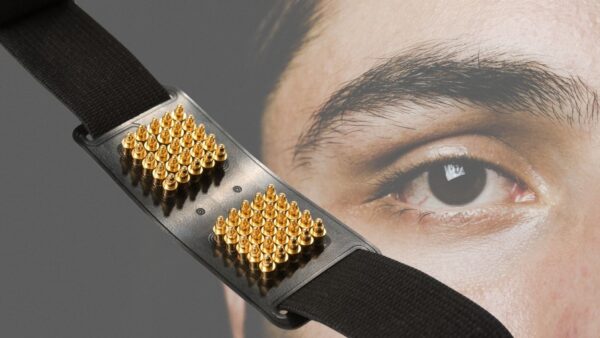
Portable EEG headsets have few channels and capture limited cortical information, making emotion decoding difficult. A team at Xiamen University of Technology in the eastern Chinese province of Fujian developed the Spatiotemporal Spectral Asymmetric Fusion Network (STSANet), which models nonlinear hemispheric lateralization between homologous frontotemporal electrodes. It reached 86.80% accuracy on the public SEED dataset and 87.43% on a self-collected dataset. The team also found consistent spectral energy distributions between the portable Xmuse headset and the professional-grade Enobio, suggesting the method could run on consumer EEG hardware. The work is a preprint and has not been peer reviewed.

Chongqing University's MTANet Reaches 89.47% on Motor Imagery EEG Benchmark

A team at Chongqing University's School of Electrical Engineering in southwestern China built MTANet, an end-to-end neural network for decoding motor imagery EEG. An EEG inception attention module extracts and weights coupled time-frequency-spatial features, and a parallel temporal attention module runs several temporal convolutional networks over weighted segments of different feature sequences. In offline tests on three public datasets, MTANet outperformed seven existing models, with average accuracies of 89.47% on BCI Competition IV dataset IIb, 83.39% on dataset IIa and 77.06% on BCI Competition III dataset IIIa. It has not been tested in an online BCI setting.

EEG Foundation Models Trail Supervised Decoders on Motor Imagery, Audit Finds

Pretrained EEG foundation models are increasingly seen as general-purpose encoders for brain-computer interfaces, but recent benchmarks disagree on how well they transfer. Evaluated under a validation-locked protocol on the four-class BCI Competition IV-2a motor imagery dataset, two leading models, LaBraM and CBraMod, underperformed every supervised comparator in every configuration, including validation-selected fine-tuning. A key confound emerged: foundation models and task-specific decoders are usually evaluated with different input pipelines. When three supervised architectures were retrained on the broadband input the foundation models use, accuracy moved in opposite directions (ATCNet gained 0.078, EEG Conformer lost 0.088), and none of the changes was significant after multiple-comparison correction at n = 9. Measuring the foundation-model gap against a single comparator may therefore be unreliable. The work is a preprint and has not been peer reviewed.

Study Improves Cross-Subject Motor Imagery EEG Classification Across Four Datasets

The study introduces a model designed to reduce the impact of differences between participants' EEG signals on motor imagery classification. It combines comprehensive deep feature representation with domain adaptation to learn information shared across participants. Tests on four benchmark datasets produced average accuracies of 84.34%, 89.59%, 73.32%, and 87.75%. The authors report better performance than the state-of-the-art deep domain adaptation models included in their comparisons. Ablation experiments also assessed the two core modules. These findings concern cross-subject classification on datasets, not demonstrated online BCI control or rehabilitation benefits.

Patch-token adapter lifts EEG image decoding to 95.4%

When a person views an image, the brain leaves measurable electrical and magnetic traces. Most existing decoders match those signals to a single global image embedding. This study instead aligns them with all patch tokens from an intermediate layer of a vision model, using a lightweight Residual Patch Adapter (RPA). On the public THINGS-EEG2 dataset it reached Top-1 accuracy of 95.4% within-subject and 35.5% cross-subject; on THINGS-MEG the figures were 65.2% and 6.7%. The authors report state-of-the-art results on both. The study is a preprint and has not been peer reviewed.

Two Occipital EEG Channels Decode Blinks and Saccades at 72.37% Accuracy

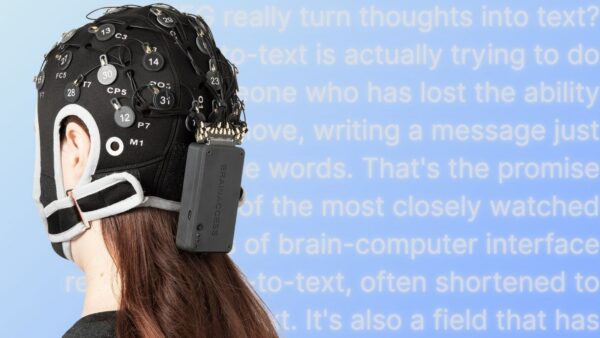
A research team in Poland used just two occipital electrodes (O1 and O2) on an EEG headband to distinguish four classes of eye events (blinks, left saccades, right saccades and a neutral state) with 72.37% test accuracy. Instead of training a single stronger model, they split four one-dimensional convolutional neural networks into binary experts and used stacked generalization, letting a meta-classifier resolve conflicts between them. Notably, the experts that performed worst on their own produced the best results when combined. The work was published by Neurotechnology, an EEG hardware maker whose BrainAccess brand makes consumer EEG headbands; HALO is its four-channel portable headband, and the accompanying software is free. Eye tracking usually requires dedicated equipment, and this study shows that two occipital channels on a consumer EEG headband can also pick up blinks and saccades. But the data come from only 4 healthy participants and 1,284 samples, so the approach is still a long way from replacing an eye tracker.

BCI-Adaptive Learning Platform Lifts Retention in 90-Learner Study

Researchers divided 90 learners into two groups: one used a BCI platform that read attention, cognitive load and mental fatigue in real time and adjusted content and pacing accordingly; the other followed a conventional online course. The BCI group showed stronger sustained engagement and better knowledge retention. The mixed-methods design combined quantitative data (pre- and post-test scores, task completion rates and neural activity indicators) with surveys and semi-structured interviews on perceived engagement, usability and the overall learning experience. The participants came from English House Language Center, the European University of Armenia and Mesrop Mashtots University. The authors also flag unresolved privacy, ethical and accessibility questions around collecting and using neural data in education.

Synchron Stent Electrode Beats Scalp EEG per Channel in One ALS Patient

A participant with severe upper-limb paralysis caused by amyotrophic lateral sclerosis (ALS) wore an endovascular stent-electrode array and a scalp EEG cap at the same time, in the same session, while attempting ankle flexion and extension. Both recordings changed markedly during attempted movement, but the stent array showed stronger per-channel motor modulation and was unaffected by skull attenuation. Scalp EEG was more susceptible to eye blinks and jaw-muscle activity, while the stent array picked up prominent cardiac signals. Neither method reliably distinguished left from right ankle movement, leaving spatial localization an open problem.

Bio-MF Generates fNIRS From EEG in One Step, 857 Times Faster Than Diffusion

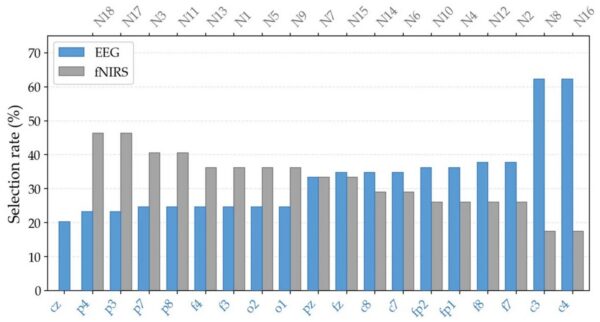
Hybrid motor-imagery brain-computer interfaces combine EEG with functional near-infrared spectroscopy (fNIRS) to exploit complementary electrical and blood-flow signals, but wearing two headsets is cumbersome and costly, and earlier diffusion-based methods for generating one signal from the other need about a thousand iterative steps, too slow for real-time use. Researchers from the Key Laboratory of Modern Teaching Technology (Ministry of Education) at Shaanxi Normal University and Microsoft (Beijing) propose Bio-MF, which predicts fNIRS waveforms directly from EEG in a single step. On one RTX PRO 6000 GPU it produces a trial in 7 ms, 857 times faster than a 1,000-step diffusion model. Adding the synthetic fNIRS to EEG raised classification accuracy over EEG alone by 3.37 to 4.15 percentage points on one dataset, and by 2.50 to 2.98 points on a second dataset with an unseen 64-channel EEG layout. All validation was offline; the work is a preprint and has not been peer reviewed.

Study Compares AI Command Execution With External Gating in BCIs

Researchers tested five language models as AI agents using 1,065 episodes from 47 people with amyotrophic lateral sclerosis. At matched execution coverage, providing reconstructed decoder confidence never reduced unfaithful execution below a deterministic gate; two models performed significantly worse. Apparent safety improvements mainly reflected less frequent action. A subsequent test gave ten models the same command vocabulary as a deterministic resolver. No direct agent arm improved on the resolver's risk-coverage frontier. However, a hybrid architecture that let models propose semantic corrections while an external gate controlled admission extended coverage in five of ten models without observed unfaithful executions.

Chinese Team Proposes Unified Theory Framework for BCIs

BCI hardware and decoding algorithms have advanced quickly, but basic questions such as how much intent can be read from brain signals and how low decoding error can go still lack a systematic theoretical answer. This paper treats a BCI as a closed-loop stochastic process: a user forms an intention, the brain encodes it as neural activity, the device observes the signal, an algorithm decodes it statistically, and feedback returns to the user. Using information theory and statistical decision theory, the authors derive theorems on when intent is decodable, the upper bound of observable information, the lower bound of optimal decoding error, and the convergence of closed-loop learning, plus laws describing constraints from signal-to-noise ratio, class separability and non-stationary co-adaptation. A four-class SSVEP-BCI, in which users gaze at targets flickering at different frequencies, serves as a theoretical case study. The work is theoretical and reports no new experimental data.

Exploratory Adult Study Links BCI Learning to Reading Gains

Researchers developed a non-invasive EEG brain-computer interface using auditory inputs and visual feedback to target phonological processing in developmental dyslexia, initially testing it in adults with and without dyslexia. Participants completed 16 sessions and underwent phonological awareness and reading assessments before and after training. Among participants who learned the BCI, including both dyslexic and control participants, offline BCI scores were significantly associated with improvements in nonword reading. BCI learning also showed significant associations with gains in real-word reading and amplitude rise time discrimination. These associations do not establish causation or demonstrate benefits in infants or children. This study is a preprint and has not been peer reviewed.

Study Finds Distinct Neural Populations Encode Imagined Grasps and Object Properties

In three participants with tetraplegia imagining object manipulation, neural activity across several brain regions represented the configuration of the whole hand during imagined grasps. The posterior parietal cortex simultaneously encoded grasp and object properties, largely through distinct neuronal subpopulations. Grasp-related activity varied with motor planning versus imagined execution and with object presence versus absence; some regions also represented object shape during planning. The authors suggest that separating grasp and object information could support more stable BCI grasp control. However, the motor imagery task does not establish restored hand function or improved robotic grasp performance. The study is a preprint that has not been peer reviewed.

New Analysis Identifies Opposing Neural Wave Modes in Marmoset and Human Recordings

Researchers introduced a framework for analyzing neural traveling waves and identified oppositely directed propagation modes in marmoset electrocorticography and human EEG recordings. The waves were concentrated in specific spatial and temporal frequency ranges, involving alpha and low-beta activity, with propagation speeds the authors considered physiologically plausible. The framework analyzes temporal frequency, spatial frequency, and propagation direction, accommodates irregular sensor layouts, and helps distinguish traveling from standing waves. The study also introduces a single-trial detection method. These findings concern animal and human neural signal analysis, not demonstrated improvements in BCI control or clinical outcomes. The work is a preprint that has not been peer reviewed.

CoME Framework Scores How Mobile an EEG Study Really Is

A participant walking on a treadmill and one walking freely outdoors with a recorder on their back can both be described as doing mobile EEG, yet their freedom of movement differs enormously. The CoME framework, proposed in 2017, scores a study on four dimensions (device mobility, participant mobility, system specification and channel count) in a format such as (2D, 4P, 17S, 32C). Device and participant mobility have to be scored separately: a head-mounted system used for resting-state recording earns a high device score but still rates 0P for participant mobility. The framework is not a product ranking, and a higher score does not mean a better system.

EEG-to-Text Results Overstated as Random Noise Fools Some Decoders

Translating scalp EEG directly into free-form text has long been seen as one of the most ambitious goals for non-invasive brain-computer interfaces. But when researchers fed random noise instead of real EEG into several published decoders, some models still produced fluent sentences and scored about as well as they did on real brain data, suggesting the language model was doing most of the work. The field has since made noise-baseline tests and decoding without teacher forcing standard validation practice, and has used magnetoencephalography (MEG) as a comparison to quantify how far EEG trails cleaner signals.

iMINDBench Sets a Shared Cross-Institution Test for Intracranial EEG Decoding

Intracranial EEG (iEEG), recorded by electrodes implanted inside the brain, is widely regarded as an ideal signal for decoding intent, but differing datasets and preprocessing pipelines make it hard to tell whether models are actually improving. A research team built iMINDBench, a benchmark that brings together naturalistic movie-watching data from three institutions, 15 decoding tasks, standardized preprocessing and fixed evaluation splits. Pretrained systems generally beat baselines within their own preprocessing pipeline, but classic spectral baselines remained competitive on other institutions' data. Scaling up supervised data from other subjects or institutions to 25 times the volume yielded only limited, task-dependent gains over training on data from the same session.

SPAR-EEG Single-Channel Denoiser Lifts P300 Speller Accuracy by 7.8 Points

Wearable neurotechnology and BCI applications, from assistive interfaces to clinical monitoring, favor single-channel EEG because it needs few electrodes and is light to wear. But muscle, eye and motion artifacts are hard to remove from a single channel, especially without auxiliary channels, artifact labels or hand-picked clean baseline segments. SPAR-EEG needs none of these: it applies three artifact-specific attenuation passes to each EEG segment, one based on variational mode decomposition for high-frequency muscle bursts and two based on singular spectrum analysis for blink-like ocular transients and slow motion drift. It achieved the best artifact-region SNR improvement at all 26 SNR levels tested and raised final accuracy by 7.8 percentage points in a P300 speller task using only the FP1 and FP2 leads.

AI Should Read Intent in BCI Exoskeletons While Controllers Enforce Limits, Review Says

A brain-computer interface can read neural activity tied to movement, while a powered exoskeleton supplies the force needed to carry it out. But EEG is noisy, muscle signals shift with fatigue and recovery, and the right level of assistance depends heavily on the user and the task, so AI's main value lies in handling several changing signals at once rather than relying on a single fixed input. The review surveys how EEG, EMG and mechanical sensing are combined for exoskeleton control and contrasts two applications with very different goals: stroke rehabilitation and healthy users. The author argues that higher classification accuracy alone is not enough, since latency, calibration, fatigue, uncertainty and physical safety also determine whether a system is truly usable.

Review of 129 EEG-BCI Papers Finds 61.2% State Data Availability, Only 20.9% Share Code

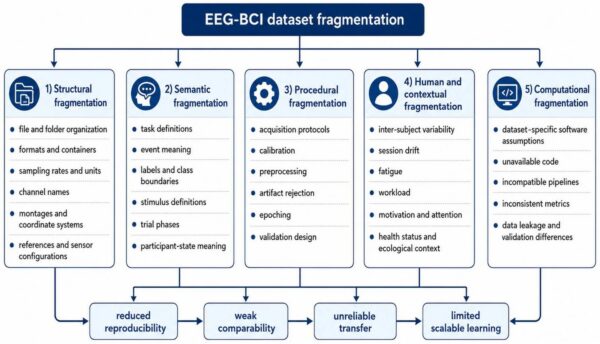
Public datasets for EEG-based brain-computer interfaces (BCIs) keep multiplying, but electrode layouts, task definitions, preprocessing and participant records differ from study to study, making the data hard to reuse across datasets and the results hard to replicate. This review screened 16,920 records down to 129 publications, mapped the fragmentation across structural, semantic, procedural, human/contextual and computational layers, and scored reporting transparency against 10 criteria, with a median score of 9. Data availability was stated in 61.2% of the papers; code or pipeline availability in just 20.9%. Existing standards, ontologies, software platforms and transfer-learning methods each solve part of the problem, the authors conclude, but none yet delivers full semantic interoperability.

Low-Cost 8-Channel EEG and VR Headset Reach Up to 90% Accuracy in Single-Subject Test

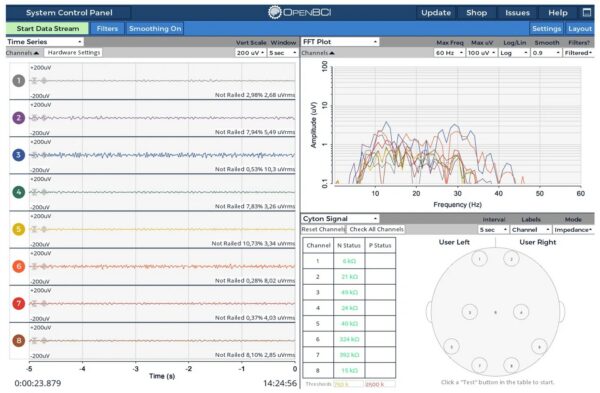
Researchers paired an 8-channel OpenBCI Cyton board and an EEG cap laid out on the international 10-20 system with a Meta Quest 2 headset to capture motor imagery and attention signals, reaching up to 90% subject-specific online classification accuracy with the EEGNet model when the signal was stable. The work targets cognitive control training for attention-deficit/hyperactivity disorder (ADHD), building EEG sensing into a virtual reality (VR) serious game so users can regulate their mental state in real time; earlier approaches mostly relied on hardware-heavy multichannel systems and did not combine motor imagery with attention levels. The team also documented artifacts from high impedance, channel saturation and mechanical tension from the headset strap, showing that a low-cost setup is usable only once skin-electrode impedance and mechanical interference are under control. This is a single-subject feasibility study with no clinical evaluation.

4,096-Channel μECoG Array Maps Brain Function During Surgery With 91.3% Channel Yield

During removal of a right parafalcine meningioma, surgeons placed four Layer 7 μECoG arrays, 4,096 electrodes in total, on either side of the central sulcus and recorded somatosensory evoked potentials under 5 contralateral stimulation conditions. Using a 2 MΩ impedance cutoff, 3,739 channels were usable, a 91.3% yield; phase-reversal latencies were 19, 21, 25, 26 and 25 ms, consistent with the standard intraoperative mapping performed in the same operation. The researchers caution that the setup provides dense spatial sampling rather than submillimeter physiological resolution: measured responses were correlated across roughly 3–4 mm of cortex.

Adding fNIRS to EEG Fails to Improve Brain-Controlled Stimulation in 16-Person Trial

Combining EEG with functional near-infrared spectroscopy (fNIRS) did not make brain-controlled electrical stimulation more accurate in a blinded randomized trial of 16 healthy volunteers. The hybrid and EEG-only groups showed no statistically significant differences in real-time three-class recall, sense of agency, attention or physical comfort; median recall was 53.5% in the hybrid group and 57.3% with EEG alone. The researchers also released the full EEG-fNIRS dataset.

Adaptive BCI Decoders Concentrate Task Information in Fewer Monkey Motor Neurons

After days of practicing a brain-computer interface with adaptive decoders, rhesus macaques needed significantly fewer motor cortex neurons to reach 80% task classification accuracy than in early sessions (p = 9.8 x 10^-4). Fixed decoders produced no such compaction. A neural network model suggests the adaptive decoders directly contribute to these more compact representations; the authors propose this may be because the decoders alter the error information used for credit assignment. The finding implies that assistive algorithms do not merely boost immediate BCI performance but actively reshape how the brain learns over time -- a consideration for real-world decoder design. The study used 128-channel microwire arrays in motor and premotor cortices of two monkeys and has not been tested in humans.

Single Brain Implant Decodes Speech and Gestures at Once

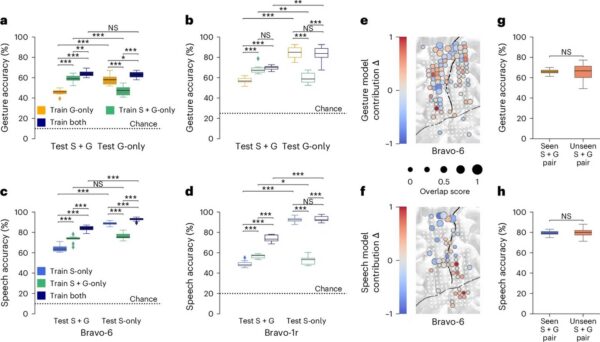
People with paralysis often lose both speech and gesture, yet most brain-computer interfaces decode only one. Researchers at the University of California, San Francisco showed that a single high-density electrode array on the brain's surface can decode attempted speech and gestures simultaneously. 3 participants with paralysis used it to control a personalized virtual avatar, speaking and gesturing together or separately. Training decoders on both isolated and simultaneous attempts improved performance across contexts.

MINTS Plans Home Motor Imagery Training for Stroke

The MINTS protocol plans to enroll 21 people who are at least 6 months post-stroke and have persistent upper-limb motor impairments. They will complete 14 home-based motor imagery neurofeedback sessions, imagining movements while receiving feedback on brain activity. Training will use mobile EEG every second day. The single-group study will repeat measurements during baseline periods of different lengths and throughout training to track brain activity and motor performance. Primary assessments concern EEG activity and a measure of functional connectivity, alongside brain imaging, motor testing, daily-life movement monitoring, and an exploratory three-month follow-up. This protocol has not been peer reviewed and reports no training outcomes.

EEG and MEG Decoding Reaches 79.4% Median Motor Imagery Accuracy

Researchers developed FUSE, a two-phase learning framework that combines simultaneous EEG and MEG recordings for motor imagery classification, and evaluated it on data from 20 participants. Learned representations increased median classification accuracy from 0.734 with conventional handcrafted spectral features to 0.794. The combined approach also exceeded MEG alone at 0.680 and EEG alone at 0.765, although the gain over EEG was modest. In transfer tests, more than half of cross-subject models performed within 0.01 accuracy of their subject-specific counterparts. These findings concern signal classification and representation transfer, not clinical efficacy. This study is a preprint and has not been peer reviewed.

Researchers Predict Brain-Region Waveforms From Signals Recorded Elsewhere

Researchers introduced NeuroGate, a cross-regional signal translation framework that predicts an unrecorded brain region's waveform from a recorded region. Across 56 pathways spanning rodent local field potentials, human stereo-EEG and electrocorticography, and scalp EEG, its waveform predictions were more accurate than those of 13 deep-learning and linear baselines. To test directionality, the researchers silenced piriform-cortex output. Piriform-to-bulb predictions collapsed in all 8 folds, while reverse predictions were preserved. The authors interpret this as consistent with monosynaptic anatomy and demonstrate applications in assessing recording redundancy and testing directional translation. This study is a preprint and has not been peer reviewed.

Low-Cost EEG Decodes Imagined Steering Direction

Can an EEG headset tell whether a driver is imagining a left or a right turn of the wheel? A team from Wuhan University of Technology and Guangxi Normal University designed a motor imagery task built around the actual steering action: participants imagined turning a wheel left or right with the right hand only. Using a low-cost OpenBCI device with 8 electrodes, they recorded EEG from 12 participants and found steering-direction differences over the central scalp. Their SMB-TCSAN decoding model reached an average classification accuracy of 66.80% on the steering-direction dataset. The authors describe the work as a preliminary feasibility check for driving-assistive BCI, not a working system.

© 2026 BCIwiki.com Digest Topics Tips Subscribe Revisions About