
/ EN

Industry Platforms

54 entries

The BCI industry is scaling from lab to market, with governments establishing dedicated industry zones and service platforms. This topic covers BCI industry clusters, incubators, government policies, and venture funding in China and worldwide.

July 2026

Shandong Bids to Be China BCI Testing Hub

Sixteen departments in China's Shandong province, led by the Health Commission, issued the Work Plan for Accelerating Clinical Translation and Application Innovation of Brain-Computer Interfaces, document number Lu Wei Yi Zi [2026] No. 13, dated July 7, 2026 and released on July 8. It is the only provincial BCI document led by a health authority and Shandong's second after the science department's industry plan. The plan advances a positioning it summarises as validated in Shandong, applied globally, working through an alliance, scenarios, policy and industry follow-through. Targets rise in four steps: an operating clinical research alliance in 2026; about 20 core technology breakthroughs and 30 technology SMEs by 2027; at least 30 alliance members, more than 20 foreign and domestic teams setting up validation bases, more than 30 multicentre projects and a 2 billion yuan industry by 2028; and a national validation cluster by 2030.
NIRx and Artinis Form fNIRS Partnership Backed by Gilde Healthcare

NIRx Medical Technologies and Artinis Medical Systems, the Dutch fNIRS pioneer, have formed a strategic partnership backed by healthcare investor Gilde Healthcare to speed innovation and broader adoption of functional near-infrared spectroscopy (fNIRS) brain imaging. Both companies keep their own brands and operating locations while combining R&D and commercial scale, and leadership is unchanged, with Dr. Patrick Britz remaining chief executive of NIRx and Dr. Willy Colier chief executive of Artinis.

Microsoft and INBRAIN Neuroelectronics Partner on AI-Driven BCI Therapeutics

Microsoft and INBRAIN Neuroelectronics said they will work together on AI-driven brain-computer interface therapeutics, pairing INBRAIN's graphene-based neural interfaces with Microsoft's cloud computing and data infrastructure to speed development of treatments for neurological disorders. INBRAIN, a Spanish neurotechnology company, says its system combines graphene electrodes with AI algorithms to read and modulate brain signals with high precision, on a platform it describes as bringing together neuroscience, bioelectronics and AI.

INBRAIN and Microsoft Team Up on AI for Neurology and BCI

Barcelona-based INBRAIN Neuroelectronics said it will work with Microsoft on AI for neurology and brain-computer interfaces, combining INBRAIN's neuroscience, bioelectronics and AI work with Microsoft's cloud and AI infrastructure. INBRAIN's graphene-based neural interface is being developed as an adjunctive therapy for Parkinson's disease; it received FDA breakthrough device designation in 2023 and entered its first-in-human study in the fall of 2025.

INBRAIN and Microsoft Partner on AI for Real-Time BCI Adaptation

INBRAIN Neuroelectronics has announced a partnership with Microsoft to apply the software company's large language models and data analytics tools to make its brain-computer interfaces adapt in real time. INBRAIN builds graphene-electrode BCIs for neurological disorders, spanning invasive and non-invasive applications, and recently partnered with the Mayo Clinic to speed clinical development and commercialization of its BCI therapies, with investigator-led clinical research under way.

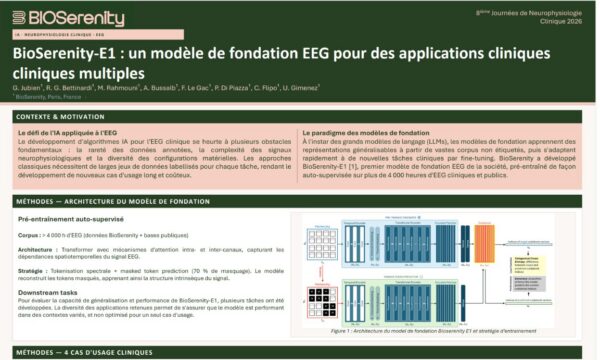
BIOSerenity's E1 Foundation Model Posts Strong Results on Four Clinical EEG Tasks

French medtech company BIOSerenity has built an EEG foundation model, BIOSerenity-E1, pre-trained self-supervised on more than 4,000 hours of recordings, and reports strong results on four clinical tasks: normal/abnormal classification, Alzheimer's disease detection, pediatric sleep staging and seizure detection. The normal/abnormal algorithm is already built into a CE-marked medical device, and the seizure-detection algorithm is in clinical evaluation. The work will be shown as a poster at the 8th Journées de Neurophysiologie Clinique in Grenoble, France.

China's MIIT and Six Ministries Issue BCI Industry Development Guidelines

Seven Chinese ministries led by MIIT issued guidelines targeting breakthroughs in core BCI technologies by 2027 — including electrodes, chips, and integrated devices at internationally competitive levels — with accelerated deployment in manufacturing, healthcare, and consumer markets. By 2030, the plan calls for cultivating 2–3 globally influential BCI companies and building an internationally competitive industry ecosystem.
June 2026

OYMotion and MicroPort NeuroScientific Partner on Endovascular BCI Rehab System

OYMotion and MicroPort NeuroScientific signed a strategic cooperation agreement on May 28, 2026 to jointly develop an interventional brain-computer interface rehabilitation system. The first product will be a multi-channel endovascular BCI that threads a signal-recording stent through the blood vessels to a target brain region, capturing intracranial electrical activity without opening the skull. MicroPort NeuroScientific will build the BCI system as a whole and OYMotion the limb side, with the pair targeting medical rehabilitation and human-machine interaction.

Anhui Splits BCI Work Across Three Cities

The General Office of China's Anhui Provincial People's Government issued the Action Plan for Accelerating Brain-Computer Interface Technology and Industry Development in Anhui (2026-2030) on June 15, 2026, document number Wan Zheng Ban Mi [2026] No. 24. Its spatial layout assigns Hefei the role of innovation origination and talent attraction, Bengbu the fabrication and validation of key components on the strength of its smart sensor industry plus a new Longhu Laboratory, and Wuhu clinical translation through a national regional medical centre and a brain science institute at Wannan Medical College. The first main task backs the University of Science and Technology of China in leading a research institute with Chinese Academy of Sciences partners. Targets fall in 2028 rather than 2027, covering at least ten application scenarios, three approved invasive clinical trials, five systems and three backbone firms.

China's Neuracle Files for Shanghai IPO, Seeking RMB 2.5 Billion

The Shanghai Stock Exchange accepted an IPO application from Neuracle, which is seeking RMB 2.5 billion for BCI product development, industrialization and working capital. The filing shows an established non-invasive neurophysiology equipment business alongside invasive products that still require clinical, regulatory and commercialization spending. Acceptance starts the review process and is not approval to list.
May 2026

Tianjin Plans 10bn Yuan BCI Fund Cluster

The General Office of China's Tianjin Municipal People's Government issued the Action Plan for Promoting Innovative Development of Brain-Computer Interfaces in Tianjin (2026-2030), document number Jin Zheng Ban Fa [2026] No. 8, dated May 26, 2026 and released on May 28. All product targets sit on the non-invasive track, while invasive systems are covered only by milestones for entering registration trials and winning market approval. By 2027 Tianjin wants two to three national-level innovation platforms, more than five non-invasive products in clinical use, more than ten new products across elderly care, education, entertainment, smart living and advanced manufacturing, 50 innovative firms, one to two national standards, and three to five industry funds. By 2030 it targets more than ten non-invasive products in large-scale clinical use, market approval for invasive products, and a fund cluster exceeding 10 billion yuan.
April 2026

China Hubei Approves a Provincial BCI Innovation Centre Led by a Hospital

On 31 March 2026 Hubei's provincial science and technology department approved the formation of a provincial brain-computer interface technology innovation centre, led by Tongji Hospital in Wuhan together with 12 organisations including Huazhong University of Science and Technology and Hubei Optics Valley Laboratory. Chinese reports describe it as the country's first provincial BCI platform positioned as comprehensive and full-chain. Its stated priorities are neural signal decoding, domestic sourcing of core components, and refining both non-invasive and implanted approaches. It is headed by Tang Zhouping, the hospital's party secretary.
March 2026

Jiangsu Opens BCI to Nuclear and Mining Work

Nine Jiangsu provincial departments in eastern China led by the Department of Industry and Information Technology issued the Action Plan for Innovative Development of the Brain-Computer Interface Industry in Jiangsu in March 2026, implementing national guidance from seven ministries. Its most distinctive provision covers industrial deployment, directing firms in hazardous materials, nuclear power, mining and electricity to pilot BCI systems in safety management and deep-sea and deep-pit operations, sectors no other provincial document names. Headline goals are at least two provincial clusters by 2027 and two to three leading enterprises by 2030. Its quantitative targets sit at the end of 14 tasks and all fall in 2030, including at least 15 programme projects, 15 key technology tasks, about 10 innovation platforms, 30 certified flagship products, 20 registered medical devices and a dataset of at least 20,000 samples.
November 2025

Jiangxi Floats Mutual Ethics Review for BCI

The General Office of China's Jiangxi Provincial People's Government issued Several Measures for Accelerating the Development of Brain-Computer Interface Technology and Industry in Jiangxi on November 26, 2025, document number Gan Fu Ting Fa [2025] No. 29, setting out 11 measures across four areas. It was the first provincial document to follow the seven-ministry national guidance and is the only one that sets no quantitative industry targets at all. Its eleventh measure calls for implementing BCI research ethics guidelines and establishing mutual recognition of clinical research ethics review, a first among provincial documents. Other measures deploy a provincial major science and technology programme, back Ganjiang New Area in building a rehabilitation centre and a high-quality EEG dataset, and offer early regulatory engagement plus rewards for Class II and Class III innovative device approvals.

Synchron Raises $200 Million Series D, Bringing Total Funding to $345 Million

Synchron raised a $200 million Series D led by Double Point Ventures, taking its total funding to $345 million. The company plans to use the capital to commercialize its Stentrode endovascular BCI, prepare pivotal trials and expand its AI and engineering teams. Synchron said 10 people with paralysis had received the implant in U.S. and Australian trials at the time of the announcement.
May 2025

Shandong Issues BCI Industry Innovation Plan

Thirteen departments in China's Shandong province, led by the Department of Science and Technology, jointly issued the Action Plan for Scientific and Technological Innovation in the Brain-Computer Interface Industry in Shandong (2025-2027), document number Lu Ke Zi [2025] No. 50, dated May 13, 2025 and released on May 16. By 2027 the province aims for roughly 20 breakthroughs in frontier and core technologies, about 30 innovative technology SMEs, two to three high-level talent teams, and one to two specialised incubators in areas rich in research and education resources, with applications reaching medicine, industry, elderly care, education and entertainment. By 2030 it expects an initial BCI industry ecosystem. The plan organises work into six campaigns and backs Jinan and Qingdao as innovation clusters. It is the first of Shandong's two provincial BCI documents and covers the industrial side.

Sichuan Targets 3,000 Brain Implant Ops a Year

Eight Sichuan provincial departments in southwestern China led by the Department of Economy and Information Technology issued the Action Plan for Breakthroughs in the Brain-Computer Interface and Human-Machine Interaction Industry in Sichuan (2025-2030) on May 12, 2025. The plan is unusual in making surgical volume a headline metric, targeting 3,000 invasive BCI procedures a year by 2030, along with services for more than 100,000 patients a year with neurodegenerative disease, psychiatric conditions and drug or digital addiction, and rehabilitation device use exceeding 20,000 sessions a year. By 2027 it aims to complete development and medical device registration of three invasive and five non-invasive products, carry out the province's first invasive BCI operation, serve more than 50,000 patients a year, and cultivate 10 chain-leading firms, 100 specialised SMEs and 200 innovative smaller enterprises. Chengdu, Mianyang, Deyang and Nanchong are named as host cities.
January 2025
February 2023
October 2021
© 2026 BCIwiki.com Digest Topics Tips Subscribe Revisions About