/ EN

Papers

257 entries
May 2026

Integrated Ultrasonic Platform for Bioelectronic Control Through Biological Barriers Based on Metasurface

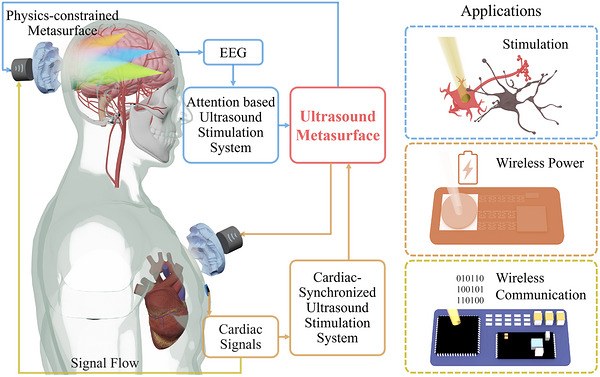
The study presents an integrated ultrasonic platform that delivers high-resolution, multi-point ultrasound energy through highly aberrating barriers such as the skull and ribs, with about ±6.5% intensity uniformity across foci, using a physics-constrained metasurface design framework, and demonstrates two adaptive stimulation paradigms — attention-gated and cardiac-synchronized stimulation. A dual-channel acoustic link sustains continuous transcranial wireless power and data streaming through a single ultrasonic metasurface, remaining robust even under a 400-fold power difference. The authors frame the platform as groundwork for next-generation ultrasound-based brain-computer interfaces (uBMI) and closed-loop bioelectronic therapies.
April 2026

Feasibility of a Hybrid SSVEP-Motor Imagery BCI with Robotic Feedback for Stroke Upper Limb Rehabilitation

Researchers assessed the feasibility of a hybrid brain-computer interface that integrates motor imagery (MI) and steady-state visual evoked potentials (SSVEP) with robotic glove feedback for upper limb motor rehabilitation in 32 stroke patients, split into a conventional-treatment control group and an experimental group receiving 10- or 20-day BCI interventions. The experimental group showed considerable improvement in Fugl-Meyer scores over the control group, and the BCI achieved EEG classification accuracy up to 98.08% with stable operation; after longer training, accuracy rose, the laterality coefficient moved toward normal, and task-related brain connectivity strengthened. The authors say the hybrid system may overcome the limits of conventional therapy and single-modality BCIs.

Ultra-Flexible Arrays Record 719 Single Neurons in 11 Surgical Patients

A Nature Communications study tested ultra-Flexible Implantable Neural Electrode arrays during awake surgery in 16 patients. Valid single-unit recordings were obtained in 11 patients, yielding 719 isolated neurons and as many as 135 simultaneously, while five early cases failed because of operating-room noise or damaged insertion needles. The work was intraoperative and does not establish long-term implant performance.

Xidian Team Drops Transformer Encoder, MLP Decoder Holds 0.94–0.98 AUC

Researchers at Xidian University built DisCo-Former, a Transformer framework for single-trial rapid serial visual presentation (RSVP) EEG decoding with three components guided by neurophysiological priors, then found its attention consistently collapsed: attention maps went nearly uniform and value-projection weights shrank toward 0. Stripping out the Transformer encoder left DisCo-MLP, a pure multilayer perceptron that matched or beat the Transformer version across two datasets and three evaluation regimes, with within-subject mean AUCs of about 0.94 to 0.98. For RSVP-EEG, the authors argue, modeling the signal's structure matters more than architectural complexity. The study was published in the International Journal of Neural Systems on April 10, 2026.

Dynamic Source Domain Selection: An Adaptive EEG Transfer Learning Framework

To reduce negative transfer in motor imagery BCIs, the study presents an adaptive dynamic transfer learning framework that decomposes EEG time-frequency features via wavelet convolution, matches source and target samples through a dynamic transfer attention module, and uses a joint loss to shrink marginal and class-conditional differences. On BNCI2014001, BNCI2014002 and BNCI2015001 it reached 78.78%, 82.11% and 78.19% accuracy, averaging 0.13% to 27.7% above baseline algorithms.

Enhancing the Capability and Accuracy of Motor Imagery Classification: A Deep Neural Network-Powered Multifaceted Strategy Model

Researchers propose DPMS-Net, a deep network that uses dynamic convolution to mine discriminative cues across temporal, spatial and frequency dimensions, combines channel and temporal attention, and adds a spectral-domain analysis component to surface subtle oscillatory features hidden in the EEG spectrum. On the BCI Competition IV 2a and 2b datasets it reached subject-dependent accuracies of 83.93% and 88.38%, and 67.67% on a self-collected stroke-patient dataset. The authors say its efficient decoding and robustness suit neurorehabilitation BCI systems.
March 2026

Real-Time Channel Selection for Enhanced SSVEP Online Brain-Computer Interface Systems

The study presents MAPS-CS, an online SSVEP brain-computer interface that selects channels dynamically during the experiment. A multi-dimensional feature framework covering signal energy, stability and inter-channel correlation quantifies anomalies and generates scores that a hierarchical decision step combines into a channel-quality score to identify and remove bad channels — with no training required. Against the channel ensemble (CE) method, MAPS-CS lifted standard FBCCA accuracy by 3.5%, 4.1%, 4.4% and 6.5% at stimulus durations of 2 s, 1.5 s, 1 s and 0.5 s, the best among the CE, binary harmony search and TOP-K local optimization methods compared.
February 2026

MSARFNet Tops 84% Accuracy on Two Motor Imagery Benchmarks

Researchers have proposed MSARFNet, a multi-scale attention-based reconstruction fusion network that reached average classification accuracies of 84.64% and 87.96% on the BCI Competition IV 2a and 2b motor imagery datasets, outperforming several existing methods. The network extracts spatio-temporal features through parallel multi-scale convolutional branches and fuses them with an attention mechanism to sharpen transient motor-imagery responses, targeting the non-stationary EEG signals and inter-subject variability that make MI decoding unreliable. The study was published on February 27, 2026, in IEEE Journal of Biomedical and Health Informatics.

Children With Cerebral Palsy Show Keen Interest in BCI-Controlled Boccia Ramp

Researchers designed an assistive Boccia ramp controlled by a brain-computer interface so that children with severe motor impairments who cannot speak can take part in the Paralympic sport. Six caregivers took part in semi-structured interviews and six children completed a newly developed 21-item survey; the children showed keen interest in playing Boccia with a BCI. The study also maps current barriers and facilitators to sport participation, and the issues that must be resolved before such technology can be rolled out.

Improved Spontaneous EEG Signal Decoding Efficiency by Function Predefined Convolutional Neural Network

Researchers propose a function predefined convolutional neural network (FPCNN) for decoding spontaneous EEG in brain-computer interfaces. Its learnable function predefined convolution (FPC) layer searches for the key spatial-frequency parameters of spontaneous EEG so the parameters carry clear physical meaning, and it builds trainable orthogonal detectors on the FPC to capture complex phase-varying signals. On three spontaneous EEG datasets, FPCNN outperformed state-of-the-art methods by 2.09%, 3.08% and 3.41%, with single-round training and testing taking just 67.96 and 19.36 seconds on non-GPU hardware, which the authors say makes it suited to EEG processing in diverse environments.

EEG-Based Emotion Recognition Using Spatial-Temporal Graph-Aware Network With Channel Selection

The study presents an EEG emotion recognition framework that couples discriminative channel selection with hierarchical spatial-temporal modeling. Wavelet coherence and mutual information adaptively select informative channels across frequency bands, and a spatial-temporal graph-aware network (STG-Net) models inter-channel spatial relations and the temporal evolution of emotional states before fusing frequency-spatial-temporal features for classification. The authors report better recognition accuracy and model efficiency than state-of-the-art methods.

Layer 7 Array Decodes Speech and Cursor Direction in Four Surgical Patients

A Neurosurgical Focus paper tested Precision Neuroscience's 1,024-channel Layer 7 micro-ECoG array in four awake-craniotomy patients. Four-word speech classification reached 77.5% accuracy and four-direction cursor classification reached 78% to 84%, with no device-related adverse events reported during the procedures. The small, short intraoperative study was a feasibility test rather than a pivotal motor-restoration trial.
January 2026

Researchers Say BCIs Should Decode User Goals, Not Motor Cortex Signals

Researchers in Germany, the Netherlands and Japan argue in an opinion piece that brain-computer interface design should be rebuilt around ideomotor theory, which treats voluntary action as driven by internally represented sensory outcomes. BCI research has made remarkable technical progress but remains limited in scope, the authors write, typically relying on motor and visual cortex signals in a narrow range of patient populations, and they describe this underused framework as a principled basis for next-generation interfaces that align more closely with the brain's own intentional and action-planning architecture. Reorganizing BCIs around the purpose of an action, meaning the user's goals and anticipated effects, would be a more intuitive, generalizable and scalable path, they suggest, and advances in neural recording and artificial intelligence-based decoding of sensory representations make the shift feasible and timely, potentially easing persistent usability and generalizability problems in BCI design.

September 2025

Neuropixels Ultra Doubles Neuron Yield With 6-Micrometer Site Spacing

A Neuron paper describes Neuropixels Ultra, which packs 6,144 switchable recording sites at 6-micrometer center-to-center spacing while reading 384 channels simultaneously. In mouse visual cortex recordings, neuronal yield increased by more than twofold. The study also improved subcellular signal detection and cell-type classification, but it did not report simultaneous recording from 10,000 neurons.
March 2025

DGPDR: Discriminative Geometric Perception Dimensionality Reduction on the Riemannian Manifold for EEG Classification

The study proposes a discriminative, geometry-aware dimensionality reduction method on the Riemannian manifold for symmetric positive definite (SPD) matrices in EEG classification, aimed at boosting discrimination while reducing information loss. On BCI Competition IV Dataset 1 and Dataset 2a, the method improved classification accuracy by 5.0% and 19.38% respectively, indicating robust performance is retained after dimensionality reduction.
© 2026 BCIwiki.com Digest Topics Tips Subscribe Revisions About