

Electroencephalography is the most widely used signal acquisition technique in BCI, offering low cost, portability, and non-invasiveness for applications from lab research to consumer products. This topic covers EEG hardware, signal processing methods, and novel electrode materials.
August 2026
Interpretable BCI Framework Pairs Emotion Recognition With Thought-to-Speech Decoding
A new study proposes an interpretable brain-computer interface framework that combines affective state recognition with EEG decoding to enable emotion-aware thought-to-speech. Tested on public imagined-speech EEG datasets in subject-independent settings and scored on accuracy, precision, recall, F1-score, inference speed and interpretability, the framework improved decoding reliability over conventional opaque models and produced clinically meaningful explanations, the authors report. They present it as a practical basis for assistive communication tools for people with paralysis, amyotrophic lateral sclerosis, locked-in syndrome and other conditions that disrupt natural speech.
Tianjin University Team Cuts EEG Channels Without Losing Decoding Accuracy
A team at Tianjin University in northern China has built a graph neural network framework that jointly optimizes EEG channel selection and classification, picking a small subset of channels for motor imagery decoding while holding accuracy close to that of the full electrode set. Reported in the journal Chaos, the method was validated on three datasets — BCI Competition IV 2a, High Gamma and a newly collected set — and could cut system complexity for uses such as neurorehabilitation.
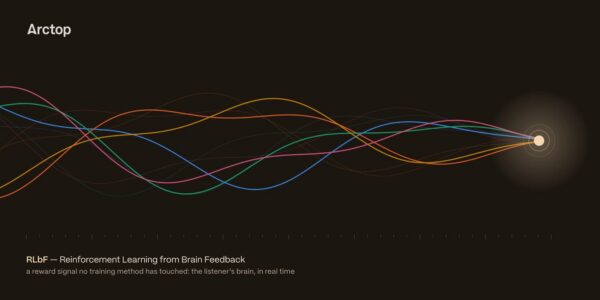
Arctop Unveils RLbF, Which Trains LLMs on Real-Time EEG Feedback
German Team Decodes Hand Motor Imagery From EEG Microstate Sequences at 89% Accuracy
German researchers tested whether sequences of EEG microstates, a handful of brief, stable patterns of brain activity, can serve as on/off switches for a brain-computer interface. Participants imagined moving the left or right hand, and a deep learning model read the microstate sequences to tell which hand, using the result as a trigger command. With transfer learning across sessions or participants, peak accuracy reached about 89%, though reaching 80% took about 400 seconds of calibration on average. The researchers say the approach could ease the calibration burden before use. The work is a preprint and has not been peer reviewed.
Phase-sliding oscillation lifts async BCI to 94.2%
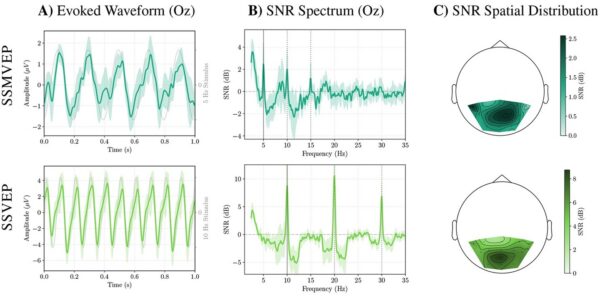
Phase mismatch between live EEG and fixed templates has long been the weak point of asynchronous steady-state visual evoked potential (SSVEP) brain-computer interfaces, which are seen as a promising route to real-world control. A new method, PSO-AC, exploits a phase-sliding oscillation phenomenon the authors observed and validated. Offline, 22 participants produced a mean control/non-control accuracy of 94.2% from just two seconds of EEG data, a result the authors say outperforms a state-of-the-art baseline; 9-class decoding also kept its edge across different time delays. Online, in robotic-arm experiments, the method delivered more stable command triggering and higher control efficiency, with the command cost per successful trial falling from 4.30 to 1.14. The paper was published in the International Journal of Neural Systems on August 21, 2026.
Motion-Based Visual BCI Reaches 85.67% Accuracy Without Flicker
Dual-View Network Reaches 67.74% on Handwriting-Imagery EEG
DRDNet separates spatial EEG features into two temporal views, models them with a bidirectional Mamba encoder and a Transformer, and then combines them through dynamic fusion and LSTM aggregation. On a public dataset, it reached 67.74% accuracy for imagined Chinese-character strokes and 62.51% for imagined pinyin vowels, outperforming seven EEG-decoding baselines.
Southern Federal University Releases Directional-Word EEG Data From 22 Volunteers
Southern Federal University recorded directional-word EEG from 22 healthy volunteers: 12 native Russian speakers and 10 native Spanish speakers. Both groups performed six directional words, with an additional “next” command in Russian. Recordings used 38 electrodes at 500 Hz, with concurrent articulation-related EMG in six participants. Random Forest accuracy of 78 ± 4% came from per-participant five-fold cross-validation distinguishing rest, overt speech and inner speech—not six-word recognition. Keypress, muscle and task-order effects require consideration in subsequent analyses.
FDA Clears FIND Neuro CN-Suite Localization Tool
The US Food and Drug Administration cleared CN-Suite, source localization software from FIND Surgical Sciences Inc., doing business as FIND Neuro, on August 16, 2026, finding it substantially equivalent under submission number K260563 via the Traditional 510(k) pathway. FDA lists the device as Source Localization Software for Electroencephalograph or Magnetoencephalograph, a Class II device under regulation number 882.1400, reviewed by the agency's neurology advisory committee. Such software works back from electrical or magnetic fields recorded at the scalp to the intracranial origin of the signal, supporting presurgical planning such as locating epileptic foci.
AI Model Fusing EEG and Gaze Hits 91.8% Accuracy in Attention Recognition
Researchers have built an AI model that combines EEG with visual gaze to score a learner's attention and cognitive load at the same time, reporting 91.8% accuracy on attention recognition and 89.4% on cognitive load, with generalization validated on public datasets. They present it as an answer to the noise sensitivity of single-signal monitoring in online learning.
WABO Appoints Speech-Cognition Researcher Jianwu Dang as Joint Scientist
WABO appointed Jianwu Dang to its Scientific Advisory Board and named him joint scientist. Dang, a researcher at the Shenzhen Institutes of Advanced Technology and a distinguished professor at Shenzhen University of Advanced Technology, will support task-conditioned intent models that combine EEG, EMG, speech, text and task context; WABO said the work is not aimed at context-free mind reading.
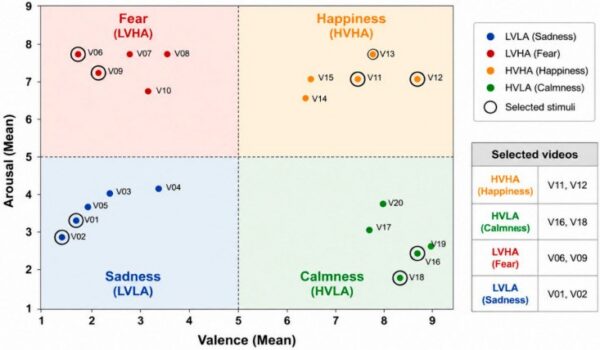
Few-Shot Calibration Raises EEG Emotion Decoding Accuracy to 0.77
BLCU Team's Falsifiable Substitution Test Keeps 0.968 AUC After Target Events Are Removed
Brain-computer interface decoders can guess the right label using information unrelated to the target mental state. A team at the School of Psychology, Beijing Language and Culture University (BLCU), proposes a falsifiable substitution-test standard: candidate evidence must persist in disjoint data, survive capacity-matched substitutions of physical organization or listener templates, and remain testable after target events are excluded. Across six EEG datasets (41 participants), averaging four neural-speech margin metrics brought 5-second decoding to what the authors call a leading level; in two hierarchical interfaces, parent-stream error scores kept AUCs of 0.968 and 0.965 after all target-command events were excluded. The framework offers a test for attributing evidence in neuroscience and BCI.
P300 BCI Reads Silently Chosen Digits in a Granada Classroom
Air Force Medical University Releases Multi-Day fNIRS Stroop Dataset from 55 Adults
Researchers at Air Force Medical University have published a functional near-infrared spectroscopy (fNIRS) dataset in Scientific Data: frontal hemoglobin responses from 55 young adults, each recorded across three color-word Stroop sessions spread over about two weeks, with more than 30 trials per condition. The authors offer it for work on conflict inhibition, for building decoders for neurofeedback training, and for training large-scale cross-subject fNIRS models.
July 2026
DSTF-Net Decodes SSVEP from Frontal EEG, Dropping the Occipital Electrode
Researchers writing in npj Biomedical Innovations have proposed DSTF-Net, a framework that decodes steady-state visual evoked potentials (SSVEP) from frontal EEG alone, removing the need for electrodes over the occipital cortex. In cross-subject transfer to 20 new users, including eight brain-injured patients lying supine, it improved decoding accuracy by as much as 33.47% over baseline methods.
Researchers Build Wearable ExG Chip That Sends Data Through the Body at 10 Mbps
Researchers have designed a wearable readout chip that records EEG, EOG, EMG and ECG and transmits multichannel data at 10 Mbps using body channel communication, which uses the wearer's body as the transmission medium. The chip alternates between recording and transmitting in separate time slots, so noise from the transmitter does not contaminate faint brain signals, and dropping the bias electrode raised communication signal amplitude about 2.13-fold. Fabricated in a 180-nm process, it reached a total common-mode rejection ratio of 101.1 dB and stayed stable under 18-Vpp common-mode interference and 15% electrode mismatch. The work targets wearable human-machine interfaces such as extended reality and BCIs; the abstract reports chip test metrics, not results from BCI use.
Hospices Civils de Lyon trial decodes motor imagery for stroke rehab
Hospices Civils de Lyon has registered a clinical study in France to decode motor imagery from non-invasive brain recordings as a prerequisite for innovative motor rehabilitation therapies. Combining MRI, MEG, and EEG, the study will design a subject-specific neurophysiological model, noting that standard BCI approaches neglect transient features such as beta bursts. The approach will first be validated in healthy subjects, then assessed for feasibility in stroke patients.
Random Forest Model Hits 92.49% Accuracy in EEG Eye-State Detection
Researchers paired interquartile-range clipping for outlier removal with a random forest classifier on the UCI machine learning repository's EEG-Eye-State dataset, classifying eyes-open versus eyes-closed at 92.49% accuracy with a ROC-AUC of 0.9791. Cross-validation put mean accuracy at 92.86%. The authors present the pipeline as a stable, interpretable option for BCI uses such as drowsiness monitoring and assistive technology.
Can a BCI boost attention in older adults? UT Austin launches trial
The University of Texas at Austin has registered a study on ClinicalTrials.gov to explore whether an EEG-based brain-computer interface (BCI) decoding the P300 event-related potential in real time, combined with non-invasive interventions such as mindfulness relaxation or transcranial electrical stimulation, can enhance attention and memory neural markers—proxies for cognitive reserve—in healthy older adults and those with mild cognitive impairment (MCI). The trial is recruiting and aims to test whether targeted modulation of attention-related brain activity can support cognitive reserve.
Zander Labs and Encord Trial EEG Data for Robot Model Training
BrainAccess Releases MATLAB API for Direct EEG Data Acquisition

Tianyou Hospital Review Finds Gains on Some Upper Limb Measures After BCI Training
A team at Tianyou Hospital, Wuhan University of Science and Technology conducted a systematic review and meta-analysis of motor imagery-based BCI training for upper limb dysfunction in people with post-stroke hemiplegia. The review included 27 studies; 24 studies involving 846 participants contributed to the meta-analyses. Compared with the respective study controls, training produced statistically significant improvements on upper limb motor assessments reflecting isolated movement and fine motor control. Effects on complex functional activities, activities of daily living and spasticity were not statistically significant. Because control conditions varied and included sham interventions, the evidence does not establish superiority over standardised traditional rehabilitation.
SpikeGadgets Headstage Records 1,024 Channels Across 10 Brain Regions
A post from SpikeGadgets surveys how far multichannel electrophysiology has scaled: its Modular Stacking Headstage supports chronic recording of 1,024 channels across 10 brain regions; the University of Pittsburgh's MePhys platform uses 992 electrode contacts to cover an entire macaque hemisphere; and a Rice University preprint describes a custom ASIC that supports 5,376 simultaneous recording channels.
Ghost-LENet Tops 80% on Motor Imagery EEG Using a Few Thousand Parameters
Researchers have built Ghost-LENet, a lightweight convolutional network that classifies motor imagery EEG at 82.18% on the BCI Competition IV-2a dataset and 83.05% on IV-2b using only a few thousand trainable parameters. The design combines dilated temporal convolutions, a stationary wavelet transform, dynamic residual fusion and Ghost modules, holding accuracy while cutting model complexity for BCI hardware with little compute to spare.
UCL Workshop Syncs EEG, Eye Tracking, ECG and GSR in a Flight Simulator

CMU Trains User and Decoder Together, Letting BCI Novices Reach 86% Cursor Accuracy
BCI Feedback Sharpens Detection of Subtle Errors
Federated Graph Framework Fuses EEG and EMG to Decode Motor Intent
A team writing in Computing and Informatics has proposed FSDFGL, a federated graph learning framework that folds EMG into EEG when the graph is built and then shares only structural information between clients, avoiding the accuracy loss that comes with exchanging heterogeneous features. The design targets three problems in hybrid BCI work at once: the low spatial resolution of EEG, datasets that are small and privacy-sensitive, and the uneven data distributions federated learning has to cope with. Experiments on the TAN dataset show an advantage in identifying complex motor intentions.